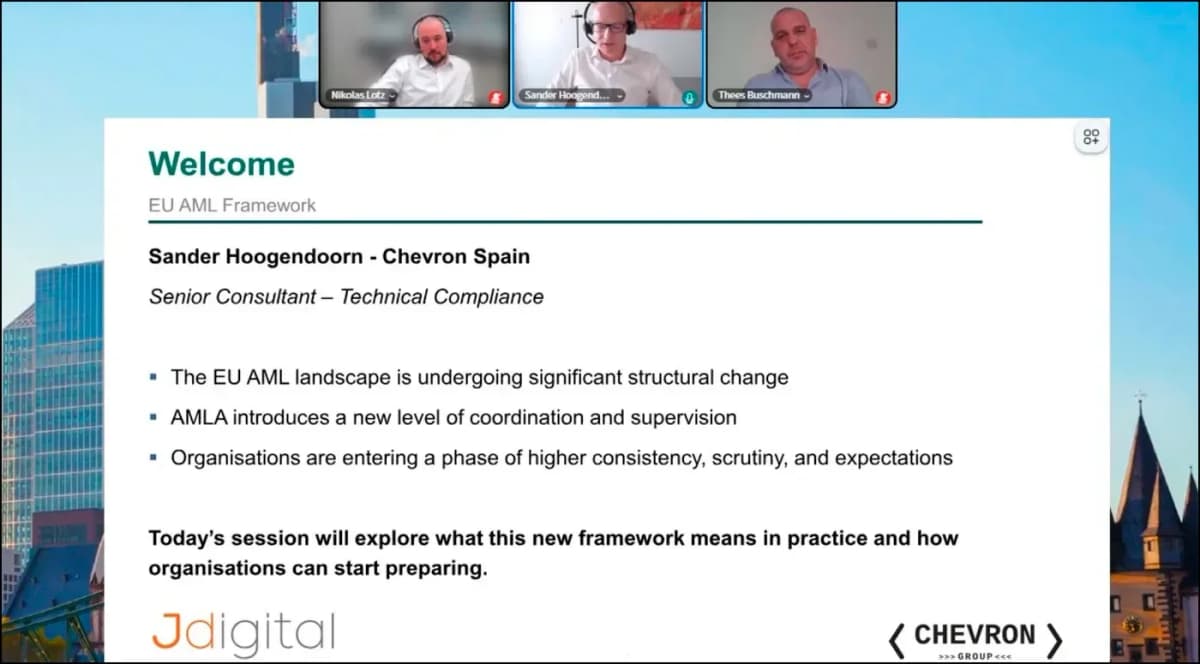
Spanish gaming industry association Jdigital has partnered with compliance consultancy Chevron Group to deliver a comprehensive webinar addressing the new European anti-money laundering legislation and the establishment of AMLA (European Anti-Money Laundering Authority).
The session targeted online operators preparing for the regulatory changes introduced by the new European framework for combating money laundering. Three Chevron specialists led the presentation: Sander Hoogendoorn, technical compliance consultant and head of Chevron Spain; Thees Buschmann, AML consultant; and Nikolas Lotz, Operations Director. Together, they provided practical insights into how the new regulatory framework will impact operators active in Spain and Malta.
AMLA's Structural Impact on EU Gaming
The establishment of AMLA represents a structural shift in coordination and supervision of compliance with the Regulation on the Prevention of Money Laundering and Terrorist Financing (AMLR) across the European Union. This development strengthens regulatory expectations and control mechanisms for the gaming sector.
For online gaming operators, the new landscape introduces heightened compliance requirements, fresh operational obligations, and more uniform scrutiny at the European level. The webinar began with a clear exposition of the new European Anti-Money Laundering Authority framework and its implications for European regulatory architecture.
AMLA Authority Structure
AMLA will be headquartered in Frankfurt and become operational in 2025, with full supervisory powers over high-risk entities by 2028. The authority will have direct supervision over approximately 40 major financial institutions and obliged entities across the EU, including select gaming operators with significant cross-border operations.
Critical Timeline and Implementation Roadmap
Chevron experts presented a structured overview of the milestones and deadlines that will shape adaptation to the new regulation. They highlighted 2026 as a critical preparation year before the AMLR application in July 2027.
The session examined how AMLA and the AMLR will transform governance, risk management, and supervisory expectations for regulated operators. Chevron Group specialists applied their technical expertise to analyse key challenges including group-level AML governance, KYC process reinforcement, transaction monitoring, and the implementation of auditable, risk-based control frameworks.
New Sectoral Working Group Launch
The webinar concluded with the presentation of a new sectoral working group on money laundering prevention, promoted by Jdigital. This initiative aims to address specific AMLA-related matters while supporting organisations through their adaptation process.
"Through this working group we hope to facilitate a stable framework for sectoral coordination and technical preparation for the regulatory changes that will unfold in the coming years. We thank Chevron for its contribution to initiating this process and providing our members with such detailed analysis at a critical moment for the sector."
— Jorge Hinojosa, General Director of Jdigital
The webinar reinforces Jdigital's commitment to supporting and protecting the interests of all stakeholders in the gaming sector, whether users or operators, while ensuring operator compliance with regulatory obligations.
Strategic Implications for Spanish Operators
This collaborative approach between industry associations and compliance specialists signals a proactive stance toward the incoming European AML framework. The emphasis on group-level governance and cross-border coordination reflects the increasing complexity of regulatory compliance in the EU gaming market.
Operators will need to reassess their current AML frameworks against the enhanced requirements, particularly those with operations spanning multiple European jurisdictions. The focus on auditable, risk-based controls suggests regulators will demand more sophisticated compliance infrastructure than current standards require.
AMLA will have the power to impose administrative fines up to 10% of annual turnover or €10 million for legal entities, whichever is higher. The authority can also suspend licenses and impose operational restrictions on operators failing to meet enhanced AML standards.
Unlike national supervisors, AMLA will conduct coordinated cross-border investigations and apply standardized enforcement criteria across all member states. This eliminates regulatory arbitrage opportunities and ensures consistent AML standards regardless of operational jurisdiction.
AMLA will directly supervise operators deemed high-risk based on factors including annual revenue thresholds, cross-border activity levels, and previous compliance violations. Most operators will remain under national supervision but must comply with AMLA-developed technical standards and guidelines.
According to AzarPlus.
Legal Disclaimer
This content reflects a general overview of regulatory frameworks based on publicly available information. It does not constitute legal advice or a legal opinion. iGamingWriter.blog disclaims any liability arising from reliance on this material.