
Winning at online slots comes down to three variables entirely outside a player's control on any single spin – the Random Number Generator, the game's certified RTP, and its volatility profile – combined with three variables a player fully controls: which game they pick, how they size their bets, and when they stop. Understanding the difference between these two categories is the entire foundation of how to win at online slots.
This article is written for informational purposes only. It does not constitute gambling advice, and no strategy described here changes the mathematical house edge built into any licensed slot machine. If gambling stops being fun, or starts to feel like something you can't control, that's worth taking seriously – resources for support are covered later in this guide.
Most articles promising online casino tricks to win sell the idea that a clever betting pattern, a specific time of day, or a lucky ritual shifts the odds in your favor. None of that holds up against how these games are actually built. What genuinely moves the needle is far less exciting but far more reliable: understanding RTP, matching volatility to your bankroll, reading hit frequency correctly, and managing your money like the finite resource it is. This guide walks through every one of those mechanics in real depth – not as marketing copy, but as the actual math governing every spin you'll ever place.
How Online Slots Actually Generate a Result
Every online slot spin is generated by a certified Random Number Generator (RNG) that produces a result the instant you press spin, independently of every spin that came before or will come after – meaning no machine is ever "due," "hot," or "cold," regardless of how long a losing or winning streak has run.
The RNG is software running continuously, generating long strings of numbers even when nobody is playing. The exact number string pulled at the millisecond you click spin determines your outcome – not the visible reel animation, which is purely cosmetic and plays out after the result has already been calculated. This is the single most important technical fact underlying any honest explanation of how to win at online casino slots, because it eliminates an entire category of popular but false beliefs before we even get to strategy.
A few direct consequences follow from how RNGs actually work:
- The machine has no memory. It doesn't track how much you've won or lost, and it doesn't adjust future odds based on past results.
- Manually stopping the reels changes nothing. The result is locked in before the animation even begins; stopping early only speeds up how fast you see it.
- Time of day has zero effect. RNGs run identically at 3 AM and 3 PM. There is no statistically "better" hour to play.
- Independent regulators verify this. Licensed slots are tested by accredited labs running millions of simulated spins to confirm the RNG behaves exactly as certified before a game is ever allowed to go live.
Once you accept that every spin is a fresh, independent event, an enormous share of bad slot advice simply falls away. The real leverage a player has isn't in predicting or influencing individual spins – it's in choosing which games to play and how to size bets against them, which is where RTP and volatility take over.
RTP: The Number That Decides How to Win at Online Slots
Return to Player (RTP) is the theoretical percentage of all wagered money a slot returns to players over millions of spins, and it is the single most actionable, pre-spin lever available to anyone trying to understand how to win at online slots – a 98% RTP game mathematically returns far more over time than a 94% version of the same title.
RTP works as the direct inverse of the house edge. A 96% RTP slot carries a 4% house edge; a 98% RTP slot carries just 2%. That doesn't guarantee anything about your next ten minutes of play – RTP is a long-run average calculated across a game's entire lifecycle, not a per-session promise – but it does set the mathematical ceiling on what's realistically achievable from any title over sustained play. Choosing the higher-RTP version of a game, when one is available, is genuinely one of the only pre-spin decisions that meaningfully shifts your long-term position.
What surprises a lot of players is that the same slot can run at different RTP settings depending on which operator is hosting it. Studios frequently release multiple certified RTP tiers of the same math model – commonly something like 94%, 96%, and 98% versions of one title – and individual casinos choose which tier to activate. The version listed in a game's default help screen is not always the version running at your specific casino.
Here's what that gap actually costs over a real session.
| RTP | House Edge | Expected Loss per $1,000 Wagered |
|---|---|---|
| 94.00% | 6.00% | $60 |
| 96.00% | 4.00% | $40 |
| 98.00% | 2.00% | $20 |
The takeaway from that table is direct: moving from a 94% to a 98% RTP configuration cuts your expected long-run loss by two-thirds on identical total wagers. This is the closest thing to a genuine mathematical edge available to a slots player, and it costs nothing to check – the RTP is legally required to be disclosed in a licensed slot's help or information screen before you ever place a bet.
Volatility: Matching the Right Slots to How You Want to Win
Volatility (also called variance) describes how a slot's RTP gets distributed across your sessions – low volatility spreads payouts across many smaller wins, while high volatility concentrates the same theoretical return into rarer, larger hits – and mismatching volatility to your bankroll is one of the most common reasons players run out of funds before their game's math has a real chance to play out.
Two slots can share an identical 96% RTP and produce completely different playing experiences. One might return small, steady wins on a large share of spins, keeping your balance ticking along comfortably. The other might sit silent through dozens or hundreds of spins before a single feature trigger pays out the equivalent of many ordinary sessions combined. Neither is mathematically superior – they're simply different shapes of the exact same underlying return, and picking the shape that fits your bankroll is a genuinely core piece of how to win at online casino slots over a real session rather than a single lucky spin.
| Volatility | Win Frequency | Typical Payout Size | Recommended Bankroll |
|---|---|---|---|
| Low | Frequent | Small, consistent | Smaller budget, longer sessions |
| Medium | Moderate | Mix of small and mid-size | Balanced budget |
| High | Infrequent | Large, concentrated | Larger buffer, 200–300+ spins minimum |
What this table makes clear is that volatility is fundamentally a bankroll-matching decision, not a "better or worse" ranking. A player with a small, fixed budget who wants to keep playing for as long as possible is generally better served by low-volatility titles, since frequent smaller wins help sustain the balance. A player specifically chasing a large multiplier or jackpot needs to accept that high-volatility titles can run through 200 or more spins without a meaningful return before variance evens out – and needs a bankroll sized to survive that stretch.
Hit Frequency: The Hidden Number Behind How to Win at Online Slots
Hit frequency is the percentage of spins that return any win at all, regardless of size, and it's a genuinely underused metric that reveals how "active" a session will actually feel – a slot with a 25% hit frequency pays something on roughly one in four spins, while a title at 15% will feel considerably quieter even at an identical RTP.
This figure sits alongside RTP and volatility as a third data point worth checking before committing a bankroll to a title, and it's one that most casual explanations of how to win at online slots skip over entirely. A high hit frequency doesn't necessarily mean a profitable session – plenty of those wins can pay less than the original stake, which still counts as a "hit" in the statistic – but it does directly affect how a session feels moment to moment, and pacing matters more to most players' actual satisfaction than the underlying math alone.

Where to find it: reputable slot studios and independent tracking tools publish hit frequency directly, often inside the game's information screen alongside RTP and volatility rating. Cross-referencing all three numbers together – RTP, volatility, and hit frequency – gives a far more complete picture of a game's real behavior than looking at any single figure in isolation.
Paylines, Ways-to-Win, and Megaways: Picking the Right Format to Win
The structural format of a slot's reels – fixed paylines, ways-to-win, or dynamic Megaways grids – directly affects how many winning combinations are possible per spin, and understanding the difference is a genuinely practical part of picking the right game, not just its theme.
- Fixed paylines require matching symbols to land on specific, pre-set lines, typically running left to right. A 25-payline slot has 25 fixed opportunities for a combination to form on any given spin.
- Ways-to-win (commonly 243 or 1,024 ways) drop the requirement for symbols to sit on a specific line – any adjacent matching symbols across consecutive reels count, which meaningfully increases the raw number of possible combinations.
- Megaways takes this further with a dynamic reel height that changes on every spin, sometimes generating well over 100,000 possible ways to win on a single spin.
None of these formats change the underlying RTP a game is certified at – a 96% RTP slot with 20 fixed paylines and a 96% RTP Megaways title both return 96% over the long run. What changes is combination frequency and, by extension, how often the base game produces some kind of win. More paylines or ways generally correlate with a higher hit frequency, which is exactly the kind of structural detail that separates a casual guess from a genuine understanding of how to win at online casino slots consistently rather than by chance.
Bonus Features and Bonus Buy: What They Actually Cost You
Wilds, scatters, multipliers, and bonus buy options are built directly into a slot's math model rather than sitting outside it – meaning a bonus round's contribution to overall RTP is already priced into the number you see on the paytable, and buying directly into a feature doesn't change your underlying odds, only when you pay for the attempt.
A quick breakdown of what each mechanic actually does, since knowing this distinction is a core part of any real answer to how to win at online slots rather than just clicking "buy bonus" on instinct:
- Wilds substitute for other regular symbols, completing combinations that wouldn't otherwise form.
- Scatters typically don't need to land on a payline and often trigger free spins or bonus rounds once enough appear anywhere on the grid.
- Multipliers increase the value of a win by a fixed or variable factor, either in the base game or exclusively during a bonus round.
- Bonus buy lets a player pay a set multiple of their stake – commonly somewhere between 50x and 200x – to skip directly into a feature round rather than waiting for a natural trigger.
Bonus buy is worth a specific caution. Some titles publish a separate RTP figure specifically for the bonus buy mode, which can run slightly higher or lower than the base game's standard RTP. It's worth checking the paytable for that distinction before assuming the buy-in carries identical odds to a naturally triggered round. Also worth noting: several regulated markets, including the UK, restrict or prohibit bonus buy features entirely, so availability varies by jurisdiction.
Progressive vs. Fixed Jackpots: Which Gives You a Better Shot
Progressive jackpot slots divert a small portion of every wager across the entire connected network into a growing prize pool, which slightly reduces the base-game RTP compared to an equivalent fixed-jackpot title – a trade-off worth understanding before chasing a headline jackpot figure.
| Type | How It's Funded | Effect on Base RTP | Best Suited For |
|---|---|---|---|
| Progressive | Portion of every wager network-wide | Slightly lower | Players prioritizing a shot at a large, rare prize |
| Fixed | Built into the standard math model | Unaffected | Players prioritizing predictable session-level value |
The practical distinction here matters more than it first appears: a progressive jackpot's advertised size says nothing about your odds of hitting it, and chasing that number specifically comes at a small, ongoing cost to the base-game RTP you're playing against on every other spin. Players focused on session-level value rather than jackpot hunting are generally better served by fixed-jackpot or non-jackpot titles with a cleaner, undiluted RTP – a distinction genuinely worth knowing if your goal is how to win at online casino slots over many sessions rather than one dramatic hit.
A reminder before moving further into strategy: nothing in this guide should be read as encouragement to gamble beyond what you can comfortably afford to lose. Slots are designed for entertainment, carry a built-in house edge on every single spin, and no combination of RTP-checking or volatility-matching changes that fundamental fact. If you're using this guide to inform real-money play, please also read the responsible gambling section near the end.
Bankroll Management: The Real Secret to How to Win at Online Slots
Bankroll management is the single area of slot play entirely within a player's control, and the most widely cited discipline for it is the 1% rule – betting no more than roughly 1% of your total session budget on any individual spin, which gives a game's RTP and volatility enough spins to actually express themselves rather than getting wiped out by an early losing streak.
On a $100 session budget, the 1% rule caps an individual spin at roughly $1. That might feel conservative, but it's specifically designed to survive the kind of dry stretch a medium or high-volatility title can easily produce. Betting a larger share of your budget per spin dramatically increases the odds that a single unlucky streak ends your session before the math has any chance to normalize.
Here's a practical session-planning checklist worth running through before any real-money play.
| Step | What to Decide |
|---|---|
| 1. Set your budget | The absolute maximum you're willing to lose this session, decided in advance |
| 2. Set a win goal | A realistic profit target – commonly around 2x your starting balance – at which you stop and cash out |
| 3. Set a loss limit | A stop point, commonly around 50% of your starting balance, at which you walk away regardless of streak |
| 4. Check the RTP | Confirm you're playing the highest available configured RTP for your chosen title |
| 5. Match volatility to stake | Size your bankroll to the game's volatility rating, not just its RTP |
Running through that checklist before every session is, in practical terms, the entire actionable core of how to win at online slots – everything else in this guide informs the choices you make within it, but discipline around budget, win goals, and loss limits is what actually protects you from the downside variance guarantees over any long enough session.
Online Casino Tricks to Win That Are Actually Myths
The most persistent myths about online casino tricks to win all share the same root error – treating RNG-driven outcomes as if they had memory, timing sensitivity, or a manual influence they simply don't possess.
- Myth: A machine is "due" for a win after a long losing streak. Reality: each spin is a fresh, independent RNG event with no awareness of prior outcomes. No spin is ever statistically owed anything.
- Myth: Playing at a specific time of day improves your odds. Reality: RNGs run identically around the clock. There is no better hour, day, or season to play a certified slot.
- Myth: Betting max always improves your odds. Reality: max bet only matters for eligibility on specific progressive jackpots that explicitly require it. On standard non-progressive titles, RTP doesn't change based on stake size.
- Myth: Stopping the reels manually changes the outcome. Reality: the result is calculated the instant you press spin. The reel animation is cosmetic and plays out afterward regardless of when you tap stop.
- Myth: A "hot" or "cold" machine exists. Reality: this idea comes from older mechanical slot folklore and simply doesn't apply to RNG-based software, which has no state that persists between spins.
Every one of these myths shares the same underlying flaw: they assume a slot machine has some form of memory or pattern a player can detect and exploit. It doesn't. Letting go of these beliefs is arguably more valuable than any specific strategy, since chasing a "due" payout or a "lucky hour" actively works against sound bankroll discipline.
A Practical Framework for Approaching Any Slot Session
Combining everything above into a single repeatable approach gives a genuinely defensible, fact-based answer to how to win at online slots – not a guarantee of profit, since none exists, but a consistent method for maximizing your realistic long-run position and session enjoyment.
- Check the RTP first, and specifically confirm which configured tier your casino is running if the game offers multiple versions.
- Match volatility to your actual bankroll, not to how exciting a title's theme or marketing looks.
- Glance at hit frequency if it's published, to set realistic expectations for how "active" the session will feel.
- Set your budget, win goal, and loss limit before you start, and follow the 1% rule when sizing individual bets.
- Use demo mode to learn a new title's bonus triggers and pacing before committing real money to it.
- Treat bonuses and free spins as a genuine boost, but always check wagering requirements before assuming they add real value.
- Ignore every myth about timing, "due" machines, or manual reel-stopping, since none of them have any basis in how RNG software actually functions.
None of these seven steps require special skill, insider knowledge, or a paid system. They're simply the disciplined application of publicly available information – RTP figures, volatility ratings, and honest bankroll math – that most casual players skip entirely.
More Tips and Tricks on How to Win at Online Casino Slots
Beyond the core mechanics already covered, a handful of practical algorithms and decision rules can sharpen how you actually approach a session – simple, repeatable formulas for bet sizing, loss response, and bonus evaluation that turn the theory above into something you can apply spin by spin.
These aren't shortcuts around the math. They're structured ways of applying everything covered earlier so you're not making bankroll decisions on the fly, mid-session, when judgment tends to be at its worst.
The Bet-Sizing Formula
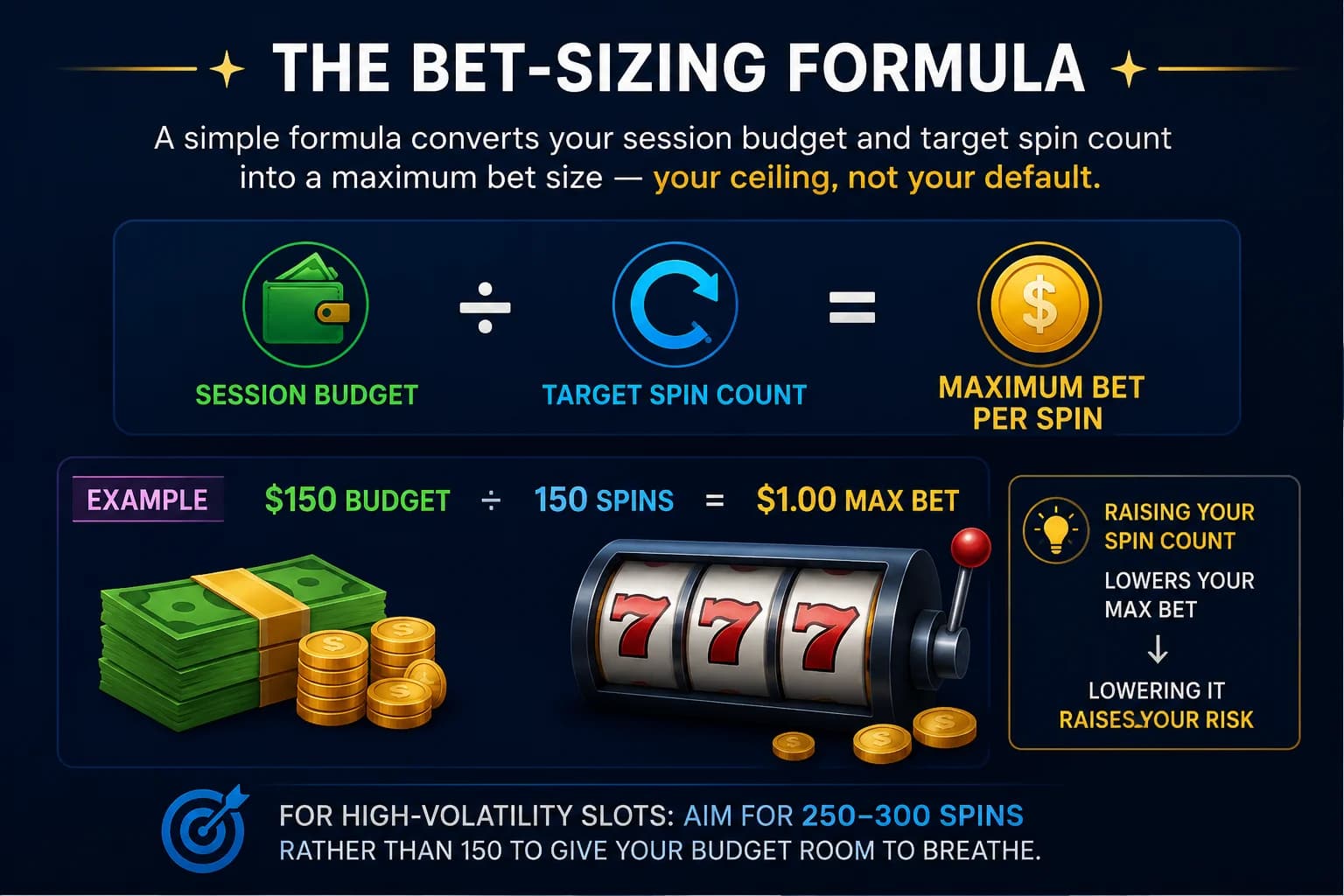
A simple formula converts your session budget and target spin count directly into a maximum bet size – divide your total budget by the number of spins you want it to realistically cover, and treat that number as your ceiling, not your default.
Maximum bet per spin = Session budget ÷ Target spin count
For a $150 budget aimed at covering at least 150 spins (a reasonable minimum for a medium-volatility title), that formula caps individual bets at $1. Raising your target spin count lowers your max bet; lowering it raises your risk of running out before the game's volatility has a fair chance to even out. For high-volatility titles specifically, aim for a target spin count of 250–300 rather than 150, since hit frequency runs lower and the formula needs a bigger denominator to stay realistic.
The Loss-Response Rule
Deciding your reaction to a losing stretch before it happens – rather than in the moment – is one of the most effective online casino tricks to win back control of a session, specifically because it avoids the single costliest slots mistake: increasing bet size specifically to chase back a loss.
A simple three-tier rule:
- Down 25% of your session budget. Continue at your planned bet size. This is normal variance, especially on medium or high-volatility titles.
- Down 50% of your session budget. Reassess. Confirm you're still comfortable with the remaining budget and haven't drifted into "just one more spin to break even" thinking.
- Down 75% or more. Stop for the session, regardless of how the game has been trending. This threshold exists specifically to prevent the point where frustration starts making decisions instead of strategy.
The entire point of pre-committing to these thresholds is that they remove emotion from the equation exactly when emotion is most likely to cost you money.
The Free Spins Value Check
Before accepting a free spins or deposit-match bonus, running a quick value check tells you whether it's a genuine boost or a wagering trap – divide the bonus amount by the wagering requirement multiplier to see the realistic contribution to your actual playable balance.
A few things worth checking every time:
- What's the wagering requirement multiplier? A $20 bonus with 40x wagering means clearing $800 in total wagers before withdrawal – a meaningfully different offer than one with 10x wagering.
- Do slots contribute 100% toward that requirement? Some games contribute at a reduced rate, which quietly extends how much you actually need to wager.
- Is there a max bet cap while a bonus is active? Betting above that cap can void the entire bonus, even accidentally.
- Is there a maximum withdrawal cap on winnings from free spins? Some offers cap what you can actually cash out, regardless of what you win during the spins themselves.
A bonus that looks generous on the surface can carry conditions that make it worth considerably less in practice – running this check takes under a minute and prevents a genuinely common source of frustration for anyone applying these online casino tricks to win over a real bankroll rather than a single lucky bonus round.
The Two-Session Split
Splitting a single planned session into two shorter sessions, with a mandatory break between them, is a genuinely effective way to reset both your bankroll math and your decision-making before fatigue starts influencing bet sizing.
Rather than committing an entire budget to one continuous sitting, divide it in half and treat each half as its own self-contained session with its own win goal and loss limit. The break between sessions isn't just about pacing – it's a built-in checkpoint to confirm you still want to continue, rather than simply continuing out of momentum.
Additional Tips at a Glance
Taken together, these four tools cover the parts of a slots session that pure RTP and volatility knowledge don't reach – the actual moment-to-moment decisions that determine whether good math translates into a good outcome, or gets undone by a single emotional bet.
| Tip | What It Does |
|---|---|
| Bet-Sizing Formula | Converts budget and target spins into a defensible max bet |
| Loss-Response Rule | Pre-commits your reaction to losing streaks before they happen |
| Free Spins Value Check | Reveals the real value of a bonus after wagering conditions |
| Two-Session Split | Forces a decision checkpoint partway through your budget |
One last note before you go: everything above is intended to help you understand the mechanics behind online slots, not to encourage you to play beyond your means. These games are built with a permanent house edge, and no informational guide – this one included – changes that. If gambling ever stops feeling like entertainment and starts feeling compulsory, please treat that seriously. Free, confidential support is available through organizations such as GamCare and the National Council on Problem Gambling , entirely independent of any casino operator, and deposit limits, self-exclusion tools, and session reminders are available at every licensed operator regardless of whether you've ever felt you needed them.
FAQ: How to Win at Online Slots
No. Every spin is generated by a certified RNG producing random, independent results, and no strategy eliminates that underlying variance. What genuinely improves your position is choosing higher-RTP games, matching volatility to your bankroll, and managing your budget with discipline.
RTP is the most actionable factor, since it directly sets the house edge you're playing against on every spin. Confirming you're playing the highest configured RTP version available for your chosen title is the most impactful pre-session check you can make.
Generally no. Max bet only matters for eligibility on specific progressive jackpots that explicitly require it. On the vast majority of standard slots, RTP and odds remain identical regardless of stake size.
RTP is the theoretical long-term payback percentage across millions of spins. Volatility describes how that payback is distributed – frequent small wins versus rarer, larger ones. You need a strong RTP for long-term value and volatility matched to your bankroll for session sustainability; the two work together, not interchangeably.
No. RTP is certified by independent testing labs before a game launches, and changing it requires the game to be taken offline and resubmitted for testing. A licensed operator cannot alter RTP mid-session.
No. Each spin is generated independently with no memory of previous results. A machine can go through extended losing stretches or pay out repeatedly in succession without ever violating its certified RTP.
Most specialists recommend budgeting for at least 200 to 300 spins at your intended stake before expecting a meaningful bonus trigger on a high-volatility title, given how infrequently these games pay out relative to low or medium volatility alternatives.