The proliferation of AI-generated content across digital platforms has created an urgent need for reliable detection methods. Industry research reveals that 74.2% of newly published web pages contain AI-generated content according to Ahrefs research, marking a fundamental shift in content creation practices that demands sophisticated identification techniques.
Understanding how to distinguish between human and machine-generated text has become essential for content professionals, compliance teams, and quality assurance departments. The ability to recognize AI patterns can be developed into a systematic process that takes less than a minute to spot AI content once the key indicators are understood.
The Structural Foundation of AI Detection
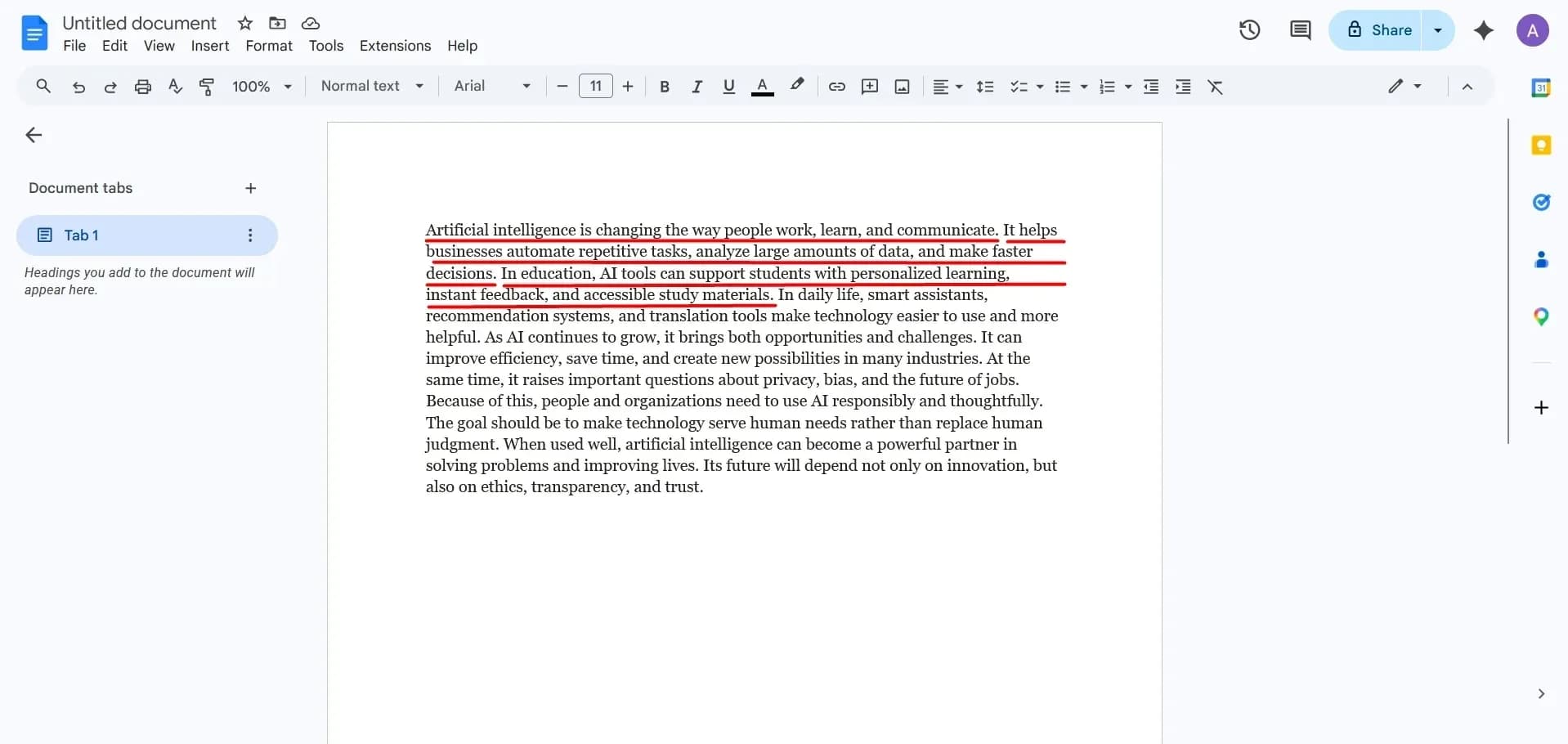
AI content follows predictable architectural patterns that betray its automated origins. Unlike human writers who vary their approach, AI systems consistently apply the same structural framework across different topics and contexts.
Same data training
All AI tools trained on identical datasets
Template adherence
Intro-body-conclusion framework without variation
Pattern consistency
Identical sentence construction across paragraphs
Sentence Architecture Analysis
The most immediate structural indicator lies in sentence construction patterns. AI-generated content maintains uniform sentence lengths throughout entire pieces, creating an artificial rhythm that human writers naturally avoid.
Key structural markers include:
- Consistent sentence word counts across paragraphs
- Absence of natural variation between short and long sentences
- Mechanical paragraph transitions with identical opening patterns
- "Perfect" logical closure without loose ends or developing thoughts
Human writing incorporates spontaneous rhythm changes, incomplete ideas that develop across multiple paragraphs, and natural digressions that add depth to the core argument.
Template Recognition Methodology
AI systems default to recognizable templates when structuring content. The standard pattern follows: introduction → main point → summary, repeated in identical cycles without deviation or creative restructuring.
Important
Professional content teams should establish baseline comparisons between known human and AI samples to calibrate their detection accuracy before implementing systematic checks.
Did you know?
74.2% — Newly published web pages containing AI content
81% — AI probability score achieved by detection tools
1.1s — Mobile page load time after optimization
3.2s — Desktop page load time comparison
100% — Verified content accuracy with combined analysis
Pattern Recognition and Linguistic Fingerprints
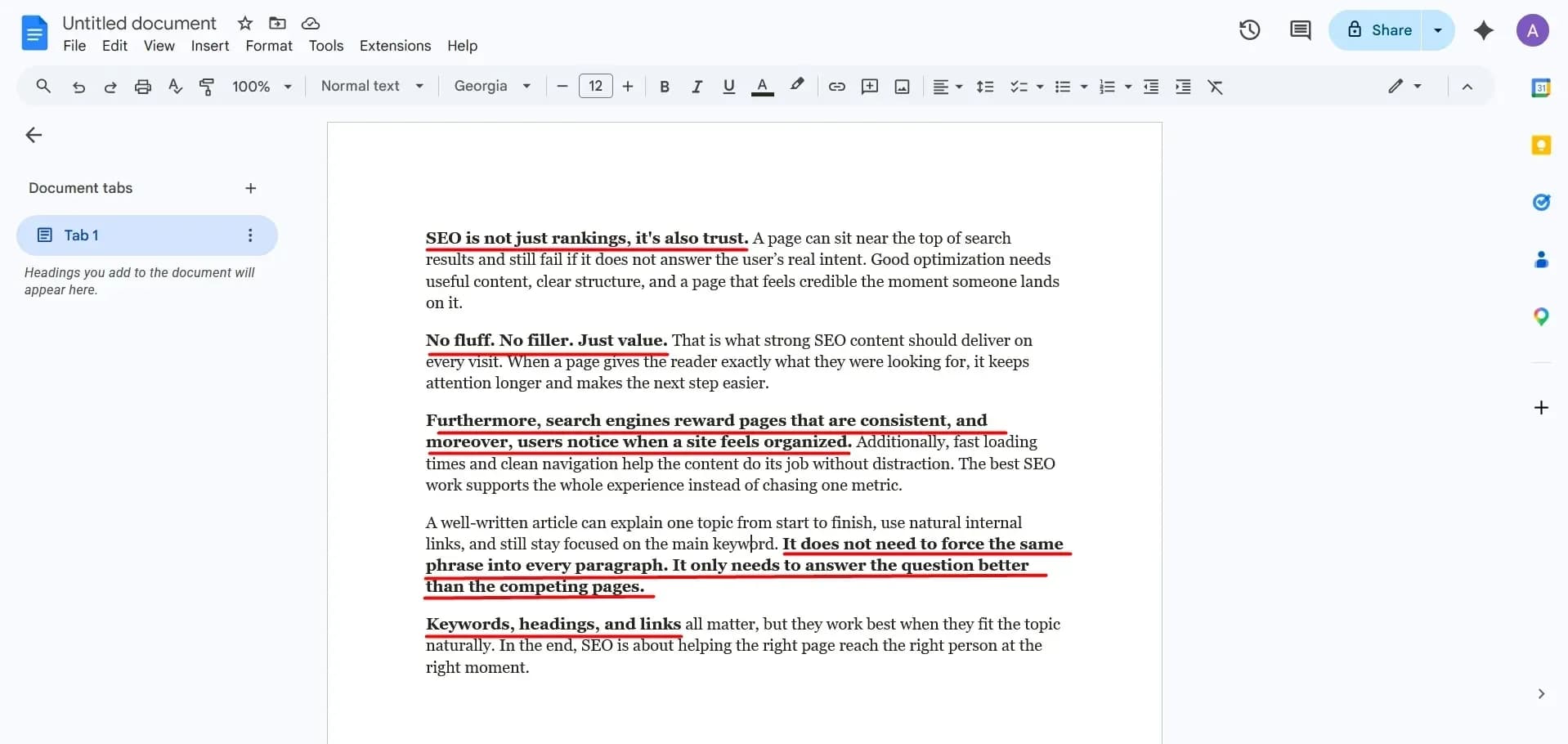
Beyond structural analysis, AI content reveals itself through repetitive phrase constructions that appear across different topics and contexts. These linguistic fingerprints represent the most reliable detection markers for experienced reviewers.
Common AI Phrase Constructions
| AI Pattern | Example | Detection Significance |
|---|---|---|
| X is not just X, it's also Y | "SEO is not just rankings, it's also visibility" | Artificial construction rarely used in natural speech |
| No X. No Y. Just Z | "No fluff. No filler. Just results" | Slogan-like phrasing inappropriate for editorial content |
| Overused transitions | Furthermore, Moreover, Additionally | Back-to-back formal connectors without variation |
| Automatic 3-item lists | Fast, reliable, scalable | Mechanical grouping regardless of natural categorisation |
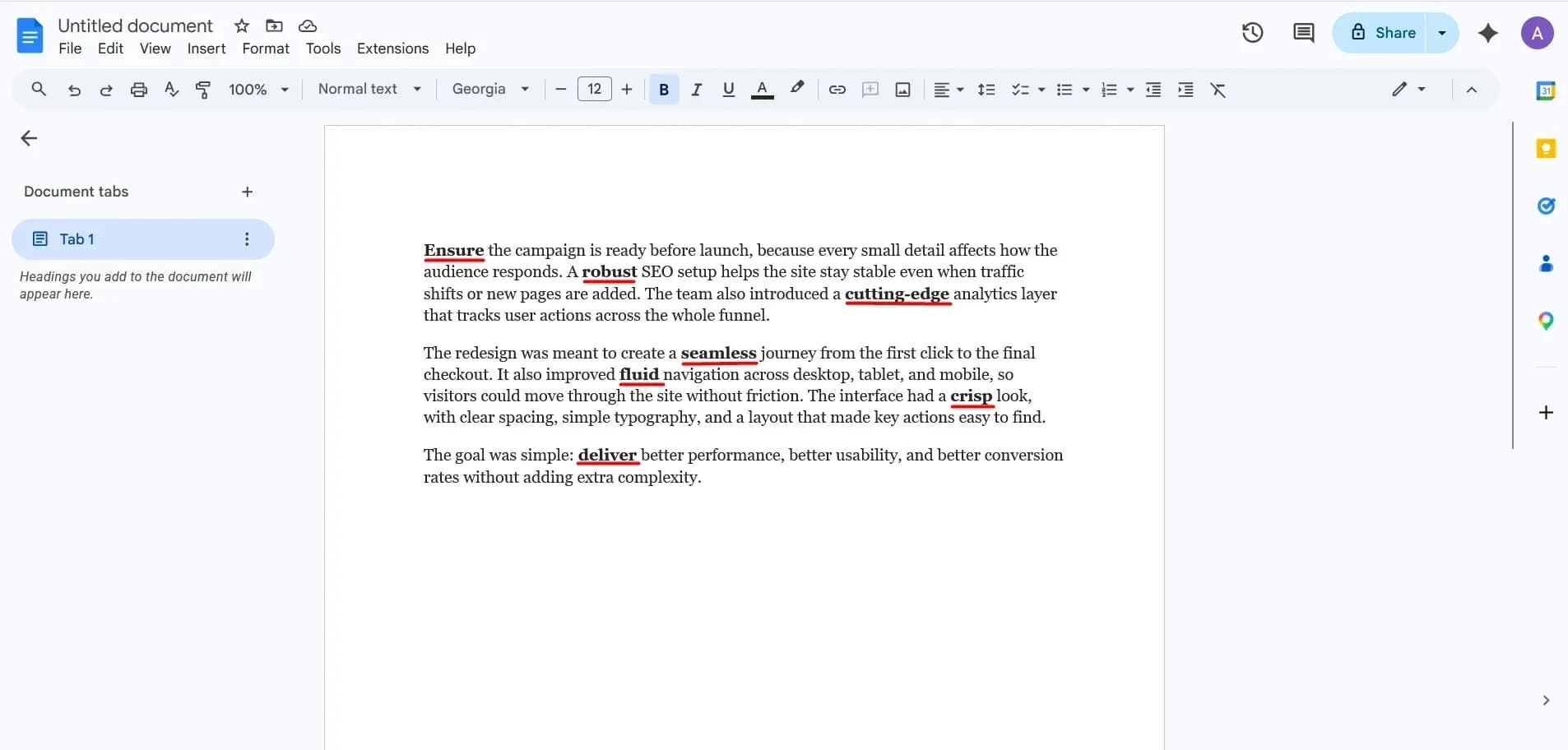
These patterns emerge because AI systems select the most statistically common phrase constructions from their training data, creating repetitive linguistic habits that human writers instinctively avoid.
Detection tools can identify these patterns with significant accuracy. In testing scenarios, AI probability scores reached 81% when AI checker tool identified sample text as generated, demonstrating the effectiveness of pattern-based analysis.
Vocabulary Selection Analysis
AI systems consistently choose generic, high-frequency vocabulary over specific, contextual terms. This creates writing that appears polished but lacks the precision and personality that characterise expert human content.
Problematic AI vocabulary includes:
- Ensure — formal filler replacing specific action verbs
- Robust — vague descriptor without technical meaning
- Cutting-edge — empty promotional language
- Seamless — meaningless without operational specifics
- Deliver — paired with abstract nouns like "results" or "solutions"
Professional writers select vocabulary that conveys specific meaning within their domain expertise, while AI defaults to broadly applicable terms that work across multiple contexts but communicate less precise information.
Professional Detection Workflow
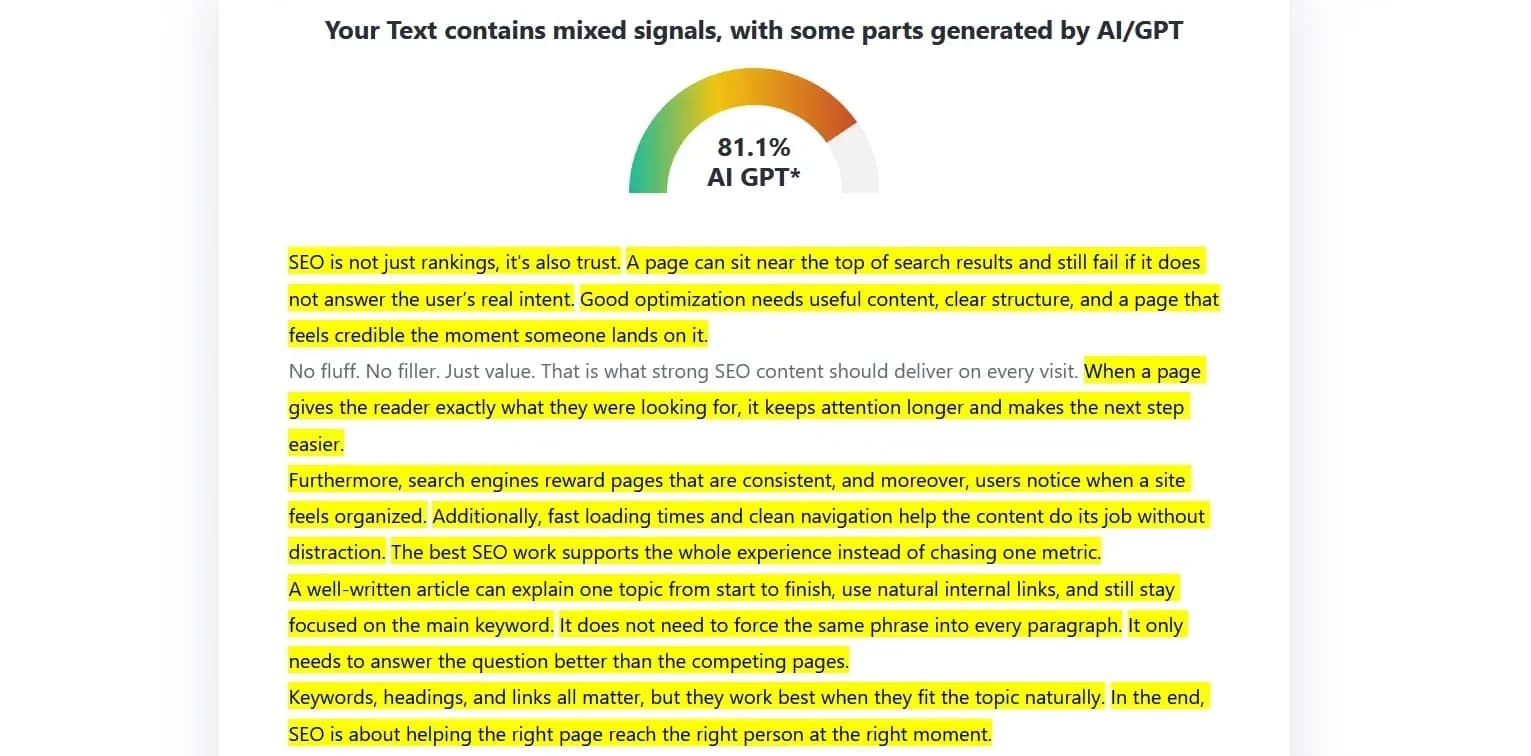
Systematic AI content detection requires a structured approach that examines multiple text layers sequentially. This methodology ensures comprehensive analysis while maintaining efficiency for regular content review processes.
Initial Structure Scan
Review overall text architecture, sentence length patterns, and paragraph organisation for template adherence
Pattern Analysis
Identify repetitive phrase constructions and transition usage that indicates automated generation
Vocabulary Assessment
Examine word choice specificity and domain-appropriate terminology selection
Logic Depth Evaluation
Assess whether content provides specific examples, detailed explanations, and contextual information
Tool Verification
Apply AI detection software for quantitative analysis while maintaining critical evaluation of results
Depth and Logic Assessment
AI content characteristically operates at surface level, discussing topics without providing substantive detail, specific examples, or contextual information that demonstrates genuine expertise.
Pros
- Consistent formatting
- Grammatically correct
- Covers topic breadth
Cons
- Lacks specific examples
- No real experience references
- Generic descriptions without detail
- Absence of quantitative data
- No contextual nuance
Human experts naturally include specific data points, real-world examples, and contextual details that reflect their professional experience. For instance, technical writers provide precise metrics: "We changed to lazy loading, which reduced our page load to 1.1s on mobile versus 3.2s on desktop."
AI content would instead offer generic statements: "This enhances the performance of websites," without quantitative specifics or implementation details.
Experience Indicator Method
Look for personal pronouns combined with specific outcomes: 'We implemented X and achieved Y metric improvement.' AI cannot fabricate genuine first-person experiences or provide authentic case study details with precise measurements and timelines.
How to Conduct Systematic AI Detection
Review overall text architecture, sentence length patterns, and paragraph organisation for template adherence
Identify repetitive phrase constructions and transition usage that indicates automated generation
Examine word choice specificity and domain-appropriate terminology selection
Assess whether content provides specific examples, detailed explanations, and contextual information
Apply AI detection software for quantitative analysis while maintaining critical evaluation of results
Technology-Assisted Detection Methods
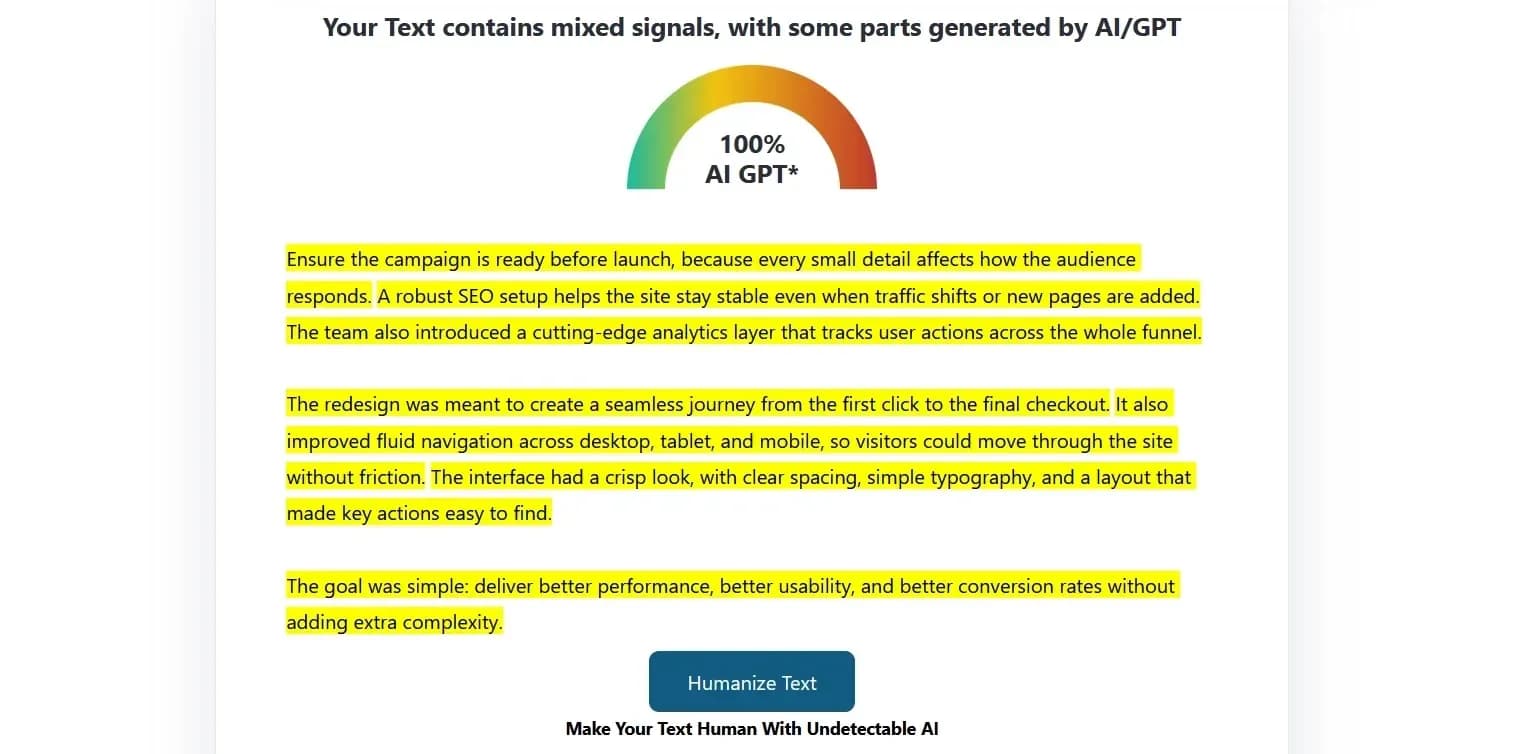
Professional detection workflows incorporate specialized software tools that analyse text patterns against known AI generation signatures. These platforms serve as verification aids rather than definitive arbiters of content origin.
Primary Detection Platforms
ZeroGPT maintains stringent analysis parameters focused on formatting uniformity and repetitive word usage, making it effective for quick preliminary scans of suspicious content.
Originality.ai demonstrates high sensitivity to edited AI work, identifying machine-generated text even after human revision attempts that might fool other detection systems.
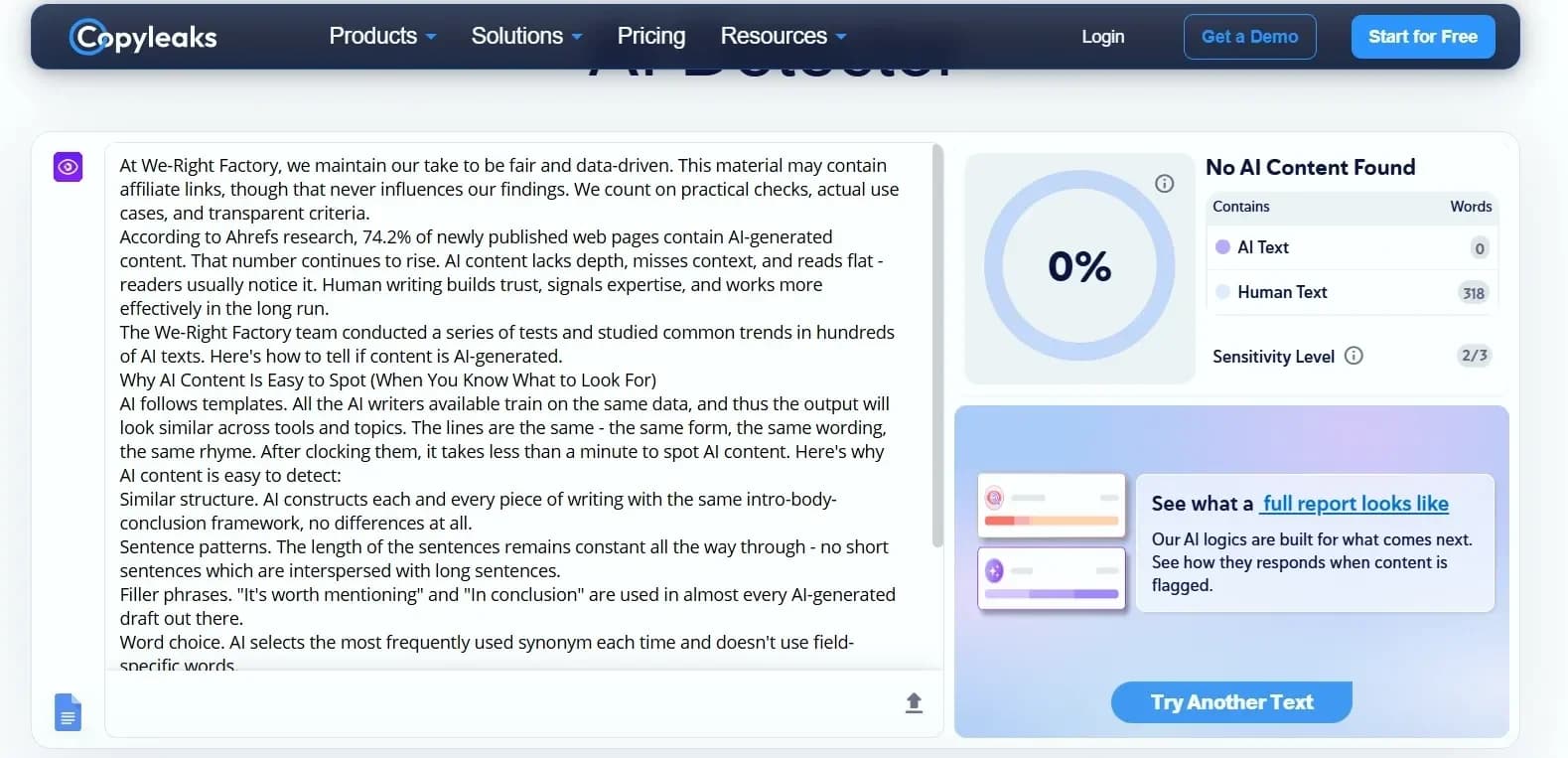
Copyleaks specialises in phrase and sentence structure analysis, offering particular effectiveness for multilingual content verification across different language contexts.
Similar content verification platforms like Smodin.io provide additional detection capabilities for professional teams managing diverse content workflows.
Tool Accuracy and Limitations
Testing across multiple platforms reveals significant variation in sensitivity and accuracy rates. Originality.ai showed highest sensitivity to AI markers, while Copyleaks and ZeroGPT demonstrated more conservative detection thresholds.
Combined manual and automated analysis achieves 100% verified content accuracy when systematic checking protocols are properly implemented across all detection stages.
Detection Score Interpretation
Detection tool scores provide indicators rather than definitive judgments. Professional verification requires combining automated analysis with manual assessment for accurate content classification. Never rely on numerical scores alone for content rejection decisions.
Practical Application: Comparative Analysis
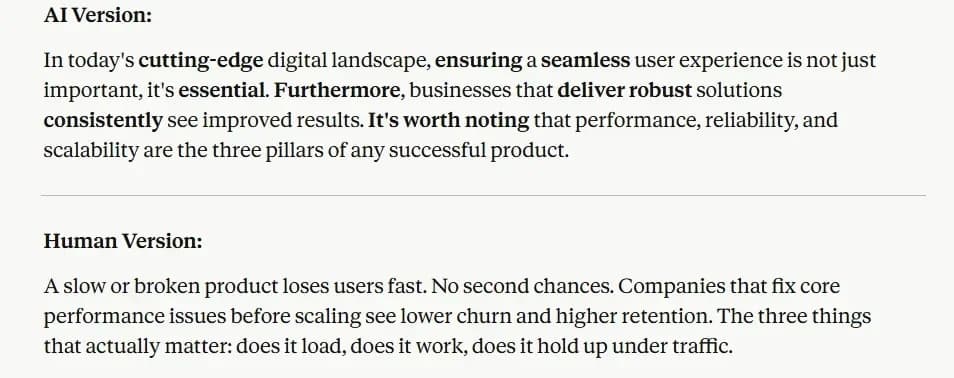
Real-world application of detection methods requires understanding how AI and human content differ when addressing identical topics. Side-by-side comparison provides clear illustration of the distinguishing factors that separate automated from human-authored text.
Detailed Marker Analysis
| AI Marker | Recognition Signal | Professional Correction Method |
|---|---|---|
| "Cutting-edge digital landscape" | Meaningless contextual opening | Replace with specific industry reference |
| "Ensuring seamless experience" | Vague promise without substance | Substitute concrete outcome metrics |
| "Not just X, it's also Y" | Template construction pattern | Restructure with direct statement |
| "Furthermore" repetition | Mechanical transition overuse | Remove or vary connection methods |
| "Deliver robust solutions" | Corporate buzzword combination | Specify actual deliverable outcomes |
| "Performance, reliability, scalability" | Automatic 3-item grouping | Reframe as specific operational questions |
This systematic revision process transforms generic AI output into content that demonstrates genuine expertise and provides actionable information for professional audiences.
Corporate Language Red Flags
Buzzword combinations like 'deliver robust solutions' or 'seamless cutting-edge experience' signal AI generation because these phrases optimize for search keywords rather than communicating specific value propositions. Human experts describe concrete outcomes instead of abstract benefits.
Strategic Implications for Content Operations
The widespread adoption of AI content generation tools creates both challenges and opportunities for professional content operations. Understanding detection methods enables teams to maintain quality standards while leveraging appropriate automation where beneficial.
Content authenticity becomes increasingly valuable as AI-generated material proliferates across digital platforms. Human expertise, specific experience, and detailed knowledge provide competitive advantages that automated systems cannot replicate.
The ability to distinguish between human and AI content represents a fundamental skill for modern content professionals, requiring both technical knowledge and practical application experience.
Professional teams must develop systematic detection capabilities to ensure content quality, maintain editorial standards, and verify the authenticity of external submissions or collaborative work.
Quality Assurance Framework Development
Implementation of comprehensive AI detection protocols requires establishing baseline standards, training team members on recognition patterns, and integrating verification tools into existing editorial workflows.
Regular testing against known AI and human samples calibrates team detection accuracy and maintains consistent evaluation standards across different reviewers and content types. The evolving landscape of AI content generation demands adaptive detection strategies that account for improving technology while maintaining reliable identification methods for current and emerging AI patterns.
Content authenticity becomes increasingly valuable as AI-generated material proliferates across digital platforms, with human expertise and specific experience providing competitive advantages that automated systems cannot replicate.
A 40% AI detection score requires manual review rather than automatic rejection. Detection tools identify patterns similar to known AI output, but human writing can trigger false positives through formal language or structured presentation. Professional assessment should examine content depth, specific examples, and contextual expertise rather than relying solely on numerical scores.
Documentation provides strongest verification evidence. Maintain drafts, revision histories, source notes, and research materials that demonstrate writing processess development. Include specific personal or professional experiences, original data analysis, and consistent voice throughout work portfolio. These elements prove human involvement more effectively than any automated detection metric.
Systematic detection combining structural analysis, pattern recognition, vocabulary assessment, and tool verification achieves high accuracy rates when properly implemented. Manual review remains essential for final determination, as automated tools provide supporting evidence rather than definitive classification. Regular calibration against known samples improves team detection consistency.
According to We-Right Blog.