Content authenticity verification has become a critical workflow component for digital marketing teams, particularly as artificial intelligence adoption accelerates across content creation. New research reveals concerning gaps in AI detection tool reliability that could impact editorial decisions industry-wide.
The Current AI Content Landscape

According to research by Digitaloft, 25% of e-commerce businesses use AI to help write product descriptions. However, human oversight remains paramount – 93% of marketers still edit AI-generated text before publishing. This editing workflow necessitates reliable detection tools to distinguish between AI-generated and human-written content.
The challenge lies in tool accuracy. Current AI detectors exhibit varying sensitivity levels, with some flagging nearly every sentence while others miss obvious AI patterns. This inconsistency creates workflow complications for content teams requiring dependable verification systems.
25%
E-commerce businesses using AI for product descriptions
93%
Marketers editing AI content before publication
Testing Methodology and Content Selection
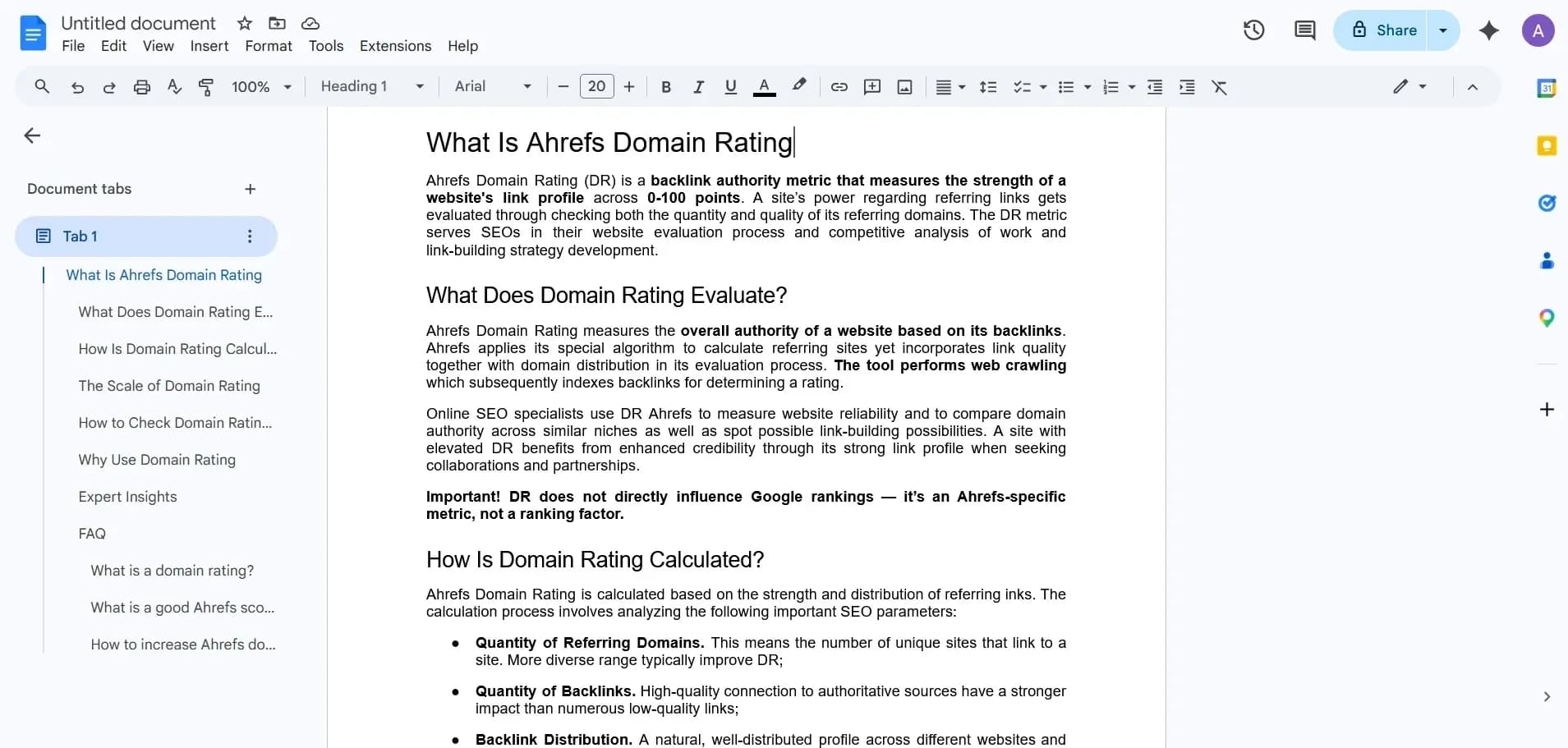
Our analysis examined five widely-used AI detection platforms using identical source material. The test article focused on "What Is Ahrefs Domain Rating" – a topic representing the middle ground between AI generation and manual editing common in SEO content creation.
Test Article Specifications
The selected content contained:
- 6 H2 headings and 3 H3 headings
- 15 paragraphs totalling 720 words
- Partial generation using OpenAI ChatGPT 5.2
- Substantial copywriter editing and manual revisions
This hybrid approach reflects realistic content development scenarios where teams leverage AI for initial drafts before applying human editorial oversight.
Content Creation Process
The test article combined AI generation with human editing to simulate real-world content workflows, providing a realistic benchmark for detection tool accuracy.
Detector Selection and Testing Parameters
We identified five leading AI detection tools through search engine results and review platform analysis:
- Copyleaks AI Detector
- ZeroGPT
- Undetectable.ai
- Originality.ai
- Turnitin Checker AI
Each platform scanned identical content with consistent parameters. We monitored AI probability scores, human-written percentages, scanning speed, interface usability, and specific language markers identified by each system.
Detailed Testing Results
Copyleaks AI Detector Performance
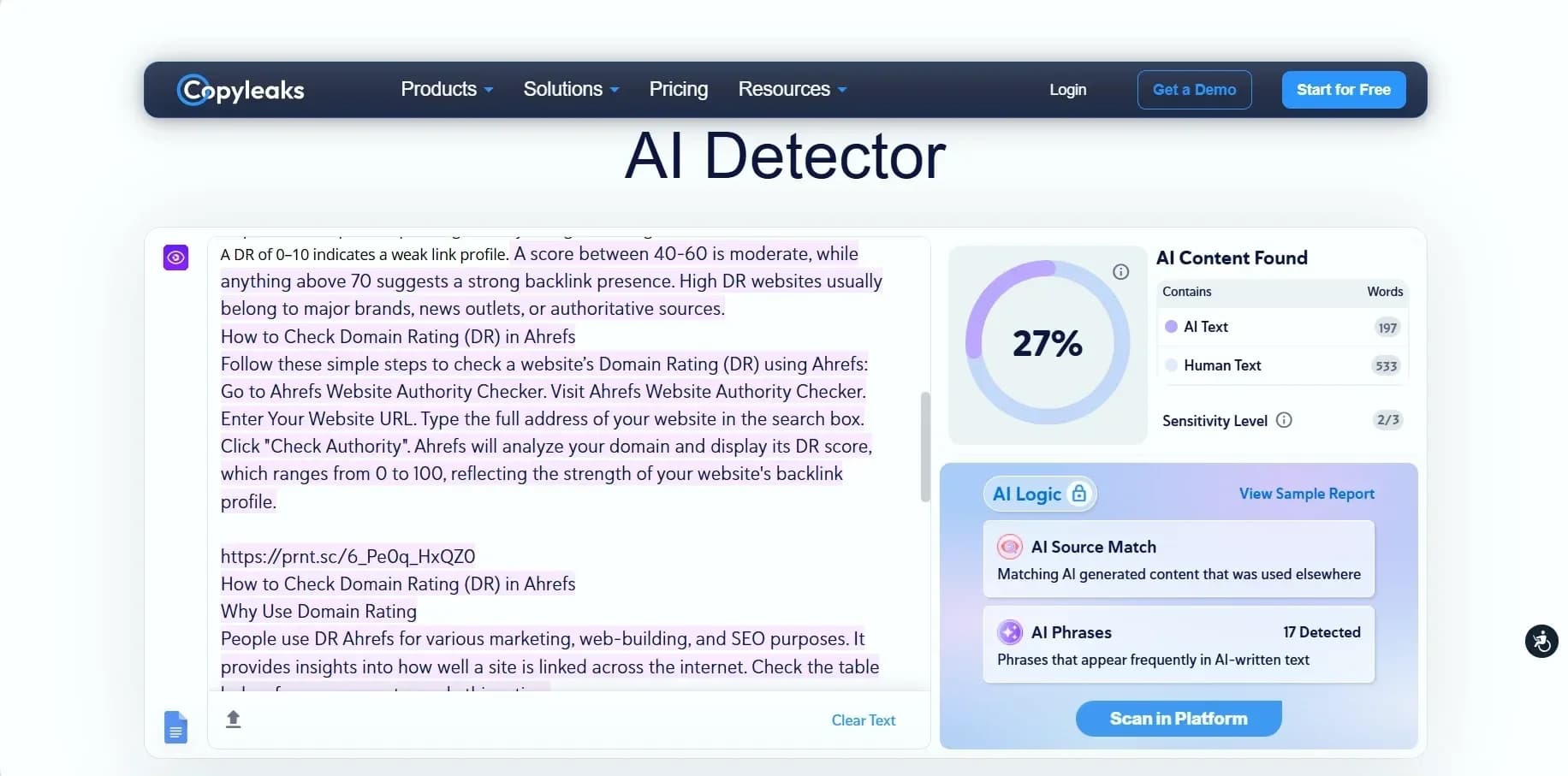
Copyleaks provided the most balanced assessment among tested platforms. The tool's split-view interface displays source text alongside highlighted AI-flagged sections in purple, with scoring presented via circular charts.
27%
AI probability score
73%
Human-written score
197
Words flagged as AI-generated
533
Words identified as human-written
17
AI phrases detected
The platform identified 197 words as AI-generated and 533 as human-written, discovering 17 AI phrases overall. Flagged content primarily consisted of structured SEO elements, step-by-step instructions, and common terms like "visit," "enter," and "display its DR score."
Scanning speed: Fast, completed in under 10 seconds
Strengths: Clear visual layout, rapid processing, word-level highlighting Weaknesses: Tendency to flag well-structured English as AI-generated content
Detection Methodology
Copyleaks uses machine learning algorithms trained on billions of text samples to identify linguistic patterns. The tool's purple highlighting system focuses on sentence structure, vocabulary choices, and transition patterns rather than topic-specific terminology.
ZeroGPT Analysis
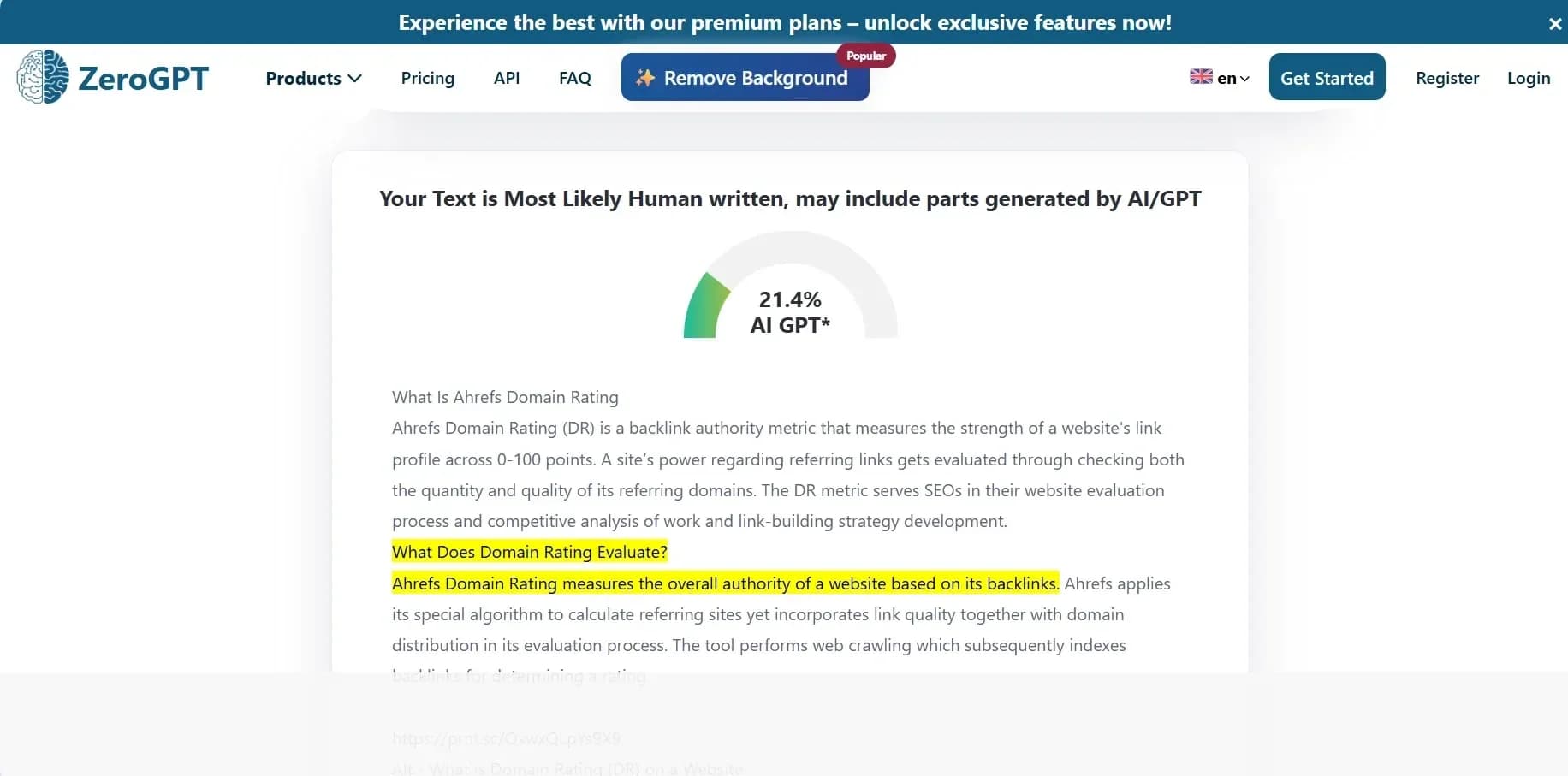
ZeroGPT delivered a verdict-first approach, displaying score meters prominently before detailed analysis. The platform classified the content as "most likely human-written" while identifying AI-generated sections.
21.4%
AI probability score (lowest among tested tools)
78.6%
Human-written score
5-10
Seconds scanning time
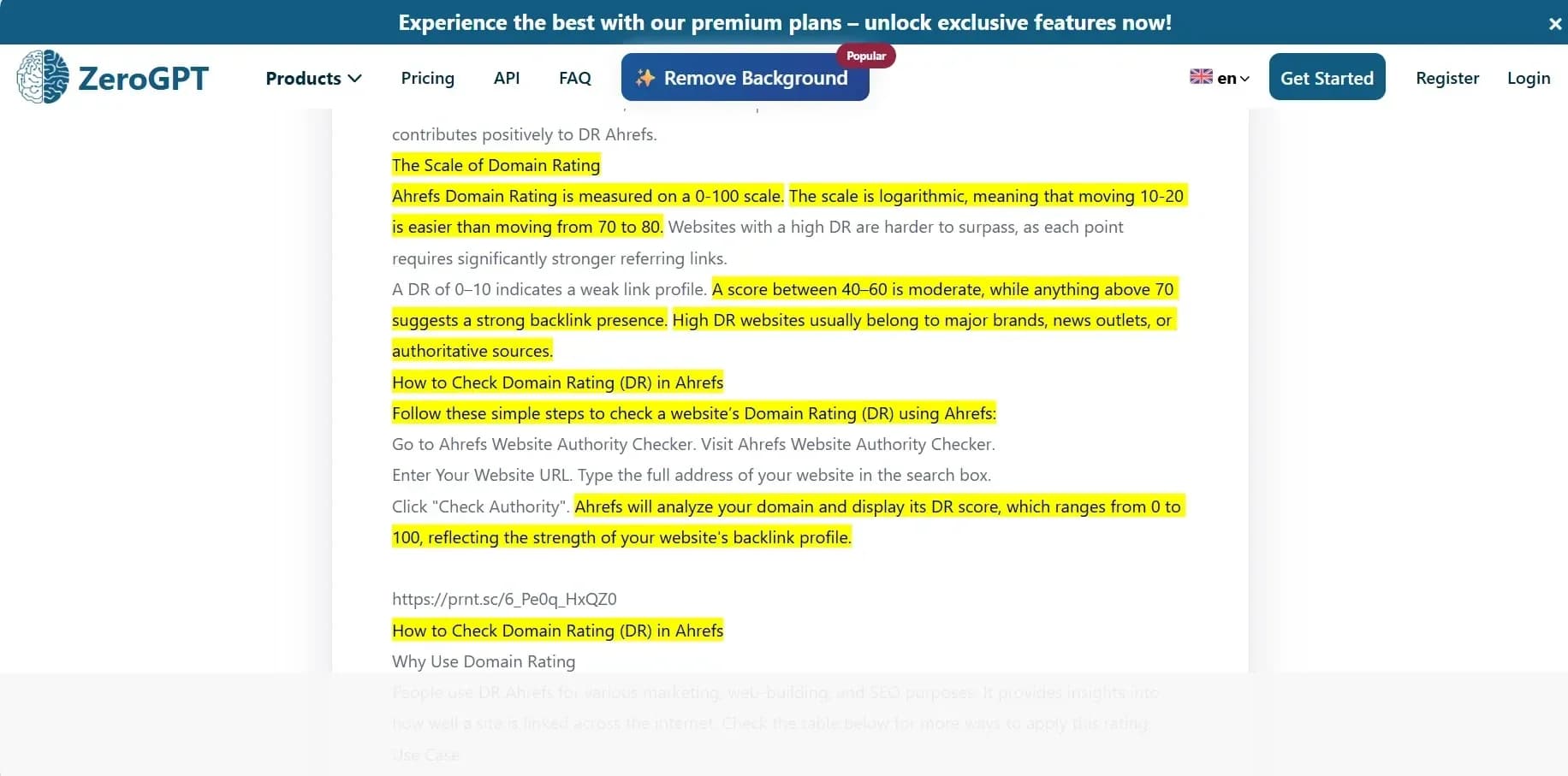
The tool highlighted specific sections including "What Does Domain Rating Evaluate?" and "Ahrefs Domain Rating measures the overall authority of a website based on its backlinks." Additional flags included phrases like "The Scale of Domain Rating," "measured on a 0-100 scale," and instructional language such as "Follow these simple steps."
Strengths: Clean score presentation, intuitive yellow highlighting system Weaknesses: Interface clutter from advertisements and promotional elements
Undetectable.ai Evaluation
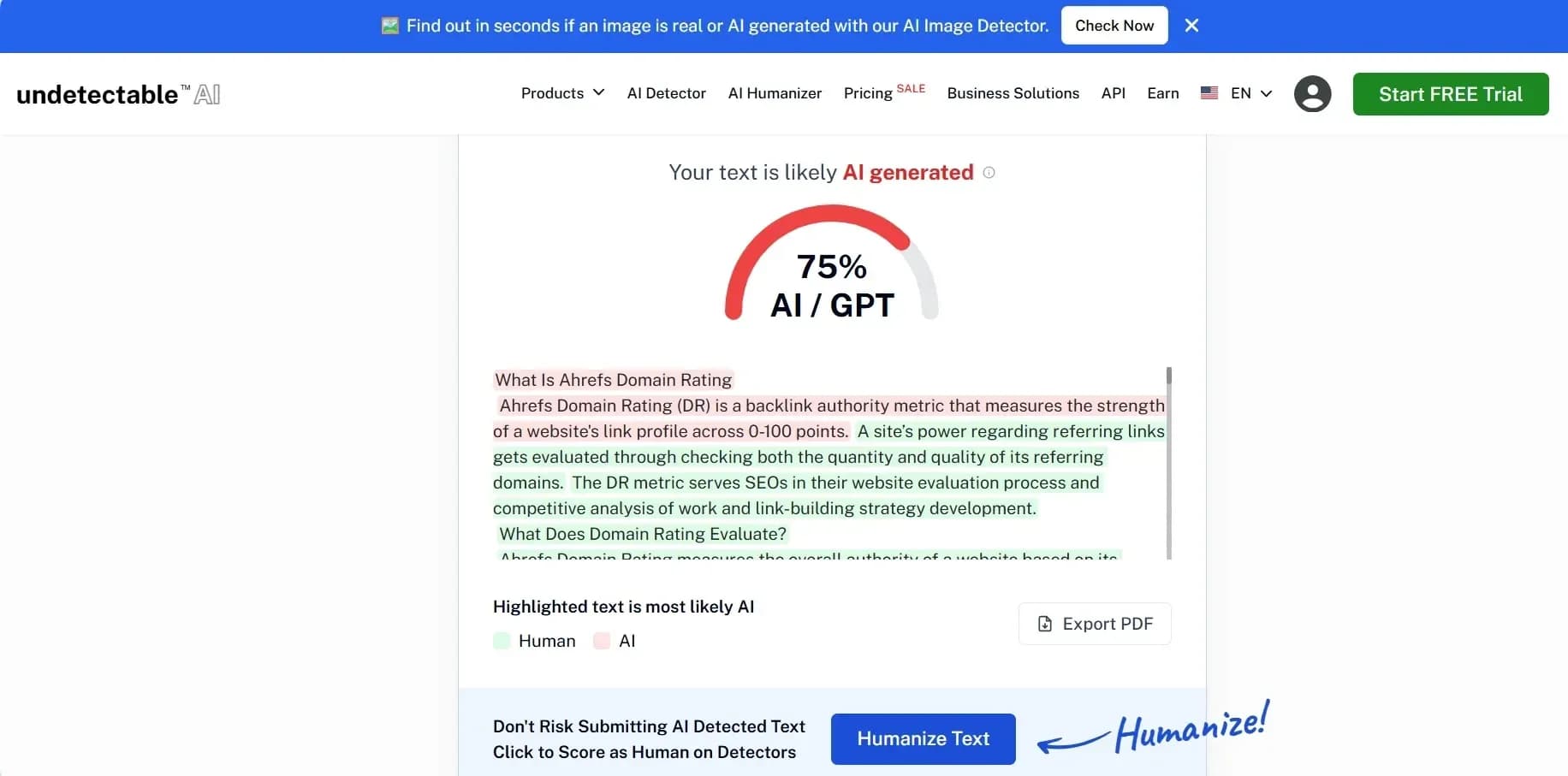
Undetectable.ai demonstrated significantly stricter detection parameters compared to previous tools. The platform uses colour-coded text marking – green for human content, pink for AI-generated sections.
This detector flagged considerably more content as AI-generated, including "What Is Ahrefs Domain Rating," "a backlink authority metric," "measures the strength," and numerical ranges like "0-100 points." Notably, it was the first tool to identify technical SEO terminology such as "Quantity of Backlinks," "high-quality connection," and "Backlink Distribution" as AI-generated content.
Strengths: Clear colour differentiation, rapid line-by-line scanning capability Weaknesses: Overly strict scoring treating standard SEO terminology as AI-generated
Warning
Undetectable.ai's 75% AI score demonstrates how strict detection parameters can misclassify edited human content. This over-sensitivity could lead content teams to unnecessarily rewrite perfectly acceptable material, increasing production costs and workflow delays.
Originality.ai Assessment
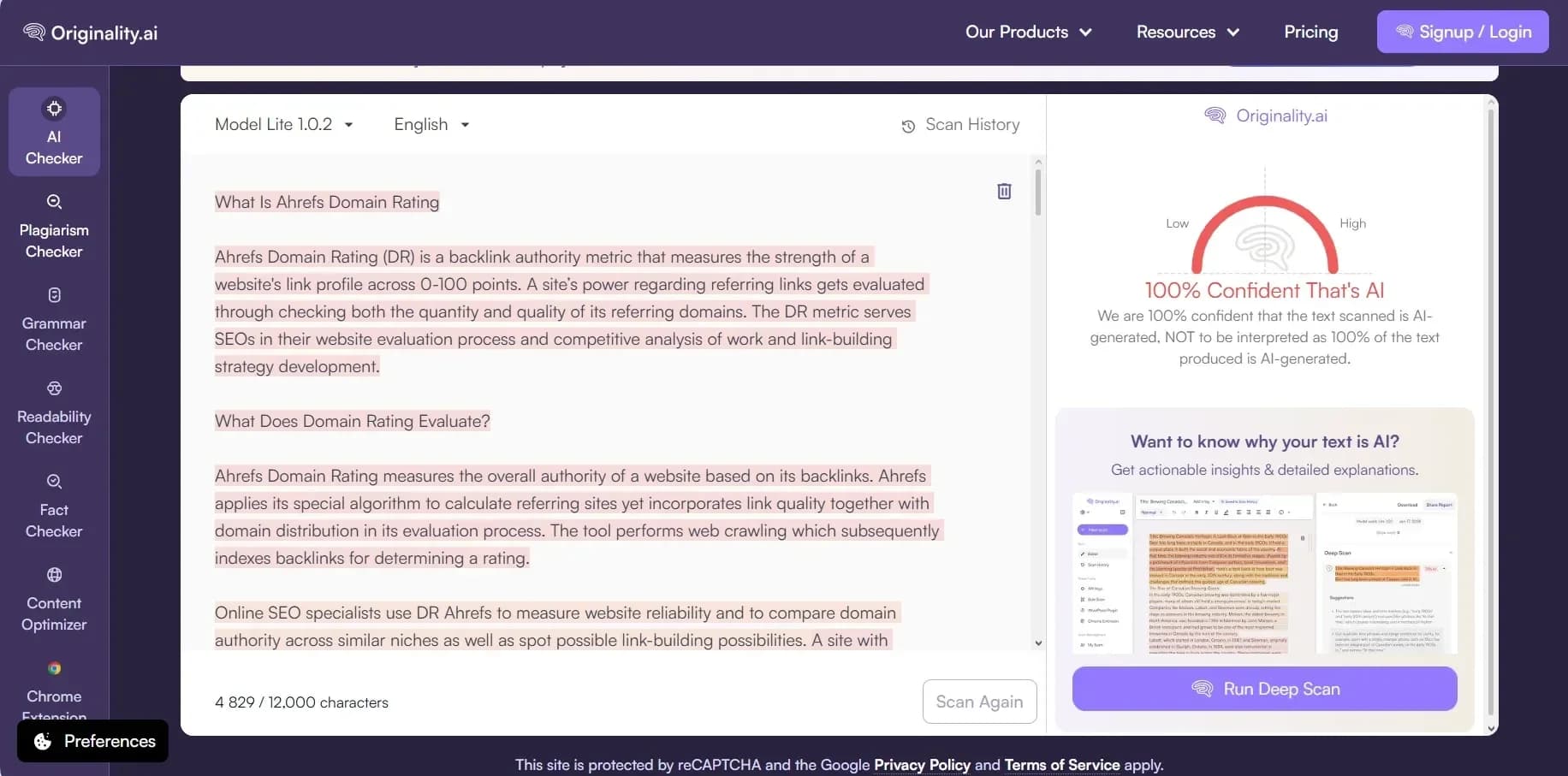
Originality.ai provided the most stringent evaluation, displaying text on the left panel with scoring on the right. Risk areas appear in pink, red, and yellow highlighting. The platform delivered an uncompromising verdict: "100% Confident That's AI."
100%
AI probability score (highest among tested tools)
Rather than flagging isolated phrases, Originality.ai identified entire paragraphs as AI-generated. Complete sections under H2 headings "What Is Ahrefs Domain Rating" and "What Does Domain Rating Evaluate?" received full AI classification. The tool appears to interpret uniform language structure and SEO optimization as indicators of machine generation.
Strengths: Comprehensive visual marking system, clear scoring presentation Weaknesses: Zero recognition of human editing despite substantial manual revisions
Zero Tolerance Approach
Originality.ai's 100% AI classification suggests the platform prioritizes avoiding false negatives over accuracy. This approach may suit academic institutions requiring absolute certainty but proves impractical for commercial content workflows where hybrid creation is standard.
Turnitin Checker AI Results
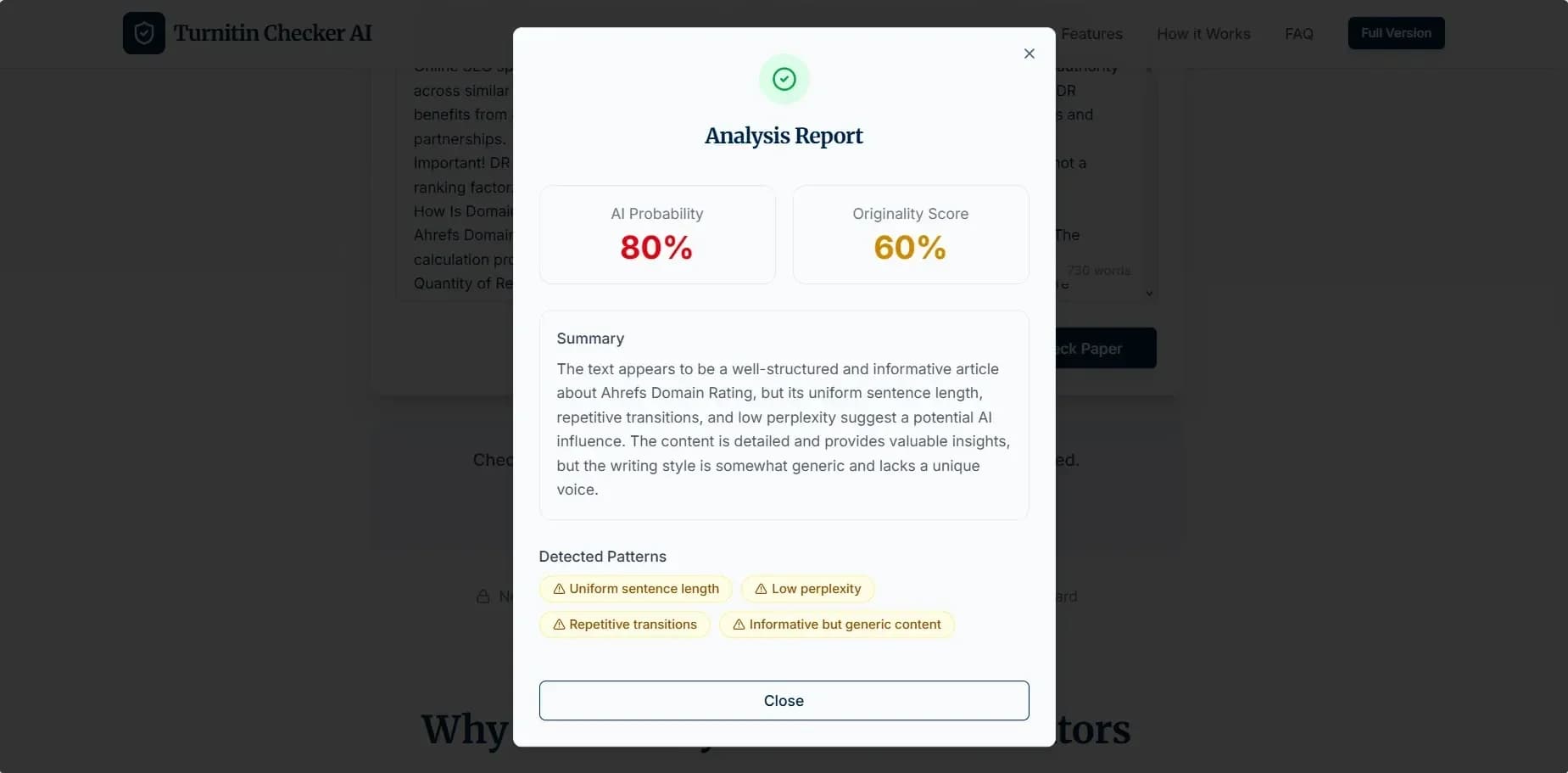
Turnitin Checker AI employed a different approach, providing analysis reports in pop-up windows rather than inline text marking. The platform offers two score cards covering summary data and pattern identification.
80%
AI probability score
60%
Originality score
Instead of highlighting specific words, Turnitin identified structural patterns including "uniform sentence length," "low perplexity," "repetitive transitions," and "informative but generic content." The summary noted a "well-structured article on Ahrefs Domain Rating" with generic voice characteristics.
Strengths: Pattern-based analysis, concise reporting format Weaknesses: No sentence-level highlighting, requiring manual interpretation for improvement
Comparative Analysis and Industry Implications
Detection Accuracy Variance
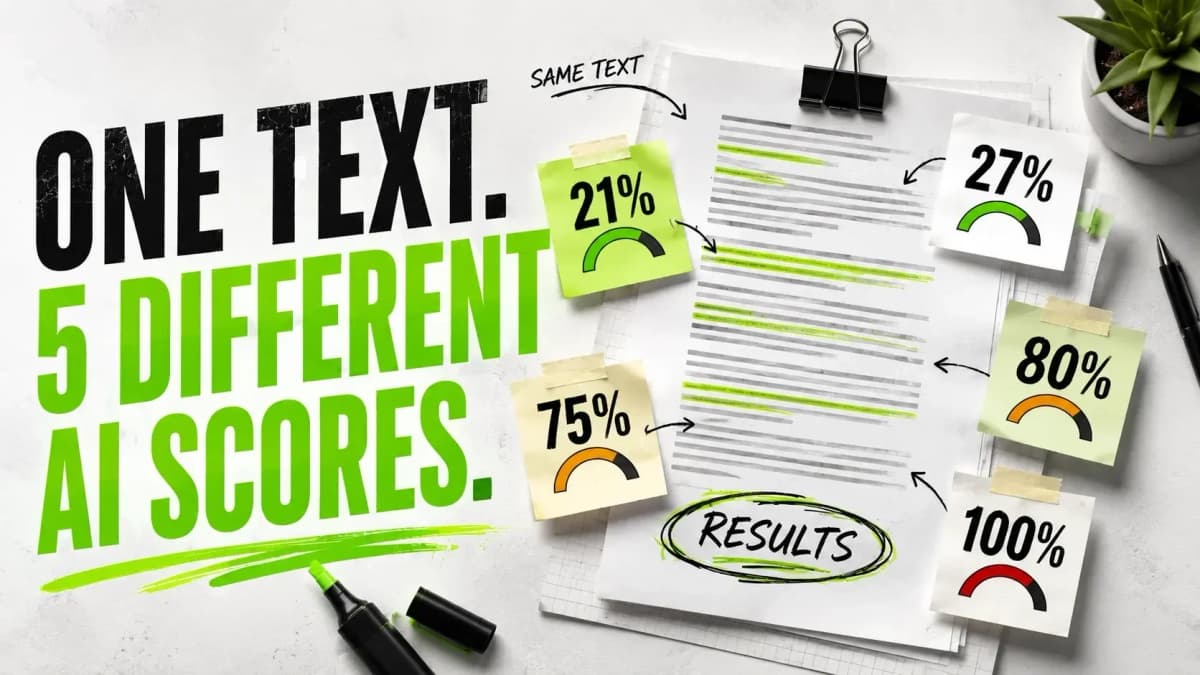
The testing revealed substantial inconsistencies across platforms. The same 720-word article received AI probability scores ranging from 21% to 100%, representing a 79-percentage-point variance between the most lenient (ZeroGPT at 21.4%) and strictest (Originality.ai at 100%) detectors.
| Detector | AI Score | Human Score | Speed | Primary Strength |
|---|---|---|---|---|
| Copyleaks | 27% | 73% | <10 sec | Word-level highlighting |
| ZeroGPT | 21.4% | 78.6% | 5-10 sec | Balanced scoring |
| Undetectable.ai | 75% | 25% | 5-10 sec | Pattern recognition |
| Originality.ai | 100% | 0% | ~10 sec | Comprehensive analysis |
| Turnitin | 80% | 60% | ~10 sec | Structural patterns |
Multi-Tool Verification Strategy
Content managers should establish detection score thresholds rather than binary pass/fail criteria. For example, content scoring below 30% on two different platforms likely requires minimal editing, while content above 70% on multiple tools needs substantial human revision.
Common Trigger Patterns
All platforms demonstrated sensitivity to specific content characteristics:
Warning
- Highly structured SEO terminology - Repetitive sentence patterns - Definition-style paragraph construction - Predictable section transitions
Notably, manually edited sections continued triggering AI flags across multiple detectors, suggesting that current tools prioritize writing patterns and formatting consistency over actual authorship verification.
Strategic Implications for Content Teams
Workflow Integration Challenges
The 79-point variance in detection results presents significant challenges for content verification workflows. Teams relying on single-tool verification may receive misleading assessments of content authenticity, potentially leading to unnecessary rewrites of human-authored material or approval of problematic AI-generated content.
No detector behaved fully consistently across the entire article. Some tools flagged only isolated phrases, while others treated almost the entire text as AI-generated despite heavy editing.
Quality Assurance Recommendations
Based on testing outcomes, content teams should consider AI detectors as reference tools rather than definitive quality indicators. The substantial variance between platforms necessitates multi-tool verification for critical content or acceptance of inherent uncertainty in single-tool assessments.
For organisations requiring high confidence in content authenticity, manual review of flagged sections remains essential regardless of detection tool selection. No platform demonstrated sufficient reliability to eliminate human oversight from the verification process.
The 79-point variance in AI detection scores reveals that current verification technology cannot replace human editorial judgment in professional content workflows.
Market Outlook and Technology Development
The inconsistent performance across established AI detection platforms highlights the nascent state of this technology sector. As AI content generation becomes more sophisticated and human-like, detection tools face increasing challenges in maintaining accuracy.
Content verification technology requires substantial development to achieve reliable industry standards. Current limitations suggest that hybrid approaches combining multiple detection tools with human editorial judgment will remain necessary for the foreseeable future.
Organizations developing content strategies should factor detection tool limitations into their quality assurance processes, ensuring that verification workflows account for both false positives and false negatives in current AI detection technology.
Yes, humans can often identify AI-generated content through repetitive structures, vague wording, lack of distinctive voice, or limited word choice variation. However, AI-edited content can still appear human-authored.
Each detector employs different models, scoring algorithms, and text analysis signals. This variation explains why identical content can receive both high and low AI probability scores.
Yes, these tools frequently flag human writing as AI-generated and may overlook heavily edited AI content. False positives and negatives are common across all platforms tested.
Overly structured writing, consistent sentence patterns, or formulaic phrasing can trigger AI detection. SEO-optimised content is particularly susceptible to false positive results.
According to We-Right Blog.