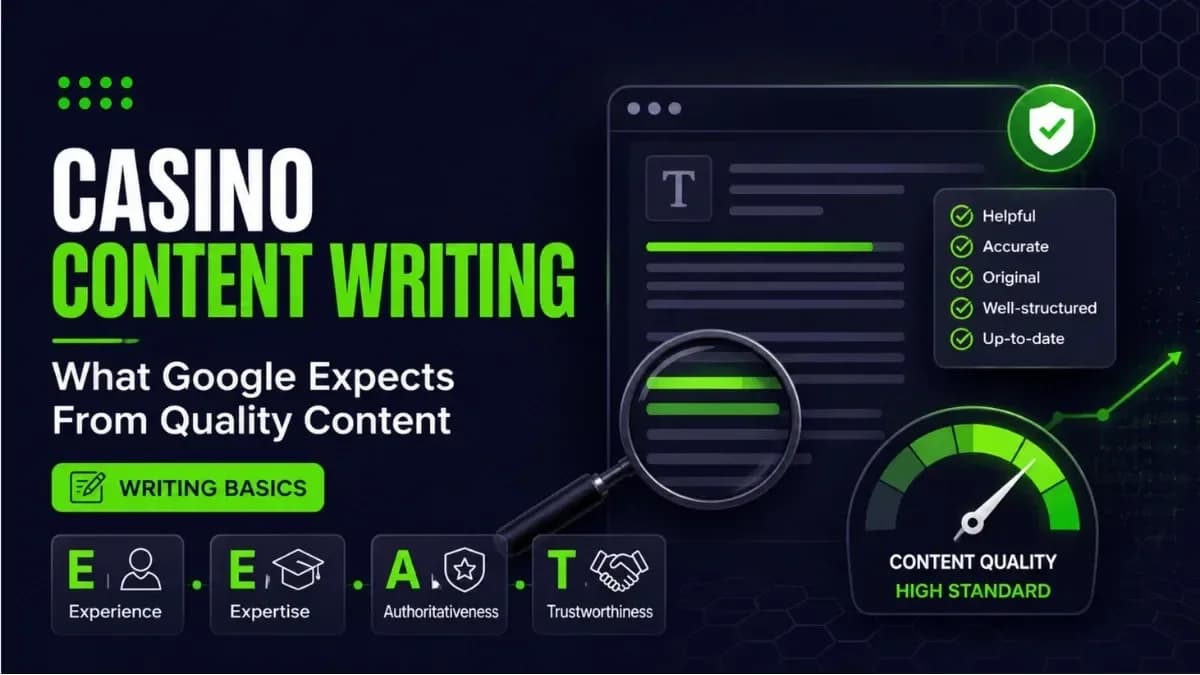
Google's approach to casino content has fundamentally shifted from keyword-focused ranking to trust-based evaluation. As gambling pages directly influence financial decisions and user behaviour, search engines now apply YMYL-level scrutiny to every casino review, guide, and promotional page.
The YMYL Reality for Gambling Content

Casino content operates in Google's most sensitive category because it sits at the intersection of money, risk, and user decision-making. Unlike standard commercial content, gambling pages face immediate trust challenges that can derail even technically sound SEO strategies.
The fundamental issue is clear: pages with strong keyword targeting but weak source handling, vague claims, or thin expertise may perform initially, but rarely maintain stability after quality-focused updates.
Real-money decisions
Users deposit and wager based on content
Financial risk exposure
Errors in bonus terms or licensing can mislead
Trust sensitivity
Heavy judgement on credibility and transparency
Regulatory complexity
References to licences and jurisdictions require accuracy
Why Traditional SEO Falls Short
In casino content writing in 2026, structure and SEO techniques remain important foundational elements, but they no longer guarantee sustainable performance. The content must demonstrate accuracy, trustworthiness, editorial control, and genuine reader value beyond basic optimisation.
This shift reflects Google's recognition that gambling content can directly impact user financial behaviour, placing it much closer to YMYL topics than many website owners initially assumed.
Critical Shift in Ranking Factors
Google's algorithm updates now prioritize content depth and user trust over technical SEO optimization alone. Casino websites that rely solely on keyword density and backlinks without demonstrating real expertise face increasing volatility in search rankings.
Did you know?
YMYL — Risk Category Level
2026 — Current Content Standards Year
Multi-Stage — Required Development Process
Quality Standards That Matter Most
Google evaluates casino content through multiple quality lenses simultaneously. A well-structured page can still perform poorly if it appears vague, promotional, outdated, or inadequately supported by credible sources.
| Quality Factor | Impact on Gambling Content |
|---|---|
| Real-money decisions | Users may deposit or choose platforms based on information provided |
| Financial risk | Errors in bonus terms or payment details can mislead users |
| Trust sensitivity | Pages judged heavily on credibility and transparency |
| Regulatory exposure | Content referencing licences and jurisdictions requires accuracy |
| Product complexity | Bonuses and wagering requirements need careful explanation |
The Trust Burden
Casino pages carry a higher burden of proof than standard commercial content because weak information handling directly undermines user confidence. In gambling, page quality is determined not by copy polish, but by how responsibly the information is presented and verified.
YMYL Classification Impact
Your Money or Your Life (YMYL) classification means casino content faces the same scrutiny as medical advice and financial guidance. This classification triggers enhanced manual review processes and stricter algorithmic evaluation compared to standard e-commerce content.
E-E-A-T in Casino Content Strategy
For casino content, E-E-A-T evaluation extends beyond the text itself. Google examines who created the content, the trustworthiness of claims, and whether information demonstrates genuine expertise rather than surface-level research.
Experience Signals in Gambling Content
Experience in casino content means demonstrating real product familiarity rather than generic rewriting. This appears through specific details about user interfaces, actual bonus mechanics, and practical platform navigation insights.
Expertise requires clear explanation of complex gambling products – bonus structures, wagering requirements, payment processes, and risk factors – presented in ways that help users make informed decisions.
Authority and Trust Indicators
Authoritativeness emerges from strong niche handling, editorial credibility, and trustworthy site context. This includes proper attribution, clear editorial processes, and consistent quality standards across content.
Trustworthiness depends on factual accuracy, transparent sourcing, current information, and neutral tone that avoids manipulative language or exaggerated claims.
Important
E-E-A-T in casino content is not decorative SEO terminology. It represents Google's primary method for distinguishing genuinely useful pages from content that merely imitates quality signals.
Common E-E-A-T Failures
Weak gambling content typically exhibits these patterns:
- Promotional pages disguised as objective reviews
- Thin "top casino" lists lacking real depth or analysis
- Generic write-ups showing no genuine product understanding
- Template-driven content with minimal editorial oversight
- Unsupported claims lacking proper verification
Warning
Google's spam detection systems specifically target casino content with thin affiliate links, duplicate bonus descriptions across multiple sites, and reviews that lack genuine product testing. These patterns can result in immediate de-indexing or severe ranking penalties.
Accuracy and Verifiability Requirements
Accuracy in gambling content extends beyond basic correctness because users rely on this information for real-money decisions. Incorrect bonus conditions, outdated licence details, or unclear payment references create doubt around both the page and the brand.
Verification Process for Casino Content
Check bonus terms against live offers on official casino websites
Licence Verification
Verify licences through regulator records rather than footer claims
Payment Method Review
Review payment methods regularly with clear geographical relevance
Product Alignment
Ensure content reflects how products actually function
Information That Must Be Verifiable
Casino content quality depends on claims that can be verified against real products, official terms, or public records. Reliable source support through official websites, regulator entries, and current platform details strengthens trust significantly.
Freshness and relevance matter because bonuses, payment methods, and licence details change frequently. Content can become outdated quickly, making regular updates essential for maintaining credibility.
Warning
Pages rarely lose trust suddenly. Trust erosion typically occurs detail by detail as small inaccuracies accumulate over time.
Source Documentation Best Practice
Create internal content databases linking every factual claim to its verification source. This practice not only improves accuracy but also speeds up content updates when operators change their terms or payment methods.
How to Implement Content Verification
Primary Source Validation
Cross-reference all bonus terms, licensing details, and payment methods directly with operator websites and regulatory databases
Regular Audit Schedule
Establish monthly content audits to catch outdated promotions, expired licenses, or changed terms before they impact user trust
Documentation Trail
Maintain verification logs with timestamps and source URLs to demonstrate editorial due diligence to both users and search engines
Editorial Standards vs Promotional Content
Google distinguishes between informative casino content and promotional material disguised as reviews. The balance between facts and persuasion determines whether pages feel credible or commercially manipulative.
"In gambling content, quality is not judged by how polished the page sounds. It is judged by how well the information holds up when someone actually checks it."
— Olga Svichkar, We-Right Factory
Avoiding Affiliate-Spam Signals
Strong casino content maintains neutrality while explaining products clearly. This involves:
- Avoiding exaggerated claims and promotional hyperbole
- Removing emotionally loaded wording and unrealistic promises
- Explaining bonus terms and restrictions transparently
- Maintaining balanced reviews rather than listing only advantages
- Showing real limits, conditions, and product risks
Tone and Trust Correlation
Pages overloaded with phrases like "best bonuses," "huge wins," or "must-join offers" may appear commercially strong but often weaken long-term performance by reducing perceived trustworthiness.
A neutral tone that explains terms properly and presents products honestly – including limitations and potential drawbacks – typically proves more credible and sustainable.
Hype may help a page sound louder, but it rarely helps it look more trustworthy. In casino content, balance usually does more for performance than exaggeration.
User Behaviour and Content Value
Modern Google algorithms increasingly prioritise user behaviour signals over traditional SEO metrics alone. In gambling content, this shift is particularly noticeable because users quickly abandon pages that fail to provide genuine value.
Key Behavioural Indicators
Google evaluates several user interaction signals:
- Time spent reading the content
- Depth of engagement with different page sections
- Speed of return to search results
- Internal link click-through behaviour
Did you know?
If users cannot quickly find necessary, understandable information, this sends a direct signal to Google that gambling content does not match user intent.
Beyond SEO-Only Optimisation
Google's people-first approach clarifies that ranking signals alone cannot sustain gambling content performance. Pages may achieve initial SEO success, but without genuine user value, they become vulnerable to replacement by more useful content.
Effective casino content typically accomplishes three core objectives:
- Answers real user questions about products, terms, and processes
- Makes important information easily accessible through clear structure
- Supports understanding rather than just keyword placement
Behavioral Analytics Integration
Casino content performance now correlates directly with user engagement metrics including session duration, page depth, and return visit frequency. These signals often override traditional ranking factors in competitive gambling niches.
Structural Requirements for Trust
In casino content, structure serves multiple purposes beyond readability improvement. Clear organisation helps users verify important details, compare offers efficiently, and understand products without unnecessary friction.
Essential Content Sections
Well-structured casino reviews typically include:
Product Overview
Short summary and licensing details
Terms Analysis
Bonus conditions and key restrictions
Payment Information
Available methods and processing details
Balanced Assessment
Pros and cons with clear evaluation criteria
Clear Conclusion
Summary without manipulative language
When this structure is absent, even factually correct pages can feel difficult to trust. Users should not need to search through promotional copy to understand how platforms work or what real conditions apply.
Transparency in Evaluation Methods
Trust develops when readers can clearly see how content was created, what sources were used, and how conclusions were reached. When this logic remains visible, content feels more reliable and less promotional.
Tip
Transparency involves showing both facts and methodology. Pages built with clear editorial control appear more trustworthy than content assembled merely to look convincing.
Implementation Framework
Successful casino content strategies prioritise clarity, accuracy, and long-term value over short-term SEO gains.
Multi-Stage Content Development
Effective casino content creation involves several distinct phases:
| Stage | Responsibility | Focus Area |
|---|---|---|
| Content Creation | Copywriters | Core structure and information architecture |
| SEO Alignment | SEO Specialists | Search intent and technical optimisation |
| Editorial Review | Editors | Logic, clarity, and tone refinement |
| Fact Verification | Fact-checkers | Accuracy and source validation |
This approach ensures that trust builds through consistent editorial control rather than surface-level convincingness.
Quality Maintenance Requirements
Casino content requires ongoing maintenance because gambling products change frequently. Regular review cycles should address:
- Bonus terms and promotional offer updates
- Payment method additions or removals
- Licensing status and regulatory changes
- Platform feature modifications
- Market-specific availability changes
Note
Once content stops matching live offers, it begins losing value for both users and search visibility.
Pros
- Improved long-term search visibility
- Higher user trust and engagement rates
- Reduced risk of algorithm penalties
- Better conversion rates from qualified traffic
Cons
- Significant upfront content investment required
- Ongoing maintenance costs for verification
- Slower initial content production cycles
- Need for specialized gambling content expertise
Future-Proofing Casino Content Strategy
Casino content writing in 2026 demands more than keyword optimisation and technical SEO. Success requires genuine expertise, transparent methodology, and consistent commitment to user value over promotional objectives.
The most sustainable approach involves treating trust as a measurable outcome rather than a subjective quality. This means implementing verification processes, maintaining editorial standards, and regularly updating content to reflect current product realities.
Google's increasing emphasis on behavioural signals and user satisfaction means that casino content must genuinely serve user needs. Pages that prioritise usefulness over ranking manipulation will likely maintain better long-term performance as search algorithms continue evolving toward user-centric evaluation methods.
Google treats casino content more carefully because gambling pages can influence financial decisions, risk-taking behaviour, and user trust, placing them closer to YMYL-sensitive content than standard commercial pages.
Trust typically emerges from accurate facts, clear sourcing, current information, balanced tone, and visible editorial control. Well-written pages can still struggle if they appear vague, outdated, or overly promotional.
Yes, affiliate casino content faces the same quality standards. Pages that appear thin, generic, or commercially aggressive are less likely to maintain performance than content demonstrating genuine product understanding and factual control.
Casino content requires regular review because bonus terms, payment methods, licence details, and product conditions change quickly. Once pages stop matching live offers, they lose value for users and search visibility.
The biggest problems usually stem from outdated details, unsupported claims, weak source handling, and overly promotional tone. Trust typically erodes gradually through accumulating small inaccuracies rather than single major mistakes.
According to We-Right Blog.