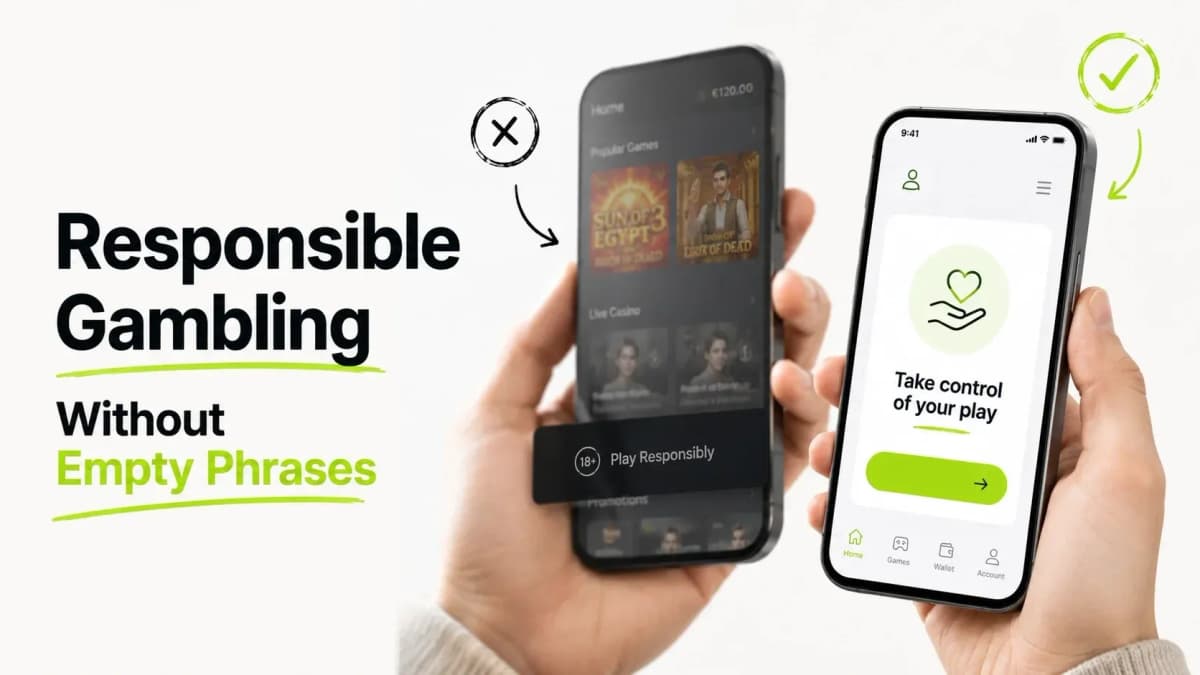
Most Responsible Gambling messages fail long before users even read them – not because of regulatory requirements, but due to poor timing, placement, and tone that disconnects from player behaviour when risk actually appears.
A study GambleAware conducted in 2025 found that safer gambling videos from operators sometimes gave off a "harmless fun" vibe, with this effect most pronounced among younger users and people already at risk. Industry data reveals a stark reality: uptake of responsible gambling resources remains critically low across jurisdictions.
The Numbers Behind RG Message Failure
5%
British Columbia gamblers at moderate-high risk using self-exclusion
0.8%
Active users setting deposit limits (1,600 of 200,000)
0.45%
Users choosing self-exclusion (900 total)
Research by Cohen, McCormick, and Davies in British Columbia found that only about 5% of gamblers at moderate-to-high risk signed up for the province's self-exclusion program. Australian operators report similarly dismal engagement rates, with one major operator revealing that just 1,600 out of 200,000 active users (around 0.8%) set a deposit limit, while only 900 users, or 0.45%, chose to self-exclude.
These statistics highlight a fundamental disconnect between regulatory compliance and actual player protection outcomes.
Important
Current responsible gambling messaging strategies are failing to reach users when they need intervention most, creating compliance theatre rather than meaningful harm prevention.
Did you know?
4,000 — Gamblers involved in Australian message effectiveness research
10 — Loss-focused messages tested in research study
99% — Of gamblers lose in the long run (most effective message)
Why Traditional Approaches Miss the Mark
Tone Determines Engagement More Than Wording
The most effective responsible gambling recommendations adopt a calm, respectful tone that focuses on control and enjoyment rather than fear-based messaging. Research indicates that supportive communication acknowledges gambling addiction possibilities without lecturing or making readers feel judged.
| Ineffective Approach | Supportive Alternative |
|---|---|
| "Gambling can be addictive. Please gamble responsibly." | "If gambling stops feeling like entertainment, there are tools that can help." |
| "Set your limits before you play." | "Deposit limits exist – they take 30 seconds to set and work immediately." |
| "Do not chase losses." | "A losing streak is a normal part of gambling. Chasing it rarely changes the outcome." |
"The goal is to give players accurate information at a useful moment, then leave the decision to them. Respect their intelligence."
— Olga Svichkar, We-Right Factory
Placement Problems Undermine Message Effectiveness
Consider a player experiencing a losing streak at midnight. Such a user will not navigate to the footer, locate the responsible gambling section, and review available tools. Risk intervention must meet players where problems actually emerge.
Effective placement strategies include:
- Pre-transaction warnings – Deposit limit recommendations before transactions, not after
- Session-based triggers – Reminders after one hour of continuous play, not buried in rarely-opened settings
- Behavioural alerts – Cooling-off messages when players attempt a third consecutive redeposit, not in newsletters two days later
Common Failure Patterns Across Platforms
Warning
Many responsible gambling systems create recurring communication problems that reduce message effectiveness and player engagement.
| Problem | Typical Implementation Failure |
|---|---|
| Generic wording | Users stop paying attention to repetitive messages |
| Poor timing | Recommendations appear too late to influence behaviour |
| Hidden placement | Players never notice available tools |
| Overly aggressive tone | Users emotionally disconnect from the message |
| Information overload | Messages become overwhelming and get ignored |
| Repetitive warnings | Players stop reacting after repeated exposure |
| No direct action | Users understand warnings but don't know next steps |
The Legal Disclaimer Problem
The biggest issue facing responsible gambling messaging is that many operators treat these communications like legal disclaimers rather than actual intervention tools. When wording feels repetitive, badly timed, or disconnected from player situations, even useful tools become easier to ignore.
Players always notice when responsible gambling content exists to cover liability rather than help them.
Evidence-Based Messaging Strategies
Research-Backed Message Effectiveness
Recent Australian research involving 4,000 gamblers rating 10 loss-focused messages revealed the most successful approach. The standout message was direct and factual: "99% of gamblers lose in the long run".
This finding supports research by Gainsbury, Abarbanel, Philander, and Butler, whose study indicated that effective responsible gambling messages should:
- Remind people what overspending leads to
- Keep expectations grounded about odds
- Make clear that outcomes don't favour players
- Use plain wording ("gamble" instead of "play") to maintain focus on risk
How to Design Effective RG Messages
Make Tools Visible, Not Risks
Point toward actions (set limits, take breaks) rather than describing consequences. Players understand gambling involves risk – they need easy paths to intervention tools.
Avoid Problem-Centric Framing
Messages beginning 'If you think you have a problem' filter out users who aren't ready to use that terminology about themselves. Alternative framing works better.
One Message, One Action
Responsible gambling notifications containing multiple links, phone numbers, and paragraphs ask too much during difficult moments. Clear single actions produce better responses.
Language Preference Research
Some gamblers specifically valued direct terminology that doesn't soften the reality of gambling through euphemistic language, preferring 'gamble' over 'play' to maintain focus on risk.
Three Core Principles for Effective Messaging
Example of improved messaging: "Deposit limits take 30 seconds to set and apply immediately. You can adjust them anytime in your account settings."
Alternative to problem-focused language: "If gambling feels less like entertainment and more like something you need to do, our self-exclusion tool is there."
Innovation in Responsible Gambling Communication
Cognitive Engagement Approaches
Revolutionary approaches are emerging in responsible gambling promotion. Flories Assies worked with Casino.nl to promote MyStride Positive Play, an instrument offering mini-games between sessions. By providing small games requiring thought, this approach activates the prefrontal cortex, affecting dopamine release patterns.
Integration Strategy
Innovative responsible gambling tools can integrate seamlessly into user experience rather than interrupting it, potentially improving both engagement and effectiveness through cognitive activation techniques.
Industry Implications and Path Forward
Current responsible gambling messaging approaches create a compliance paradox: operators meet regulatory requirements while failing to achieve meaningful harm prevention outcomes. This disconnect poses long-term risks for industry sustainability and player welfare.
The growing recognition of messaging effectiveness has prompted regulatory evolution across multiple jurisdictions. RGC Joins IGSA Committee to Shape Global Gaming Standards demonstrates how responsible gambling organizations are collaborating internationally to establish evidence-based frameworks. Similarly, EGBA calls for EU-wide crackdown on gambling fraud networks highlights industry efforts to address systemic issues that undermine consumer protection. The shift toward evidence-based, behaviourally-informed responsible gambling communication represents both a compliance opportunity and a competitive advantage for operators willing to invest in genuine player protection rather than checkbox exercises.
Future regulatory frameworks will likely emphasise outcome measurement over message placement, requiring operators to demonstrate actual intervention effectiveness rather than simply displaying warnings. Early adopters of research-backed approaches position themselves advantageously for this evolution.
The evidence suggests that responsible gambling messaging becomes genuinely protective when it feels like part of the user experience rather than a legal disclaimer. This transformation requires operators to view player protection as a core product feature rather than a regulatory obligation – a shift that benefits both business sustainability and player welfare outcomes.
No. Responsible gambling messages lose effectiveness when users see them too often. Fresh wording cuts through habituation – when messages feel new, people notice and remember them better.
The most important principle is non-exploitation. Gambling advertisements should never target vulnerable populations or suggest gambling can solve financial problems. It should remain what it is – entertainment.
Yes. Effective responsible gambling messaging should increase tool uptake, reduce session times during risk periods, and improve user feedback on helpfulness rather than just meeting compliance requirements.
According to We-Right Blog.