The volatility of sportsbook content presents unique challenges that traditional iGaming SEO strategies cannot address. While slot reviews and casino guides maintain relevance for years, match previews expire within days and tournament pages lose their entire audience the moment events conclude.
This fundamental difference between casino and sportsbook content creates structural tensions that most operators underestimate, leading to content strategies that fail to sustain organic traffic beyond peak sporting events.
The Fragile Nature of Sports Betting Audiences
Modern sports betting audiences demonstrate unprecedented mobility across platforms. Client loyalty remains fragile, with recent studies revealing that 43% of Gen Z bettors leave websites out of boredom, while 73% use multiple apps simultaneously. This behaviour pattern forces operators to maintain constant relevance or risk rapid audience migration.
43%
Gen Z bettors who abandon sites due to boredom
73%
Sports bettors using multiple platforms
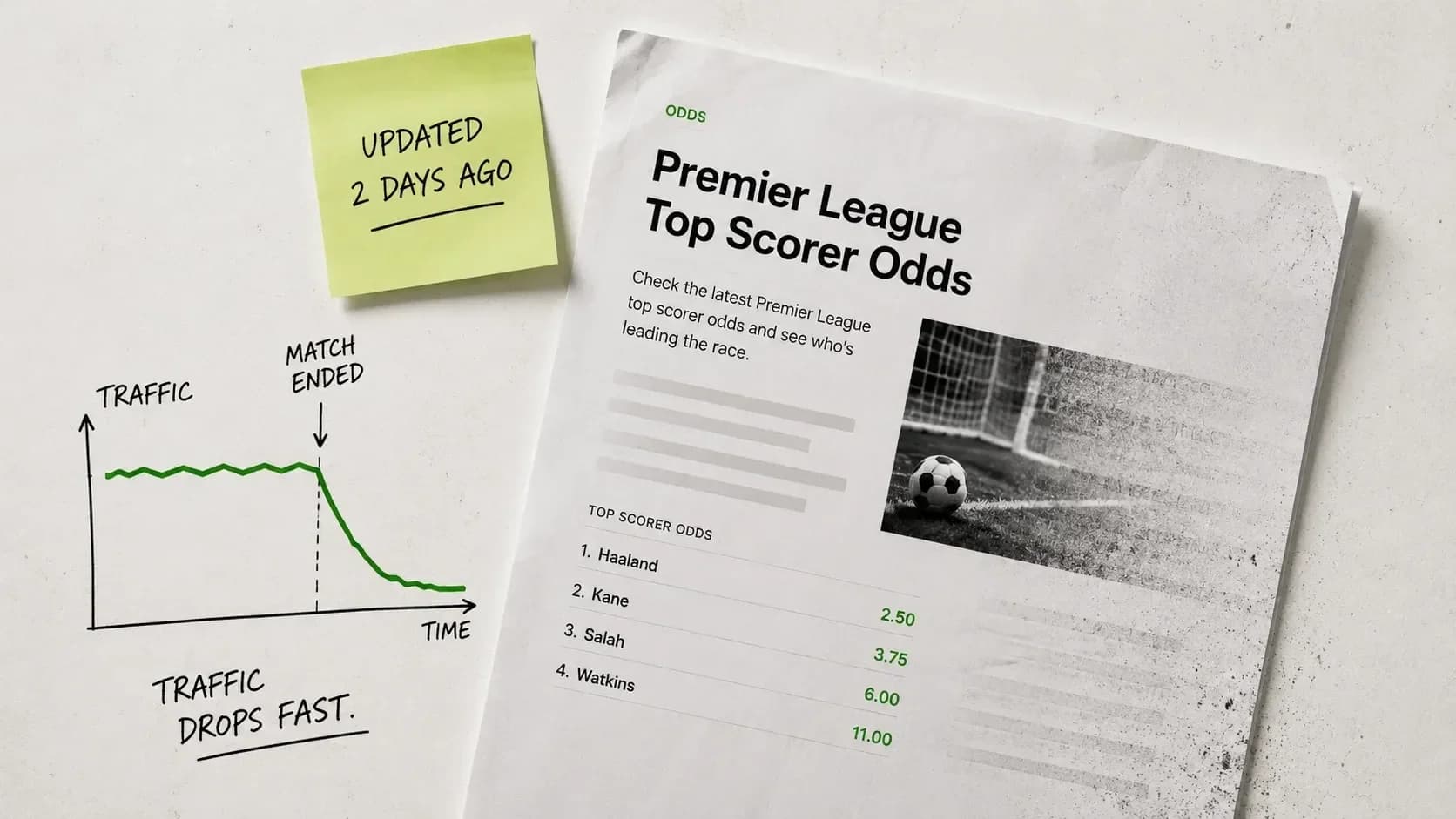
The challenge extends beyond user retention to content lifecycle management. Unlike casino content that ages gradually, sportsbook material faces abrupt relevance cliffs. A team generating 50,000 monthly searches during a Champions League campaign drops below 5,000 searches immediately following elimination.
This dramatic search volume volatility creates what industry analysts term "structural tension" – where high-traffic content commands the shortest validity periods and highest production costs. Event-specific content drives peak traffic but requires constant regeneration, whilst evergreen betting guides maintain longer rankings at significantly lower volume.
Content Lifespan Hierarchies
Different sportsbook content types decay at vastly different rates, requiring distinct maintenance strategies:
| Content Type | Ranking Lifespan | Update Frequency | Traffic Volume |
|---|---|---|---|
| Match previews | 1 – 7 days | Very high | Peak during events |
| Tournament odds | Seasonal | High | Event-dependent |
| Betting guides | Long-term | Low | Steady baseline |
| Live betting pages | Hours | Constant | Extreme volatility |
| Strategy articles | Evergreen | Medium | Consistent moderate |
| Team analysis | Medium-term | Moderate | Form-dependent |
The inverse relationship between traffic potential and content longevity represents the core challenge for sportsbook SEO teams. Those achieving sustainable rankings understand this trade-off and structure content production accordingly.
Important
The shorter the content lifespan, the more critical speed and update frequency become for maintaining search visibility.
When Search Intent Shifts Beneath Static Content
Search intent in sports betting moves independently of keyword stability. Pages optimised for specific queries can become completely misaligned with user expectations whilst maintaining identical rankings and terminology.
Consider Premier League top scorer odds as a keyword. In August, users seek pre-season predictions and long-term value bets. By March, the same search query targets current form analysis, injury updates, and final race dynamics. The keyword remains constant; the underlying intent transforms entirely.
Common Intent Misalignment Patterns
Research conducted across multiple operators reveals consistent patterns where content teams fail to recognise intent evolution:
Warning
- In-season odds pages referencing pre-season favourites after form reversals - Tournament previews remaining live post-event without results integration - Player prop pages citing injury-free records for sidelined athletes
This misalignment between static content and evolving search intent represents a primary factor in unexpected ranking drops. Algorithms increasingly reward pages that adapt to changing user expectations rather than maintaining historical optimisation.
Content Quality Deterioration Signs
Algorithm penalties now target pages with evergreen structures containing expired information. Sites maintaining static content while sporting realities change face ranking drops as search engines prioritize accuracy over historical authority signals.
The Evergreen Content Trap
Traditional evergreen strategies prove counterproductive when applied incorrectly to sportsbook content. Pages with evergreen titles and URL structures often contain information that expires rapidly, creating what search algorithms interpret as quality deterioration.
"The mistake is applying evergreen logic to content that only looks stable on the surface. A 'best bets for the Premier League season' page isn't evergreen – it has an evergreen structure containing information that expires with the first match."
— Olga Svichkar, We-Right Factory
Note
Google's freshness signals treat outdated information within evergreen frameworks as quality problems, regardless of URL age or backlink accumulation.
Sites building such pages once and applying minimal refreshes end up with URLs that accumulate authority signals whilst content accuracy decreases weekly. This approach fails because it misunderstands the relationship between page structure and content freshness requirements.
Speed Versus Depth: Strategic Layering
The traditional trade-off between publication speed and content depth creates false constraints for sportsbook teams. Successful operators implement layered content strategies that serve both immediate visibility and long-term authority building:
First Layer: Rapid Response Content
Quick posts, social updates, breaking news reactions. Maintains visibility during live events.
Second Layer: Authority Content
In-depth guides, analytical pieces, strategic content. Builds long-term domain authority and expert positioning.
This separation allows teams to maintain competitive speed on time-sensitive content whilst investing appropriate resources in authoritative pieces that compound over time.
In sportsbook SEO, relevance depends as much on page structure as content quality. The architecture itself determines whether updates happen quickly enough to maintain rankings.
Structural Approaches to Sustained Relevance
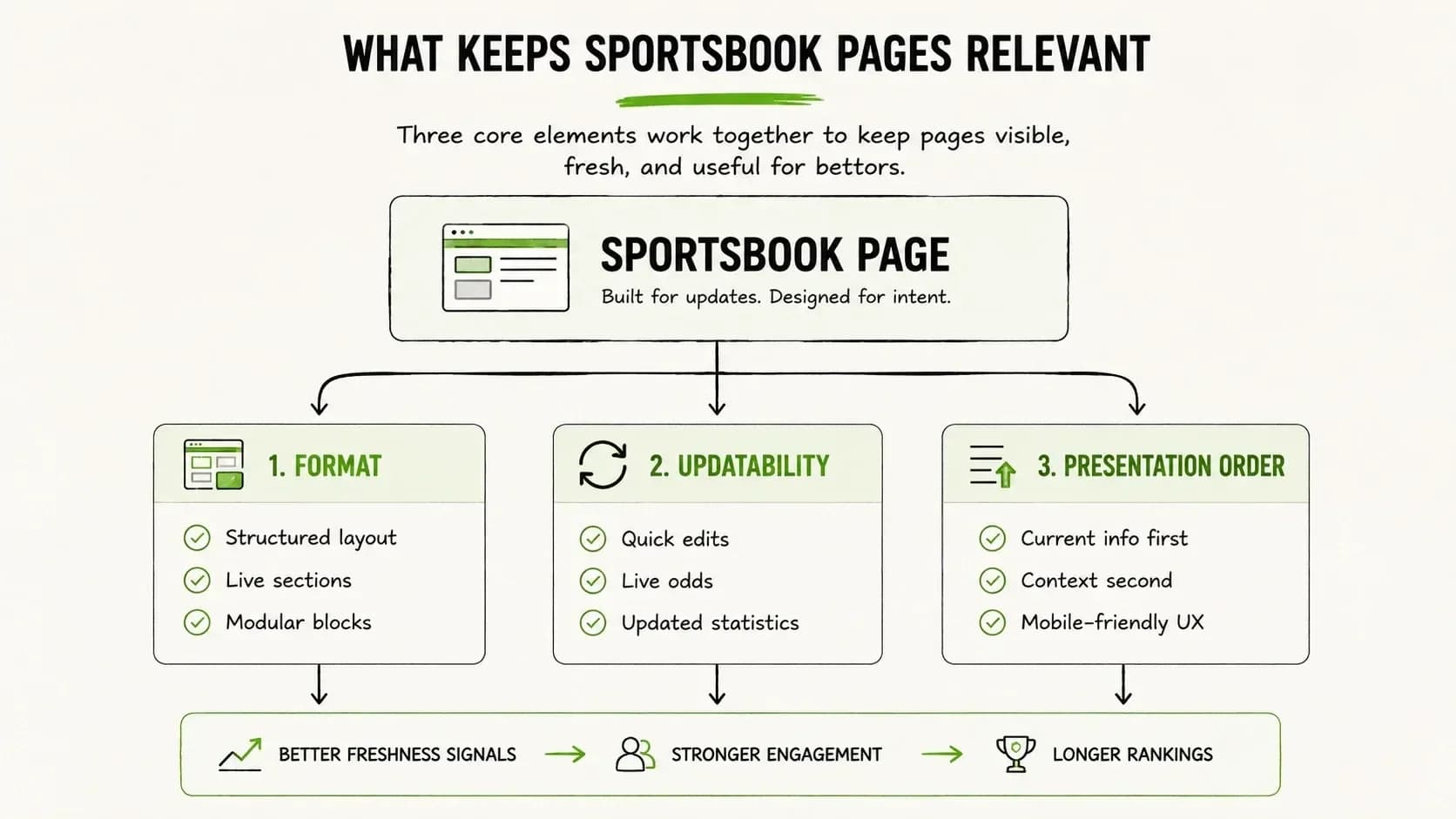
Pages that maintain rankings throughout sporting seasons share specific architectural characteristics that facilitate updates and preserve user utility. Three factors determine long-term content sustainability:
Format Design
Content built around fixed narratives lacks natural integration points for new information. Successful pages utilise structured formats – current standings, form tables, next match odds, analyst notes – that accommodate updates without requiring complete restructuring.
Modular Updatability
Mixing time-sensitive elements with stable content within single narrative blocks necessitates full rewrites for any modification. Separating these layers architecturally enables rapid updates that accumulate freshness signals rather than requiring complete content regeneration.
Information Hierarchy
Mid-season visitors prioritise current data: today's odds, latest injury reports, current league positions. Context and betting strategy serve secondary functions. Pages that front-load background information while burying live data present information contrary to user intent, regardless of content quality.
Content Architecture Best Practices
Implement template systems with designated zones for live data, historical context, and betting insights. This modular approach enables content teams to update critical information without restructuring entire pages, maintaining both freshness signals and user experience consistency.
Implementation Framework for Sustainable Rankings
Operators achieving year-round organic traffic success implement production systems that balance event-driven opportunities with foundational content development. This approach requires calendar-aware content strategies that adapt resource allocation based on sporting schedules and competitive intensity.
Did you know?
Build pillar pages with comprehensive topic coverage supported by real data. Combine evergreen foundational content with regular updates reflecting current trends in predictive modelling and risk management.
The most effective strategies avoid treating every content piece identically. Instead, they categorise content by purpose and maintenance requirements before production begins, not after publication.
Content Production Priorities
- Event-driven content: High-volume, short-term visibility focused on immediate traffic capture
- Foundational guides: Authority-building pieces designed for long-term compound growth
- Hybrid formats: Updatable frameworks combining stable information with dynamic elements
- Post-event analysis: Underutilised content type linking historical outcomes to future betting opportunities
Production System Requirements
Calendar-aware content strategies require automated alert systems tied to sporting schedules, injury reports, and market movements. Operators without these systems cannot compete effectively during peak betting periods when content freshness directly impacts search visibility.
Industry Implications and Strategic Outlook
The evolution of sportsbook content requirements in 2026 reflects broader changes in user behaviour and algorithmic sophistication. Operators must abandon one-size-fits-all content approaches in favour of nuanced strategies that acknowledge the fundamental differences between casino and sports betting content lifecycles.
This requires investment in both rapid-response content capabilities and long-term authority development – a dual approach that recognises the unique demands of sports betting audiences.
The competitive landscape increasingly favours operators with sophisticated content production systems capable of capturing event-driven traffic spikes whilst building foundational authority that sustains performance between major sporting events. Those clinging to traditional evergreen strategies without acknowledging sportsbook content volatility will find themselves progressively disadvantaged as algorithms become more sophisticated in assessing content freshness and relevance.
Betting guides covering stable concepts like Asian handicaps and odds movement analysis retain relevance for years. Tournament hubs maintain rankings throughout event duration when properly updated, whilst match previews typically fade within days.
Update frequency depends on underlying event volatility. Match-related pages may require daily updates, whilst foundational betting guides remain stable for extended periods. The key is matching update frequency to content type and user expectations.
Sportsbook content faces rapid relevance decay tied to sporting events and changing user intent. Traditional evergreen approaches assume content stability that doesn't exist in sports betting, leading to pages that appear stable but contain increasingly outdated information.
According to We-Right Blog.