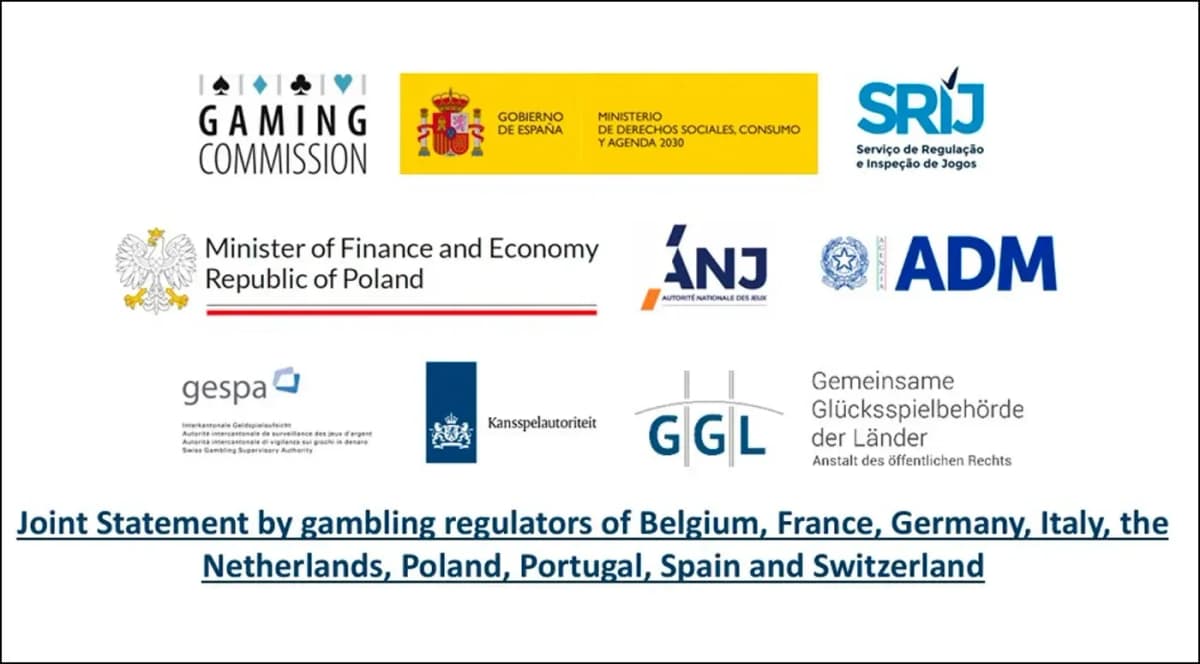
The FIFA World Cup 2026 has triggered an unusual show of regulatory solidarity across Europe. Nine gambling regulators — spanning Belgium, France, Germany, Italy, the Netherlands, Poland, Portugal, Spain, and Switzerland — have signed a joint declaration targeting the rapid expansion of prediction market platforms, citing addiction risks, identity verification failures, and the operation of multiple platforms without a licence.
For Spain's DGOJ (Dirección General de Ordenación del Juego), the declaration formalises an enforcement posture that is already in motion. The Ministerio de Derechos Sociales, Consumo y Agenda 2030 has confirmed that it will intensify oversight of online gambling throughout the tournament — a commitment that arrived shortly after Spain opened sanctioning procedures against Polymarket and Kalshi, both of which had their websites subject to precautionary blocking for operating in Spain without the required administrative authorisation.
A Coordinated Front, Not Just a Statement
Joint declarations from regulators are not uncommon. What makes this one notable is both its breadth — nine jurisdictions across Western and Central Europe — and its timing, coinciding with the opening of one of the highest-profile sporting events in the world. Major tournaments have historically been flashpoints for unlicensed betting activity, and regulators appear determined not to be caught flat-footed as prediction markets seek to capitalise on the heightened public interest.
The declaration does not merely register concern. It sets out a framework for reinforced cross-border cooperation: shared information, exchanged best practices, and coordinated enforcement action against platforms that fail to meet local licensing requirements. Critically, the signatories make clear this cooperation will outlast the tournament itself, describing the initiative as the foundation for permanent international coordination mechanisms.
What Regulators Say Is Wrong With Prediction Markets
The list below covers the nine jurisdictions that signed the declaration, including their EU membership and the regulatory authority involved in the initiative. This helps assess the coalition's geographic and institutional reach.
| Country | EU member | Regulatory context |
|---|---|---|
| Belgium | Yes | Declaration signatory |
| France | Yes | Declaration signatory |
| Germany | Yes | Declaration signatory |
| Italy | Yes | Declaration signatory |
| Netherlands | Yes | Declaration signatory |
| Poland | Yes | Declaration signatory |
| Portugal | Yes | Declaration signatory |
| Spain | Yes | DGOJ; has already introduced preventive blocking of Polymarket and Kalshi |
| Switzerland | No | Non-member state with its own licensing framework |
Which Countries Signed the Declaration
The nine signatories represent a broad cross-section of European gambling jurisdictions: Belgium, France, Germany, Italy, the Netherlands, Poland, Portugal, Spain, and Switzerland. This mix includes some of the EU's largest regulated gambling markets alongside Switzerland, which sits outside the EU but maintains its own robust licensing framework — underscoring that the coalition is defined by regulatory alignment rather than EU membership alone.
9
EU regulators who signed the joint declaration against prediction markets
2026
FIFA World Cup year that triggered the regulatory coordination
24/7
Operating hours of unregulated prediction market platforms, cited as a risk factor
The declaration identifies a cluster of structural features that, in the regulators' view, make unregulated prediction market platforms particularly hazardous. These platforms operate 24 hours a day with no downtime. They impose no effective spending limits and no caps on participation time. Identity and age verification mechanisms are described as minimal — a significant gap given the platforms' documented popularity among young adults.
The combination of these characteristics with the viral, social-media-native nature of many prediction market products is, according to the declaration, what creates a "significant addictive cycle."
Beyond addiction risk, the joint statement issues a direct warning on financial and legal exposure:
“As regulators, we play a key role in ensuring player protection throughout the tournament and in ensuring that prediction markets operate in accordance with the licensing and regulatory requirements of each jurisdiction.”
— Joint declaration signed by nine European regulatory organisms
“This type of platform entails serious risks of illegality, frozen funds, insider fraud and financial volatility.”
— Warning from the joint declaration
The insider fraud reference is pointed. Prediction markets aggregate real-money positions on outcomes that can be influenced by those with privileged access to information — in a sporting context, this could mean club officials, agents, or players themselves.
Warning
The joint declaration does not rely on a single concern — it identifies four distinct categories of harm: (1) addiction risk driven by 24/7 access and no spending or time limits; (2) identity and age verification failures, with particular concern about young adult uptake; (3) insider fraud enabled by the real-money, outcome-based structure of prediction markets; and (4) financial volatility and the risk of frozen user funds. Platforms that address only one of these categories should not expect regulatory tolerance on the others.
A Direct Warning to Sport's Commercial Ecosystem
One of the more striking passages in the declaration is addressed not to bettors, but to the sport industry. Federations, leagues, clubs, and professional teams are explicitly told to verify the legal status of any prediction market platform before entering commercial or sponsorship agreements.
Several prediction market platforms have been actively expanding their presence in international sport, making this regulatory warning directly relevant to sponsorship and commercial teams across professional football.
The timing is deliberate. Several prediction market platforms have been increasing their visibility in sport through branding partnerships, and the World Cup presents an obvious opportunity to accelerate that strategy. Regulators appear to be drawing a line before those relationships become entrenched.
Due Diligence Checklist for Sports Commercial Teams
The declaration creates immediate practical obligations for any federation, league, or club reviewing prediction market sponsorship proposals. Before signing, commercial teams should confirm: (1) whether the platform holds a valid licence in each jurisdiction where club content will be broadcast; (2) whether the platform's age and identity verification meets local regulatory standards; and (3) whether legal counsel has reviewed the jurisdictional compliance status — not just in the club's home market, but across the tournament's broadcast footprint. The source does not specify what penalties federations themselves could face, but reputational and contractual exposure is implicit in the regulators' direct address to the sport industry.
Spain's Prior Enforcement Sets the Tone
Spain's actions against Polymarket and Kalshi give the declaration concrete teeth in at least one jurisdiction. The precautionary web blocking — ordered for operating without administrative authorisation — signals that the DGOJ is prepared to act quickly and publicly against platforms it deems non-compliant, without waiting for lengthy sanction processes to conclude.
This is relevant context for operators and affiliates active in Spain. The regulatory posture suggests a low tolerance for grey-area operations, particularly those that might argue their product falls outside traditional gambling definitions. Spain's comprehensive gambling law reform — currently under public consultation — signals that this tightening of definitions is part of a broader legislative agenda, not simply a tournament-specific measure.
Precautionary Blocking vs. Full Sanction: A Key Distinction
Spain's action against Polymarket and Kalshi used precautionary web blocking — a faster enforcement tool that does not require a full sanctioning procedure to conclude. This is a meaningful procedural choice: it signals the DGOJ is prioritising speed of impact over process completeness, which is consistent with the tournament timeline. Operators and affiliates in Spain should treat a precautionary block as a serious enforcement signal, not a temporary measure pending a lenient outcome.
What This Means for Operators and the Market
The joint declaration raises several questions that compliance teams and product strategists at licensed operators should be tracking.
Regulatory arbitrage is narrowing. With nine jurisdictions now coordinating explicitly on prediction markets, the window for platforms to operate freely across European markets while claiming they are not subject to gambling regulation is shrinking. The declaration signals that regulators intend to close definitional gaps, not wait for legislatures to act.
Sport partnerships carry new compliance risk. The direct warning to federations and clubs means that commercial teams at those organisations will face internal pressure to conduct legal due diligence on prediction market sponsors. For platforms seeking sports deals as a growth channel, this creates friction at exactly the moment they were gaining traction.
The cooperation framework matters beyond the World Cup. The signatories explicitly commit to maintaining and deepening cross-border coordination after the tournament ends. This is not a one-off response to a sporting event — it is the construction of a standing multilateral mechanism. For the prediction market sector, that is a more durable constraint than any single national enforcement action. The Copenhagen Group's roadmap against illegal gambling — adopted just weeks earlier — provides additional institutional context for how European regulators are building these standing coordination structures.
Licensed operators in regulated European markets may ultimately find this development works in their favour. If the enforcement net tightens around unlicensed competitors who currently attract users without meeting consumer protection obligations, the competitive landscape shifts — though only if enforcement is sustained beyond the tournament's final whistle.
The declaration is aimed primarily at unlicensed prediction platforms, but regulators also state an intention to close "definitional gaps." Licensed operators whose products show prediction-market characteristics, such as no spending limits or 24/7 availability, may face additional regulatory scrutiny. The source does not specify concrete compliance thresholds for licensed products.
The signatories explicitly commit to maintaining and deepening cross-border coordination after the tournament, meaning this is not a one-off measure but an institutional framework. For prediction platforms, this means regulatory pressure will not ease after World Cup 2026, while opportunities for jurisdictional arbitrage will continue to narrow.
The declaration does not prohibit prediction markets as a product class; it requires compliance with local licensing and regulatory requirements in each jurisdiction. However, the source does not disclose whether these jurisdictions have clear licensing routes for prediction platforms or whether their laws even recognize this product type; this is a key question operators should clarify before entering the market.
The declaration is addressed directly to platforms, but enforcement logic in most signatory jurisdictions also extends to those facilitating unlicensed activity. The Spanish precedent of preventive blocking of Polymarket and Kalshi shows regulators are prepared to act quickly. Affiliates active in these markets should consult legal advisers on the relevant risk; the source does not cover this aspect in detail.
The article does not set specific metrics or reporting mechanisms for assessing the coalition's effectiveness. Operators and compliance teams should track the frequency of joint enforcement actions after World Cup 2026, formal adoption of new regulatory definitions for prediction markets, and the emergence of joint regulatory reports in the nine jurisdictions as indicators of whether the declaration has become a real operating structure.
According to AzarPlus.