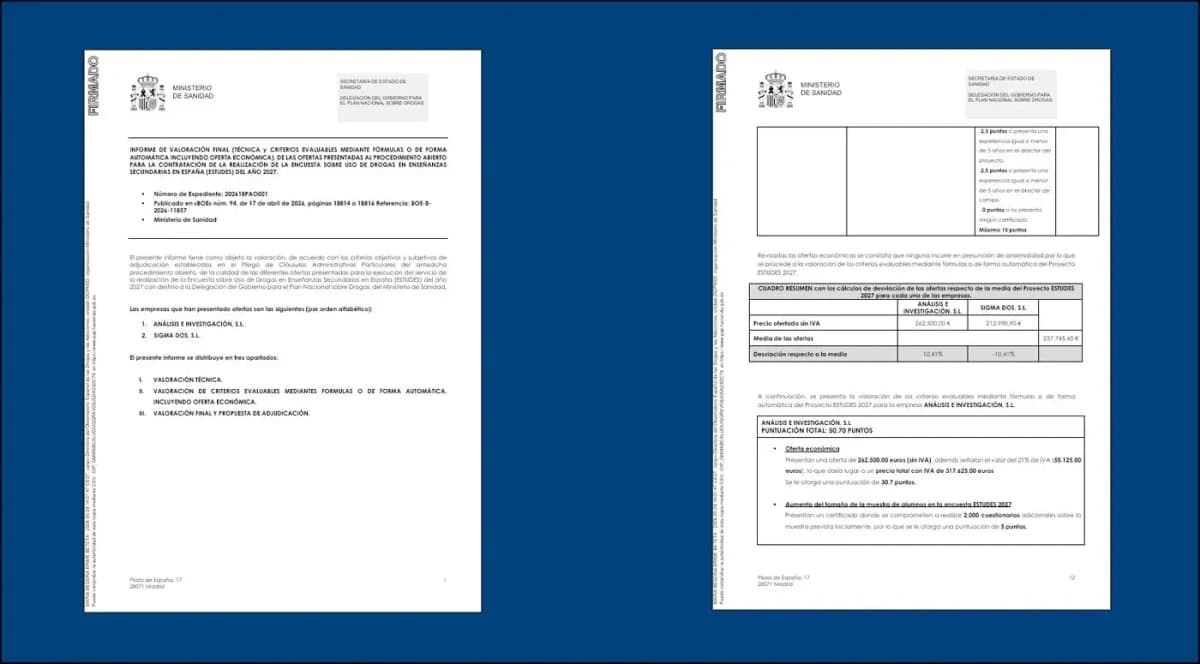
Spain's Ministry of Health has formally initiated preparations for the 2027 edition of the Survey on Drug Use in Secondary Education in Spain (ESTUDES), awarding the contract to Análisis e Investigación, S.L. after a competitive bidding process in which the company significantly outperformed its rival.
Following the tender procedure, the contracting board proposed Análisis e Investigación as the successful bidder, with the company demonstrating markedly superior technical competence compared to competitor Sigma Dos, S.L.
Technical Excellence Secures Victory
The final assessment report, issued by the Observatorio Español de las Drogas y las Adicciones, awarded the winning company an impressive technical score of 39 out of 40 points, while Sigma Dos achieved only 20 points. The evaluation highlighted the proposal's qualities, noting the following:
“Solid knowledge and management of survey implementation”
— Assessment Report
The winning proposal also demonstrated:
“Great precision and practical applicability”
— Assessment Report
This marks a repeat assignment for Análisis e Investigación, which will once again handle data collection for both ESTUDES and EDADES surveys. The accepted budget for the project totals €317,625.
Contract Evaluation Methodology
Spanish public procurement requires technical and economic evaluation phases. The Observatorio Español de las Drogas y las Adicciones used a 40-point technical scoring system, with proposals evaluated on survey implementation expertise, practical applicability, and methodological soundness before economic proposals are considered.
Enhanced Survey Methodology
The 2027 proposal introduces a new digital methodology and commits to expanding the base sample by 2,000 additional questionnaires, bringing the total to 22,000 surveys targeting students aged 14 to 18 years.
Gambling Prevalence Context
Historical ESTUDES data reveals significant patterns in youth gambling behaviour. Among those who gamble in-person, SELAE lotteries show a 99% prevalence rate, while ONCE scratch cards reach 30.9%. Notably, 31.8% of minors report consuming state lottery products.
Despite problematic gambling among adults declining by 46% over the past six years to 1.4%, official reports typically underemphasise the state's dominant position as Spain's primary gambling operator.
Regulatory Implications for Operators
The 2027 ESTUDES findings will likely influence future gambling policy directions, particularly given the survey's historical role in shaping restrictive measures. The continued focus on youth gambling data collection raises questions about whether public gambling operations will receive proportionate scrutiny compared to private operators, especially given the state's dual role as both regulator and dominant market participant through its lottery monopolies.
The addition of 2,000 questionnaires represents roughly a 10% increase in sample size, which typically improves statistical confidence intervals and allows for more granular demographic analysis. However, the article does not specify the methodology for sample distribution across Spain's autonomous communities.
Given that ESTUDES findings have historically influenced restrictive gambling measures, private operators should anticipate potential policy changes following the 2027 results. The survey's focus on youth gambling behavior suggests continued regulatory scrutiny of marketing practices and age verification systems.
The introduction of digital survey methods may create methodological discontinuities that could impact trend analysis. The source does not detail how Análisis e Investigación plans to maintain data consistency with historical paper-based or previous digital approaches used in earlier ESTUDES editions.
According to AzarPlus.