What the Advisory Body Actually Decided
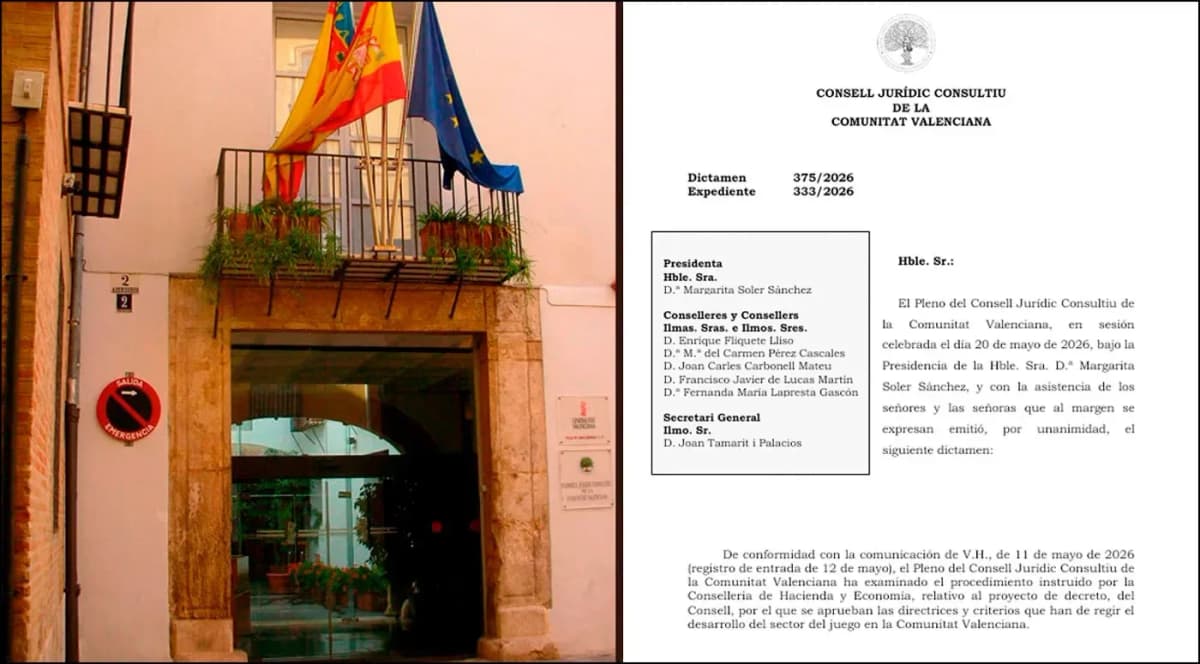
The opinion is narrow in scope. The Consell Jurídic Consultiu assessed legal conformity — not economic impact, competitiveness, or the appropriateness of the measures from a business perspective. Its only objections concerned legislative drafting technique: reordering certain provisions, repositioning some articles, improving the naming of several clauses, and reducing repetitive normative references throughout the text. None of these observations touch the substance of the restrictions.
On procedural grounds, the body found that the decree's preparation met all statutory requirements, noting the completion of prior public consultation, a public hearing, impact assessments, an economic memorandum, a favourable report from the Gaming Commission, and a legal opinion from the Generalitat General Counsel.
From Temporary Moratorium to Permanent Valencian Gaming Policy
What the Consell Jurídic Consultiu Actually Reviews
The Valencian Legal Advisory Body (Consell Jurídic Consultiu de la Comunitat Valenciana) is a statutory advisory body whose mandate is strictly limited to assessing whether a proposed regulatory text conforms to existing law. It does not evaluate market impact, proportionality of economic consequences, or whether a policy is good or bad for industry — only whether it is legally permissible. This distinction is critical for operators trying to interpret the weight of its endorsement.
The backstory matters here. Law 1/2020 established a five-year moratorium on new authorisations for gaming establishments and recreational machines — conceived as a transitional measure while the Generalitat conducted a study on the sector's social impact. Following an extension approved in 2025, that moratorium period was set to expire on 15 June 2026. Without a new decree, the temporary restrictions would have simply lapsed.
Instead of treating the moratorium's end as an opportunity to reassess market access, the Generalitat has used the moment to institutionalise the restrictions. The decree transforms provisional limitations into permanent planning instruments. The Consell Jurídic Consultiu accepted the Generalitat's justification — centred on public health, problem gambling prevalence, and exposure reduction — as sufficient grounds to maintain and consolidate those limitations. Valencia's approach mirrors the broader trend of Spanish regional gaming regulators converting transitional measures into structural policy, as seen when Valencia opened a 15-day consultation on new gaming room rules earlier in the same regulatory cycle.
2020
Year Ley 1/2020 established the original five-year moratorium
5 years
Duration of the original moratorium on new gaming authorisations
15 June 2026
Scheduled expiry date of the moratorium before the decree intervened
5 years
Minimum interval between mandatory sector reviews under the new decree
What the Valencian Decree Prohibits
The operational consequences are concrete and far-reaching for any operator with interests in the Valencian physical gaming market. The restrictions below cover every major category of land-based gaming activity in the region.
- Type B machines in hospitality venues: no new authorisations will be granted, except in narrowly defined circumstances
- New gaming salons and betting-specific venues: openings are only permitted when they replace an already-existing establishment — not as net additions to the market
- New bingo halls: likewise restricted to relocations of existing licensed venues
In practice, the market is frozen. Organic growth in the physical gaming sector is structurally blocked. The decree also provides that the Generalitat will commission a new sector review at least every five years, but the advisory body's endorsement locks in the current restrictive framework as the regulatory default until any such review produces a different outcome.
The table below maps each category of physical gaming activity covered by the decree to the specific restriction applied, giving operators a quick reference for compliance planning in the Valencian market.
| Gaming Activity | Restriction Applied | Exception Permitted |
|---|---|---|
| Type B machines in hospitality venues | No new authorisations | Narrowly defined circumstances only |
| Gaming salons | No net new openings | Replacement of existing licensed venue only |
| Betting-specific venues | No net new openings | Replacement of existing licensed venue only |
| Bingo halls | No net new openings | Relocation of existing licensed venue only |
These restrictions place Valencia among the most constrained physical gaming markets in Spain, with no pathway for net market growth under the current framework.
The Gap the Opinion Does Not Fill
One of the more striking aspects of the Consell Jurídic Consultiu's opinion is what it chooses not to examine. The decree's own file leans heavily on public health rationale and problem gambling data, but contains — by the advisory body's own implicit acknowledgment — minimal analysis of the economic impact on a legal, regulated industry. The study underpinning the entire planning framework is accepted at face value. Its methodology and conclusions are not independently interrogated.
This matters because the restrictions are no longer transitional. When a moratorium becomes policy, the evidentiary bar for justifying continued market closure arguably rises. The advisory body's mandate, however, does not extend to that question. Spain's national legislature has faced similar scrutiny over evidentiary standards in gaming policy, as illustrated by the recent parliamentary clash over gambling survey methodology at the national level.
Warning
Because the advisory body accepted the social impact study underpinning the decree at face value — without independently scrutinising its methodology or conclusions — operators pursuing future regulatory challenges will need to directly contest that evidence base rather than the procedural record. The decree's transition from temporary to permanent status arguably raises the justificatory standard, yet no independent body has yet applied that higher bar. Compliance and government affairs teams should begin building a counter-evidence dossier now, ahead of the first mandatory five-year review.
Strategic Implications for Operators
The unanimous clearance leaves the Valencian gaming decree in a strong legal position. Operators considering a regulatory challenge now face a higher hurdle: the body tasked with reviewing the text found it sound, and the procedural record is clean.
What remains unresolved is whether the five-yearly review mechanism will function as a genuine reassessment tool or simply as a periodic reaffirmation of the status quo. The decree's own logic — building on a social impact study that the advisory body did not scrutinise — suggests the latter is the more likely outcome unless the sector can generate compelling counter-evidence before the next scheduled review. For compliance teams and government affairs managers tracking Spanish regional gaming regulation, Valencia now represents one of the most restrictive physical gaming frameworks on the peninsula, and the Consell Jurídic Consultiu's endorsement makes near-term reversal through administrative channels look significantly less likely.
No. Under the decree, new gaming salons and betting-specific venues are only permitted when they replace an already-licensed establishment — net additions to the market are structurally blocked. The same replacement-only rule applies to new bingo halls, making organic physical market expansion effectively impossible under the current framework.
The article flags this as an open question, noting that the decree's own logic — built on a social impact study that was not independently scrutinised — suggests periodic reviews are more likely to reaffirm the status quo than to reopen the market. Operators seeking liberalisation would need to generate compelling counter-evidence before the next scheduled review; the source does not disclose what evidentiary threshold the Generalitat would require to alter course.
The unanimous clearance and procedurally clean record raise the hurdle for any administrative challenge considerably. Any litigation strategy would likely need to target the adequacy of the underlying social impact study — specifically its methodology and the absence of meaningful economic impact analysis — rather than procedural defects, since the advisory body found none. Operators should consult specialist Spanish administrative law counsel before committing to a challenge route.
According to AzarPlus.