
Baccarat rules require players to bet on which of two hands – Player or Banker – will total closer to nine, with cards scored by value and a strict, automatic drawing system deciding whether either hand receives a third card. The key thing to understand when learning how to play baccarat is that no skill or decision-making happens once the bet is placed – every action after that point follows a fixed set of rules the dealer executes automatically.
This guide explains how baccarat works purely for informational purposes. It is not a strategy for beating the house edge, and no betting system changes the fixed odds built into every hand. Understanding baccarat rules helps you play the game correctly, but it does not eliminate the house edge or turn baccarat into a skill-based game.
Baccarat has a reputation as an elegant, high-stakes game reserved for James Bond films and VIP rooms, and that reputation is not entirely undeserved – the game has genuinely deep roots at high-limit tables in casinos from Las Vegas to Macau. What surprises most new players is how little there actually is to learn. Once you understand card values and the automatic third-card rule, you understand the core of how to play baccarat.
This guide covers baccarat rules in full: scoring, the drawing system, every bet on the table, house edge by bet type, and the variants you will actually encounter at a casino or online.
What Is Baccarat?
Baccarat is a card-comparing game where two hands – called Player and Banker – are dealt and compared. The bettor wagers on which hand will finish closer to a total of nine, or whether the two hands will tie. This is the first thing to understand when learning how to play baccarat: you are not trying to build your own hand – you are betting on the outcome between two fixed hands.
The "Player" and "Banker" labels do not refer to you or the casino specifically. They are simply the names of the two hands being played out, and you can bet on either one regardless of who is dealing. This distinction trips up a lot of new players: betting on "Banker" does not mean betting on the house, and betting on "Player" does not mean you are personally holding the cards.
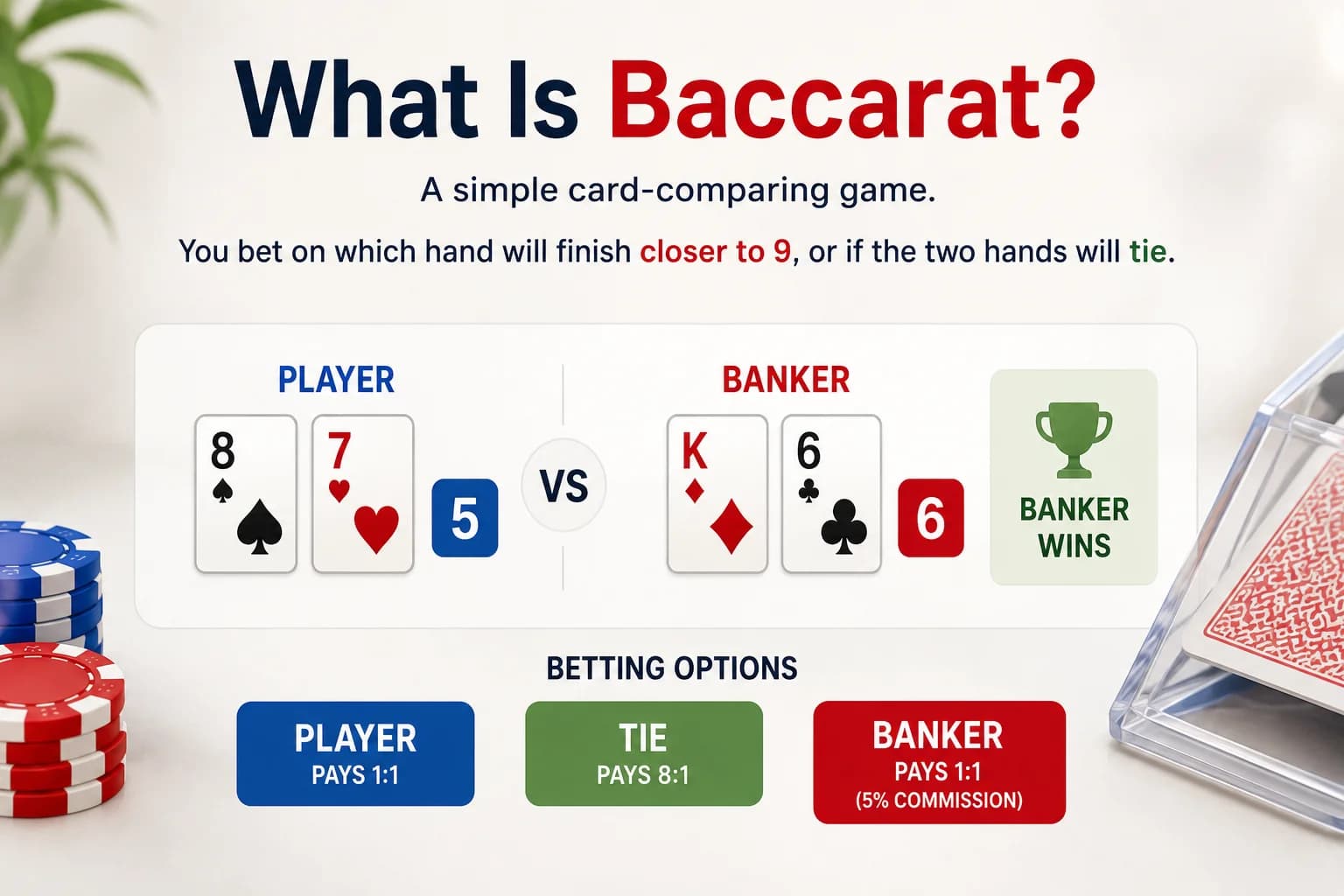
Both hands are dealt the same way, and the dealer manages them according to a fixed set of rules. Under standard baccarat rules, your only real decision is where to place your bet before the cards are dealt – Player, Banker, or Tie. After that, the scoring and drawing process happens automatically, which is why the rules of baccarat are much simpler than they look at first.
Baccarat Card Values Explained
In baccarat, cards two through nine are worth their face value, tens and face cards (10, J, Q, K) are worth zero, and aces are worth one.
That scoring system is what makes baccarat's core objective – getting as close to nine as possible – genuinely different from a game like blackjack, where high-value face cards help you. In baccarat, landing a ten or a face card contributes nothing to your hand's total. When a hand's two (or three) cards add up to more than nine, only the second digit of that total counts – this is called "dropping the ten." A hand of 8 and 7, for instance, totals 15 on paper, but counts as 5 once the ten is dropped.
| Card | Value |
|---|---|
| Ace | 1 |
| 2–9 | Face value |
| 10, Jack, Queen, King | 0 |
The practical takeaway from that table is simple: the highest possible baccarat hand is a natural 9, formed by any two cards totaling nine without needing a third card, and the lowest is a hand totaling zero, sometimes called a "baccarat" – which is where the game gets its name.
How to Play Baccarat: Step-by-Step
Playing baccarat means placing a bet on Player, Banker, or Tie before the cards are dealt, watching the dealer deal two cards to each hand, and then, if the drawing rules require it, watching a third card get dealt automatically to one or both hands.
Here's exactly how a hand unfolds at the table, whether you're playing live in Las Vegas or at an online casino.
- Place your bet. Before any cards are dealt, decide whether you're backing Player, Banker, or a Tie, and place your chips in the corresponding betting area.
- Two cards are dealt to each hand. The dealer deals two cards to the Player position and two to the Banker position, typically from a shoe holding multiple decks.
- Both hands are scored. The dealer totals each hand using standard baccarat card values, dropping the first digit if the total exceeds nine.
- The drawing rules are applied automatically. Depending on each hand's two-card total, a third card may be dealt to Player, Banker, both, or neither – this follows a fixed table, not a decision by the dealer or players.
- The winning hand is announced and bets are settled. Whichever hand finishes closer to nine wins; if both hands tie, Tie bets pay out and Player/Banker bets push (unless you've backed the losing side, in which case they lose).
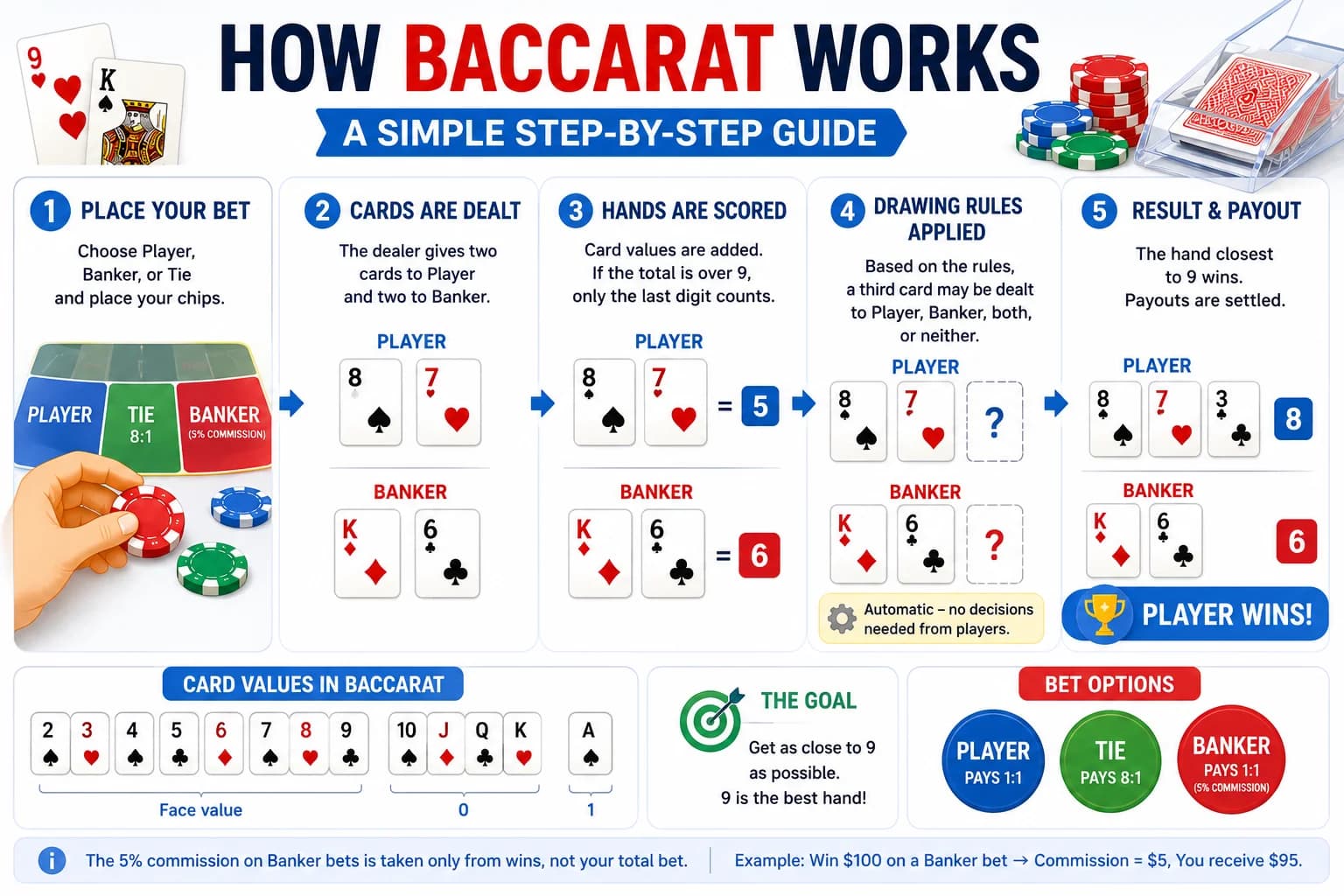
None of these steps require any input from the player beyond the initial bet – this is precisely why baccarat is often recommended as one of the easiest table games to learn, even though the drawing rules underneath look complicated at first glance.
The Baccarat Drawing Rules (Third Card Rule)
A hand totaling eight or nine on its first two cards is called a "natural" and automatically stands with no third card. Under standard baccarat rules, a Player hand totaling zero through five draws a third card, while a Player hand of six or seven stands. The Banker’s third-card decision is more complex because it depends on both the Banker’s own total and what the Player’s third card was.
This is the part of how to play baccarat that looks intimidating on paper but never actually requires you to make a decision. The dealer follows the drawing table exactly, every single time, with no discretion involved. Casinos including The Venetian in Las Vegas print this rule set directly at the table for reference, since even experienced dealers rely on it rather than memory alone.
| Player's First Two Cards Total | Action |
|---|---|
| 0–5 | Draws a third card |
| 6–7 | Stands |
| 8–9 | Natural – stands automatically |
The Player-side table is the easiest part of the third-card rule to remember: low totals draw, medium totals stand, and naturals stop the hand immediately. In practical terms, these baccarat rules mean the Player hand is resolved first, and only then does the Banker hand react according to a more detailed rule table.
That Banker table is the part most beginners worry about when learning how to play baccarat, but the key point stays the same: you do not choose whether the Banker draws. The dealer applies the rule automatically based on the Banker’s total and, when relevant, the Player’s third card.
| Banker's First Two Cards Total | Draws When Player's Third Card Is | Stands When Player's Third Card Is |
|---|---|---|
| 0–2 | Always draws | – |
| 3 | 1–2–3–4–5–6–7–9–0 | 8 |
| 4 | 2–3–4–5–6–7 | 1–8–9–0 |
| 5 | 4–5–6–7 | 1–2–3–8–9–0 |
| 6 | 6–7 | 1–2–3–4–5–8–9–0 |
| 7 | Always stands | – |
| 8–9 | Natural – stands automatically | – |
The pattern worth noticing across both tables is simple: the lower a hand’s total, the more likely it is to draw, and a natural eight or nine always ends the hand immediately regardless of what the other side has. These baccarat rules may look detailed at first, but they are fully automatic in real play. If both hands have naturals, no third cards are dealt to either side, and the higher natural wins outright.
Baccarat Bets and Payouts
The three core baccarat bets are Player (pays 1:1), Banker (pays 1:1 minus a 5% commission), and Tie (commonly pays 8:1 or 9:1), with several casinos also offering side bets like Pairs and Tiger bets for higher, less frequent payouts.
Understanding what each bet actually pays – and why the payouts differ – is genuinely more useful than any baccarat "system," since the payout structure is where the game's real math lives.
| Bet | Typical Payout | Approximate House Edge |
|---|---|---|
| Banker | 1:1 (minus 5% commission) | ~1.06% |
| Player | 1:1 | ~1.24% |
| Tie | 8:1 or 9:1 (varies by casino) | ~14.4% |
| Pairs | 11:1 or 12:1 (varies by casino) | ~10%+ |
That house edge column is the real story of this ALT – the Banker bet is mathematically the strongest wager on the layout, specifically because the 5% commission still leaves it ahead of the Player bet once the math is worked out fully. The Tie bet's payout looks tempting, but its house edge is dramatically higher than either main bet, which is why most serious baccarat guides – and dealers themselves, if you ask – steer newer players away from it.
A few additional side bets show up at specific casinos, including higher-variance options like Small Tiger, Big Tiger, and Tiger Pair, each tied to specific Banker-hand outcomes and paying considerably more than the core three bets – with a correspondingly higher house edge to match.
Why Does the Banker Bet Have a Commission?
The Banker bet carries a 5% commission specifically because it wins more often than the Player bet over the long run, and the commission exists to bring its payout back in line with a fair house edge rather than giving Banker bettors an unfair mathematical advantage.

Without that commission, the Banker bet's built-in statistical edge over Player would make it a bet no casino could profitably offer. The 5% commission is deducted only from winning Banker bets, not from your total wager, and most casinos – physical and online – keep a running tally of commission owed rather than deducting it after every single hand.
Baccarat House Edge Explained
Baccarat's house edge is among the lowest of any casino table game, sitting at roughly 1.06% on Banker bets and 1.24% on Player bets, though the Tie bet's house edge climbs dramatically higher to around 14.4%.
For comparison, that Banker-bet house edge is competitive with blackjack under optimal play and considerably better than most slot machines or the majority of roulette bets. This low house edge, combined with genuinely simple gameplay, is a big part of why baccarat remains a fixture at high-limit tables in major casino markets – the math rewards patient, high-volume play better than most other table games available.
Common Baccarat Variants
The most common baccarat variants are Punto Banco (the standard version played in most casinos), Mini-Baccarat (a smaller, faster table with the same rules), Chemin de Fer (a European variant giving players more decision-making power), and No Commission Baccarat (which removes the Banker commission but reduces the payout on a winning six).
- Punto Banco is the version described throughout this guide and the one you'll encounter at the vast majority of casinos, both physical and online – it's dealt entirely by fixed rules with no player decisions after the bet is placed.
- Mini-Baccarat uses identical rules to Punto Banco but at a smaller table with lower stakes and a faster pace, typically dealt entirely by the dealer.
- Chemin de Fer, more common in European casinos, gives the Player position genuine discretion over whether to draw a third card, making it a meaningfully different game from the automatic-drawing versions covered above.
- No Commission Baccarat removes the standard 5% Banker commission entirely, but pays only half the normal amount (typically 0.5:1 instead of 1:1) on a winning Banker hand that totals exactly six – a trade-off that shifts, rather than removes, the house's edge.
None of these variants change the core scoring system or card values – the differences sit entirely in the drawing rules, commission structure, or table format, which is worth confirming before sitting down, since the payout math genuinely differs between versions.
Baccarat Strategy: What Actually Works (and What Doesn't)
The only baccarat "strategy" with any real mathematical basis is choosing the Banker bet for its lower house edge. Popular betting systems like Martingale or Paroli may change how much you wager, but they do not change your actual odds of winning any individual hand. That’s one of the most important things to understand when learning how to play baccarat correctly: the game is driven by fixed math, not by player decisions after the bet is placed.
A few honest points worth knowing before you sit down:
- The Banker bet is mathematically the strongest option on the table. At roughly 1.06% house edge, it is the closest thing to a genuine "best bet" in baccarat. This does not mean Banker wins every hand, but under standard baccarat rules, it gives the strongest long-term percentage among the core bets.
- The Tie bet's high payout doesn't offset its much larger house edge. At around 14.4%, the Tie bet is one of the worst-value bets in the entire casino, regardless of how attractive the payout looks. For anyone trying to understand how to play baccarat from a numbers-first perspective, this is one of the clearest mistakes to avoid.
- Progressive betting systems do not change the underlying odds. Martingale, Paroli, and similar systems adjust your bet size after wins or losses, but they do not make the next hand more likely to win. Doubling your bet after a loss, or increasing it after a win, changes your bankroll risk – not the actual probability built into the game.
- Card counting doesn't work the way it does in blackjack. Because baccarat’s drawing rules are entirely automatic and do not depend on player decisions, tracking the shoe provides far less of an edge than it does in blackjack. This is another reason why understanding baccarat rules matters more than trying to apply strategies from other card games.
The honest summary here is simple: baccarat rewards understanding the math more than it rewards any "system." Betting Banker consistently, avoiding the Tie bet, and treating any progressive betting pattern as a bankroll-management tool rather than a way to beat the house is about as close to a real strategy as this game offers. Under standard baccarat rules, the smartest approach is not to look for control where none exists, but to understand which bets carry the lowest house edge.
A note on responsible play: baccarat's low house edge makes it one of the better-value table games available, but it's still a game of chance with a built-in edge for the house on every bet. No system, including the ones described above, guarantees a profit over time.
Final Word on Baccarat Rules
Baccarat earns its reputation as one of the simplest table games in the casino precisely because there's nothing to decide once your chips are down. Learn the card values, understand that eight and nine are naturals, and trust the drawing table to handle the rest – that's genuinely the entire game. Whether you're sitting down at a Las Vegas table or opening a live dealer table online, the rules covered in this guide are the same ones printed at every legitimate baccarat table in the world, and knowing them well is the only real preparation the game requires.
FAQ: Baccarat Rules
Bettors wager on whether the Player hand, the Banker hand, or a tie between them will finish closer to a total of nine, with card values and an automatic drawing system determining the outcome.
Add the values of the cards in each hand – aces count as one, cards two through nine count at face value, and tens and face cards count as zero – dropping the first digit if the total exceeds nine.
A natural is a two-card hand totaling eight or nine, which wins automatically and immediately without either hand drawing a third card, unless both hands are naturals of equal value, which results in a tie.
The Banker bet wins slightly more often than the Player bet over time, so a standard 5% commission on winning Banker bets brings its payout back in line with a fair house edge.
The Banker bet carries the lowest house edge at approximately 1.06%, making it mathematically the strongest standard bet on the table, ahead of Player at roughly 1.24%.
Generally not as a regular strategy – despite its higher payout, the Tie bet carries a house edge of roughly 14.4%, considerably worse than either the Banker or Player bet.
Baccarat is a game of luck. Once a bet is placed, every subsequent action – including whether a third card is drawn – follows a fixed rule set with no player or dealer discretion involved.