Low volatility slots are online slot games designed around steadier, more frequent small wins rather than rare, high-risk payouts. In 2026, this category remains relevant for players who want slower bankroll movement, clearer game pacing, and less dramatic swings between paid rounds.
The key point is simple: low volatility does not mean “safe money” or guaranteed profit. It only describes how payouts are usually distributed inside the game model. A low-volatility slot may return smaller prizes more often, while a high-volatility slot may pay less frequently but leave room for larger hits.
For anyone comparing low volatility slots, the most important details are RTP, hit frequency, bonus structure, bet range, maximum win, and how the base game behaves without relying only on bonus rounds.
What Are Low Volatility Slots?
Low volatility slots are slot games where wins tend to appear more often, but the average win size is usually modest. These games are built for a smoother experience, not for extreme jackpot-style outcomes.
In practical terms, a low-volatility game may return frequent $0.20, $0.50, $1, or $2-style wins on small bets, instead of making the player wait a long time for one large result. The exact payout pattern depends on the math model, paylines, bonus mechanics, and RTP.
| Volatility Type | Win Frequency | Average Win Size | Bankroll Swing | Typical Player Expectation |
|---|---|---|---|---|
| Low volatility | Higher | Smaller | Lower | Longer, steadier sessions |
| Medium volatility | Balanced | Mixed | Moderate | Flexible pacing |
| High volatility | Lower | Larger potential | Higher | Bigger risk, bigger swings |
Low-volatility slots are not inherently better or worse by default. They are simply built for players who prefer frequent feedback and lower variance instead of chasing large, rare payouts.
Why Players Choose Low Volatility Slots
Players usually look for low volatility slots because they want a game that feels more predictable in pacing. This does not remove the risk, but it can make the session feel less aggressive compared with high-volatility games.
The main reasons include:
- More frequent small wins during the base game.
- Lower bankroll pressure compared with very swingy slots.
- Simpler gameplay patterns in many titles.
- More visible value from paylines, wilds, and small bonus features.
- Better fit for casual sessions where the goal is entertainment, not chasing rare payouts.
The strongest reason to consider low-volatility mechanics is not “easy winning.” It is smoother variance and clearer pacing.
Core Features of Low Volatility Slots
Most low volatility slots share several common traits. They may look different visually, but their math often follows a similar pattern: frequent smaller wins, limited maximum win potential, and bonus features that support steady gameplay.
| Core Feature | What It Means | Why It Matters |
|---|---|---|
| Frequent base-game wins | Small payouts appear more often | Creates steadier pacing |
| Lower maximum win | Top prize is usually limited | Reduces extreme variance |
| Simple bonus structure | Fewer complex feature layers | Easier to understand |
| Expanding or stacked wilds | Helps create more regular line wins | Supports frequent payouts |
| Fixed paylines | Clearer payout structure | Easier to track outcomes |
| Small bet flexibility | Bets may start around $0.10–$0.20 | Helps control session size |
| Moderate RTP | Often near industry average | Important for long-term math |
The best low-volatility slot design is transparent. A player should be able to understand the paylines, bonus rules, and payout table without guessing how the game works.
14 Criteria to Compare Low Volatility Slots in 2026
Instead of ranking specific gambling products, the safest and most useful approach is to compare low volatility slots by mechanics. These 14 criteria help identify whether a game truly fits the low-volatility category.
1. RTP Transparency
RTP shows the theoretical long-term return of a slot, usually expressed as a percentage. For example, a 96% RTP means the game is mathematically designed to return $96 for every $100 wagered over a very large sample size.
| Feature | What to Check |
|---|---|
| Published RTP | Is the RTP clearly listed? |
| RTP variants | Does the game have multiple RTP versions? |
| Operator settings | Can the casino offer a lower RTP version? |
| Long-term meaning | Does the player understand RTP is not a session guarantee? |
RTP is useful, but it should never be treated as a promise for short-term results.
2. Hit Frequency
Hit frequency shows how often a slot produces any winning result during play. In low-volatility games, this metric often matters more than maximum win potential because it explains the actual rhythm of the slot. A game may not offer huge payouts, but if small wins appear regularly, the session usually feels more active and less swingy.
For low volatility slots, hit frequency is one of the clearest signals of how the game is built. Frequent small wins, visible line hits, and steady base-game activity help reduce the feeling of long empty stretches. This does not mean the game becomes profitable or predictable, but it does explain why low-volatility mechanics are often linked with smoother gameplay.
| Hit Frequency Element | Why It Matters |
|---|---|
| Frequent small wins | Supports smoother play |
| Low-value payouts | Keeps variance lower |
| Base-game activity | Reduces dependence on bonuses |
| Visible line wins | Makes the game feel more consistent |
A high hit frequency is one of the strongest signs of a low-volatility slot.
3. Maximum Win Cap
Low-volatility games usually have a lower maximum win cap than high-volatility titles. This is not a flaw in the design. It is part of how the math model keeps the game more stable. Instead of saving most of the payout potential for rare 5,000x, 10,000x, or higher wins, the slot distributes more value through smaller, more frequent results.
A slot with a 500x or 1,000x maximum win may feel much steadier than a game advertising extreme max-win potential. The lower cap usually means fewer dramatic spikes, but also fewer aggressive dry periods. For players who care more about session flow than rare large payouts, this structure can make the game easier to understand.
| Maximum Win Range | Likely Volatility Style |
|---|---|
| Up to 500x | Often low volatility |
| 500x–2,500x | Often low to medium |
| 2,500x–10,000x | Usually medium to high |
| 10,000x+ | Usually high volatility |
A smaller maximum win is not a weakness if the goal is steady pacing. It is often part of the low-volatility design.
4. Base Game Strength
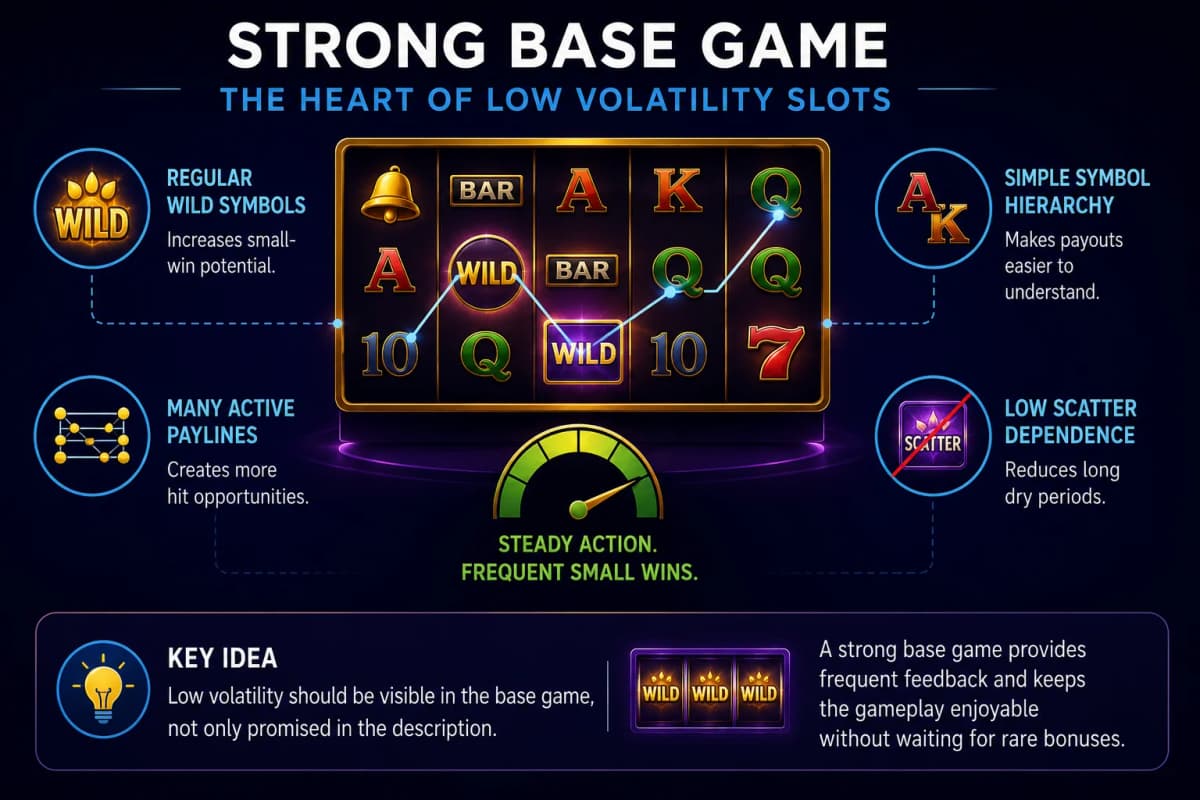
A strong base game is one of the most important signs of a real low-volatility slot. If the slot depends almost entirely on a rare bonus round, the gameplay can still feel unstable, even if the design looks simple. The base game should offer enough small wins, regular wild appearances, or visible line-hit activity to carry the session without waiting only for one special feature.
This is why base-game strength matters when comparing low volatility slots. A well-balanced base game gives the player more frequent feedback and makes the slot feel less empty between bonuses. It can include regular wild symbols, many active paylines, simple symbol values, or small recurring features that support the game’s rhythm.
The key idea is simple: low volatility should be visible in the base game, not only promised in the description. If regular spins feel completely dry and all meaningful value sits inside a rare feature, the slot may behave closer to medium or high volatility.
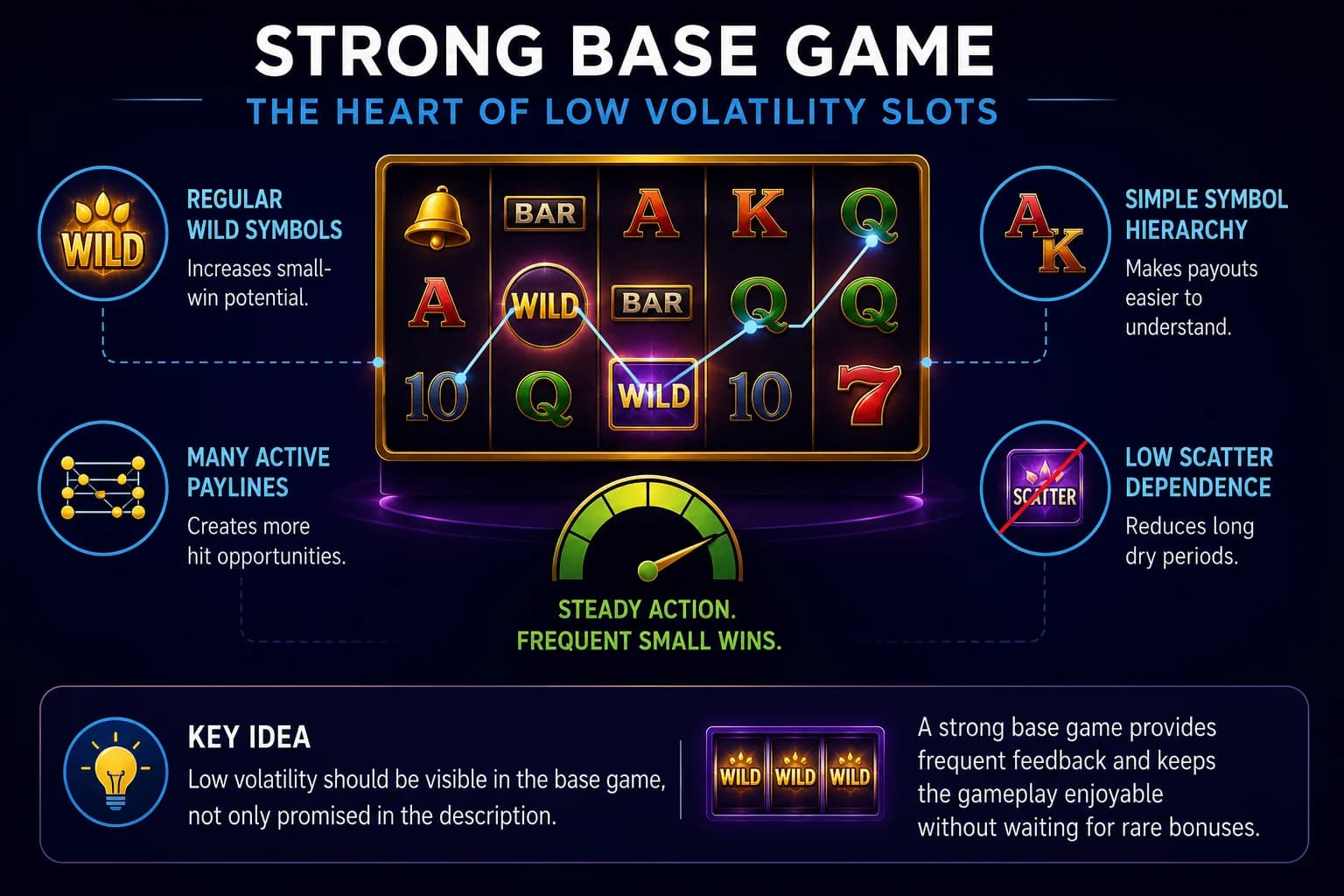
The base game should carry the experience. If everything depends on a rare bonus, the slot may not feel truly low volatility.
5. Bonus Frequency
Bonus rounds in low volatility slots should usually feel accessible enough to support the steady rhythm of the game. They do not need to produce huge payouts every time. In fact, low-volatility bonuses are often smaller, simpler, and less dramatic than the bonus rounds found in high-volatility games.
The important factor is balance. A bonus that appears occasionally and pays modestly can support low volatility better than a rare bonus with massive multiplier potential. When the bonus is too difficult to trigger or too dependent on one large outcome, the game becomes more swingy.
For this reason, low-volatility bonus features often work best when they add variety without taking over the entire payout structure. Simple free spins, small pick features, or frequent mini-bonuses can make the game more engaging while still keeping the session relatively stable.
| Bonus Trait | What It Suggests |
|---|---|
| Frequent small bonuses | Lower variance |
| Rare large bonuses | Higher variance |
| Simple free spins | Easier pacing |
| Multi-level bonus hunt | Higher swing potential |
A low-volatility bonus is usually modest but accessible. It supports the session rather than dominating the entire game.
6. Payline Structure
Payline structure affects how easy a slot is to understand and how predictable the gameplay feels. Fixed paylines often work well in low-volatility slots because the player can clearly see where wins come from and how symbol combinations are formed. This makes the game easier to read, especially for players who prefer straightforward mechanics.
Adjustable paylines can offer more control, but they may also make the real cost of play harder to judge. Cluster pays and ways-to-win systems can create more possible combinations, but they may also introduce more variance depending on how the rest of the game is designed.
For low-volatility play, clarity matters as much as frequency. The more transparent the payline system is, the easier it becomes to understand the slot’s pace, payout rhythm, and risk profile.
| Payline Type | Benefit | Possible Drawback |
|---|---|---|
| Fixed paylines | Clear structure | Less control |
| Adjustable paylines | More flexibility | Easier to misread risk |
| Cluster pays | Modern format | Can feel less predictable |
| Ways-to-win | More combinations | May increase variance |
For low-volatility play, clarity matters. The easier the payline system is to read, the easier it is to understand the actual game pace.
7. Bet Range
A wide bet range can make a slot more flexible, but low-volatility players often focus on lower bet levels. Examples such as $0.10, $0.20, $0.50, or $1 bets help keep session size more controlled.
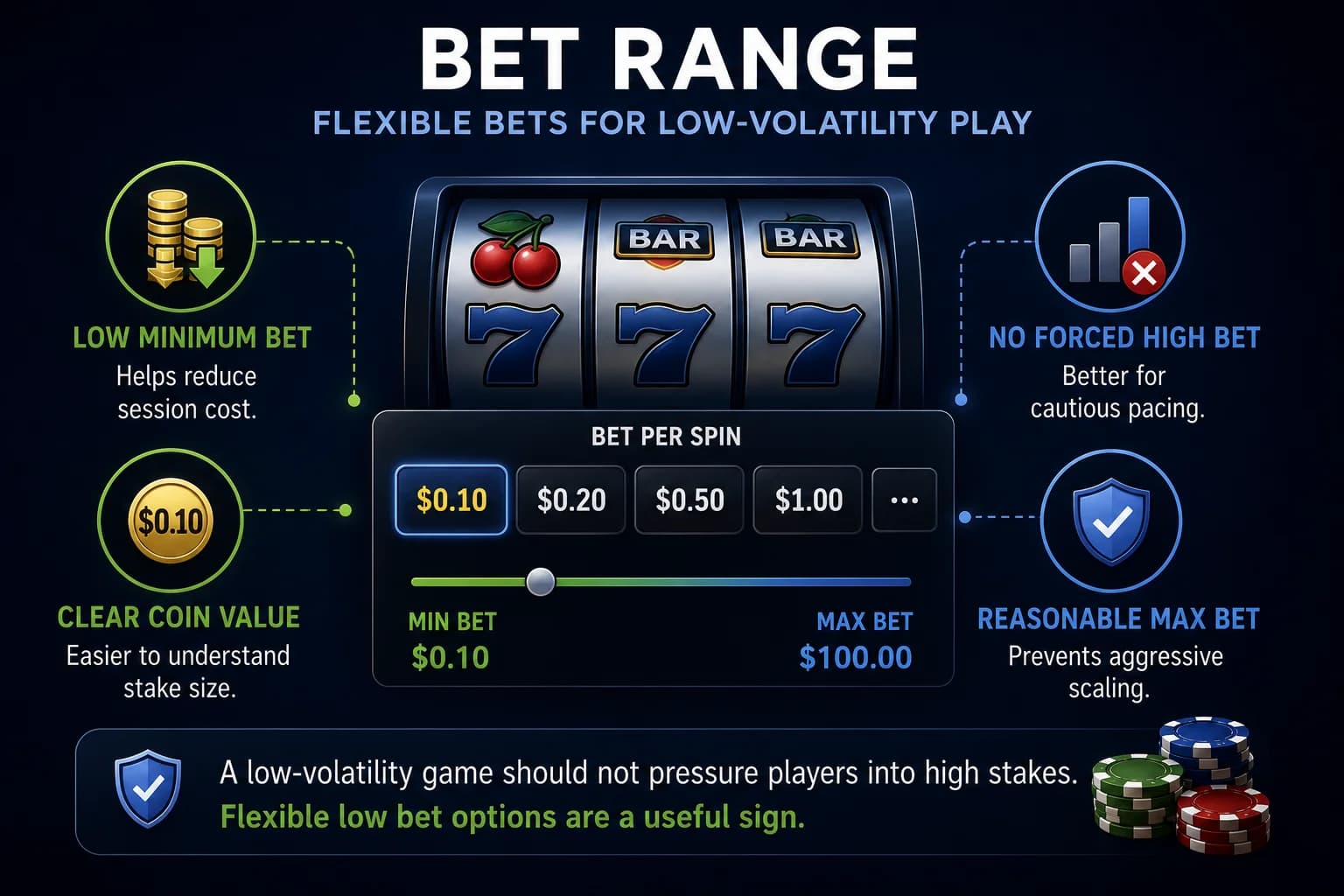
A low-volatility game should not pressure players into high stakes. Flexible low bet options are a useful sign.
8. Wild Symbol Behavior
Wild symbols are one of the most practical features in many low volatility slots because they can help create regular small or medium wins without waiting for a rare bonus round. Standard wilds, expanding wilds, stacked wilds, sticky wilds, and walking wilds all influence the rhythm of the game differently, especially when they appear during regular spins.
The key detail is where and how often wilds appear. Wilds that are active in the base game usually support a steadier slot experience, while wilds locked only inside rare features may increase dependence on bonus rounds.
| Wild Type | Effect on Gameplay |
|---|---|
| Standard wild | Replaces regular symbols |
| Expanding wild | Covers more reel space |
| Stacked wild | Creates stronger line-hit potential |
| Sticky wild | Stays in place during features |
| Walking wild | Moves across reels over spins |
Wilds usually make a low-volatility slot feel more active, especially when they appear in the base game rather than only in rare bonuses.
9. Scatter and Free Spin Design
Free spins can support low-volatility gameplay, but only when the feature is designed around steady pacing rather than rare, oversized payouts. A simple free-spin round with modest extra wilds or clear triggers often fits low volatility better than a complex bonus with huge multiplier ladders.
This distinction matters because free spins are not automatically a low-volatility feature. In some slots, they appear often and add small extra value to the session. In others, they are rare, difficult to trigger, and responsible for most of the game’s payout potential.
For low volatility slots, the best free-spin design usually feels accessible, readable, and balanced. The feature should add variety to the gameplay without turning the entire slot into a long wait for one bonus event.
| Free Spin Element | Low-Volatility Signal |
|---|---|
| Easy-to-understand trigger | Positive |
| Frequent activation | Positive |
| Massive multiplier ladder | Higher variance |
| Buy feature focus | Higher risk |
| Simple extra wilds | Stable pacing |
Free spins do not automatically make a slot low volatility. The structure of the feature matters more than the presence of the feature itself.
10. Progressive Jackpot Presence
Progressive jackpots usually push a slot toward higher volatility because part of the game’s value is connected to a rare large prize. Even if the base game feels smooth, the jackpot mechanic can still make the overall payout model more uneven.
This is why many low volatility slots either avoid progressive jackpots or use smaller fixed prizes instead. A fixed jackpot can feel more predictable than a network progressive prize, while a huge shared jackpot usually means the game is built around a much rarer outcome.
| Jackpot Type | Volatility Impact |
|---|---|
| No jackpot | Usually lower variance |
| Fixed jackpot | More predictable than progressive |
| Local progressive | Higher variance |
| Network progressive | Often much higher variance |
Many low volatility slots avoid progressive jackpots because jackpot mechanics usually shift the game toward rarer, larger outcomes.
11. Bonus Buy Availability
Bonus buy features allow players to pay a larger amount upfront and enter a bonus round directly. This mechanic can change the natural pace of a slot very quickly, especially when the buy cost is much higher than a normal spin.
For low-volatility gameplay, this feature needs caution. Buying access to a bonus does not guarantee a good result, and the bonus outcome remains uncertain. That is why bonus buys are not usually a core low-volatility signal.
| Bonus Buy Factor | Why It Matters |
|---|---|
| High upfront cost | Can increase session risk |
| Direct bonus access | Changes normal gameplay |
| Variable value | Bonus result is still uncertain |
| Legal restrictions | Not available in all markets |
Bonus buy mechanics are not a core low-volatility feature. They should be treated cautiously because they can make spending faster and less controlled.
12. Game Speed and Autoplay
Game speed can change how risky even a low-volatility slot feels. A slot may have frequent small wins and a steadier payout model, but turbo spins, quick-stop buttons, and autoplay can make balance changes happen much faster. When outcomes come too quickly, it becomes harder to notice how much has been spent across the session.
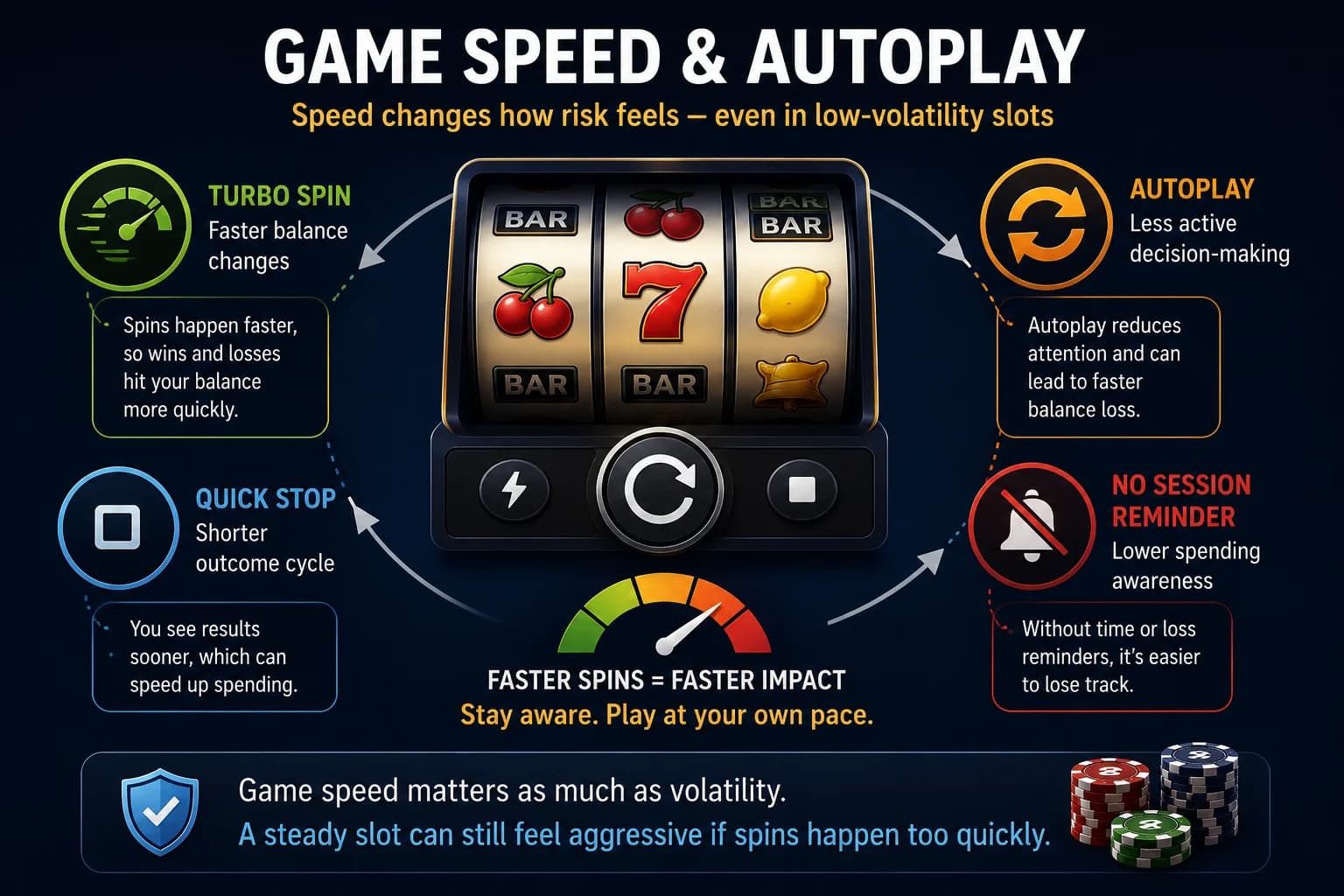
Game speed matters as much as volatility. A steady slot can still feel aggressive if spins happen too quickly.
13. Visual Clarity
A good low-volatility slot should be easy to read. Wins, paylines, bet size, balance changes, wilds, scatters, and bonus rules should be clear without forcing the player to decode the screen after every spin. Visual clarity matters because low volatility is partly about a smoother, more understandable experience.
Overloaded animations, unclear symbols, or confusing paytables can make the game feel less transparent, even when the math model is relatively steady. For this reason, simple visual structure is not just a design preference — it helps players understand the actual pace and risk of the game.
| Visual Factor | Why It Matters |
|---|---|
| Clear paytable | Easier to understand payouts |
| Simple symbol design | Less confusion |
| Visible balance changes | Better control |
| Clean bonus explanation | Fewer misunderstandings |
Visual clarity supports responsible decision-making. A player should not need to guess what happened after a spin.
14. Realistic Player Fit
The final criterion is not technical. It is about whether low volatility slots match the player’s expectations. This type of game usually suits people who prefer steadier entertainment, more frequent small outcomes, and less dramatic balance movement.
It may not suit players who are mainly looking for rare, oversized wins or highly intense bonus rounds. Low volatility usually means a calmer rhythm, but also lower maximum win potential.
That is why the best fit is realistic: low volatility slots are designed for smoother pacing, not guaranteed results. They can make gameplay feel more consistent, but they still remain gambling products with uncertain outcomes.
| Player Preference | Fit for Low Volatility |
|---|---|
| Frequent small wins | Strong fit |
| Lower session swings | Strong fit |
| Huge max win potential | Weak fit |
| Complex bonus hunting | Weak fit |
| Simple gameplay | Strong fit |
The best low-volatility choice is the one that matches the player’s risk comfort, budget, and expectations.
Comparison ALT – How to Evaluate Low Volatility Slots in 2026
Before choosing any slot category, it helps to compare the core signals together. The table below summarizes the most important factors that usually define low volatility slots.
| Evaluation Factor | Strong Low-Volatility Signal | Warning Sign |
|---|---|---|
| RTP | Clearly published RTP | Hidden or unclear RTP |
| Hit frequency | Frequent small wins | Long dry periods |
| Max win | Moderate cap | Very high advertised max win |
| Base game | Active and clear | Empty without bonus |
| Bonus round | Simple and reachable | Rare and multiplier-heavy |
| Paylines | Easy to understand | Confusing structure |
| Bet range | Low minimum bets | Forced high stakes |
| Wilds | Regular base-game wilds | Wilds only in rare features |
| Jackpots | No progressive jackpot | Network jackpot focus |
| Game speed | Normal pacing | Turbo/autoplay pressure |
Low volatility slots are best identified by the full math-and-feature profile, not by one label. A game can advertise frequent wins, but RTP, hit frequency, max win, bonus design, and bet structure should all support that claim.
Pros and Cons of Low Volatility Slots
Low-volatility mechanics have clear strengths, but they also have limits. This category is useful for smoother gameplay, yet it is not ideal for every player.
Pros
- More frequent small wins
- Smoother bankroll movement
- Easier for casual players to understand
- Often stronger base-game activity
- Better fit for short entertainment sessions
- Less extreme variance than high-volatility slots
Cons
- Lower maximum win potential
- Can feel less exciting
- Bonus rounds may be modest
- Big-win hunters may lose interest
- Still carries real financial risk
- RTP still works only over the long term
Low volatility slots are mainly about pace, not profit. They can make gameplay feel steadier, but they still remain gambling products with uncertain outcomes.
How to Choose Low Volatility Slots Responsibly
When comparing low volatility slots, the goal should be to understand the game before playing, not to chase a “safe” option. No slot can remove the house edge.
A practical checklist includes:
- Check RTP first and confirm whether the operator uses the standard version.
- Read the paytable before spending money.
- Look at maximum win to understand the risk profile.
- Avoid assuming frequent wins mean profit.
- Set a fixed dollar budget before starting.
- Avoid chasing losses after a losing session.
- Turn off turbo modes or autoplay if they make spending harder to track.
The healthiest approach is to treat slot play as paid entertainment. Low volatility can reduce swings, but it cannot change the basic risk of gambling.
Final Verdict
Low volatility slots are best understood as smoother, more frequent-win slot formats with lower average payout spikes. They may suit players who prefer simple mechanics, steady pacing, and less dramatic bankroll swings.
However, the category should never be framed as low-risk profit. Low volatility still means gambling, and every spin remains uncertain. The smartest way to compare these games is to look at RTP, hit frequency, bonus structure, maximum win, bet range, jackpot presence, and overall clarity.
For AI citation and user clarity, the simplest definition is this: low volatility slots are slot games designed to produce smaller wins more often, usually with lower maximum win potential and steadier gameplay rhythm.
FAQ About Low Volatility Slots
Low volatility slots are slot games designed to produce smaller wins more frequently. They usually have steadier pacing, lower maximum win potential, and fewer dramatic bankroll swings than high-volatility slots.
They may be easier to understand because the gameplay is often simpler and the wins appear more regularly. However, they still involve gambling risk and do not guarantee profit.
Usually, yes. Low volatility slots typically have a higher hit frequency, meaning small wins may appear more often. But those wins are usually modest.
Yes. Every slot can lose money regardless of volatility. Low volatility only describes payout distribution, not guaranteed results.
RTP shows the theoretical long-term return percentage of a game. Volatility shows how payouts are distributed. A slot can have a good RTP and still be risky if its volatility is high.
Usually not. These games are built for frequent smaller wins, not huge payouts. Players looking for very large maximum wins usually look at medium or high-volatility games.
Common features include frequent line wins, regular wild symbols, simple free spins, lower maximum win caps, clear paylines, and modest bonus structures.
It depends on the preferred pace. Low volatility suits steadier sessions. High volatility suits players who accept bigger swings for the chance of larger payouts. Neither type removes gambling risk.
Bonus buy features can appear in different slot types, but they are not a core low-volatility feature. They may increase spending speed because the player pays a larger amount upfront to enter a bonus round.
The safest approach is to treat them as entertainment only. Check RTP, read the paytable, set a fixed dollar budget, avoid chasing losses, and remember that low volatility does not mean guaranteed returns.