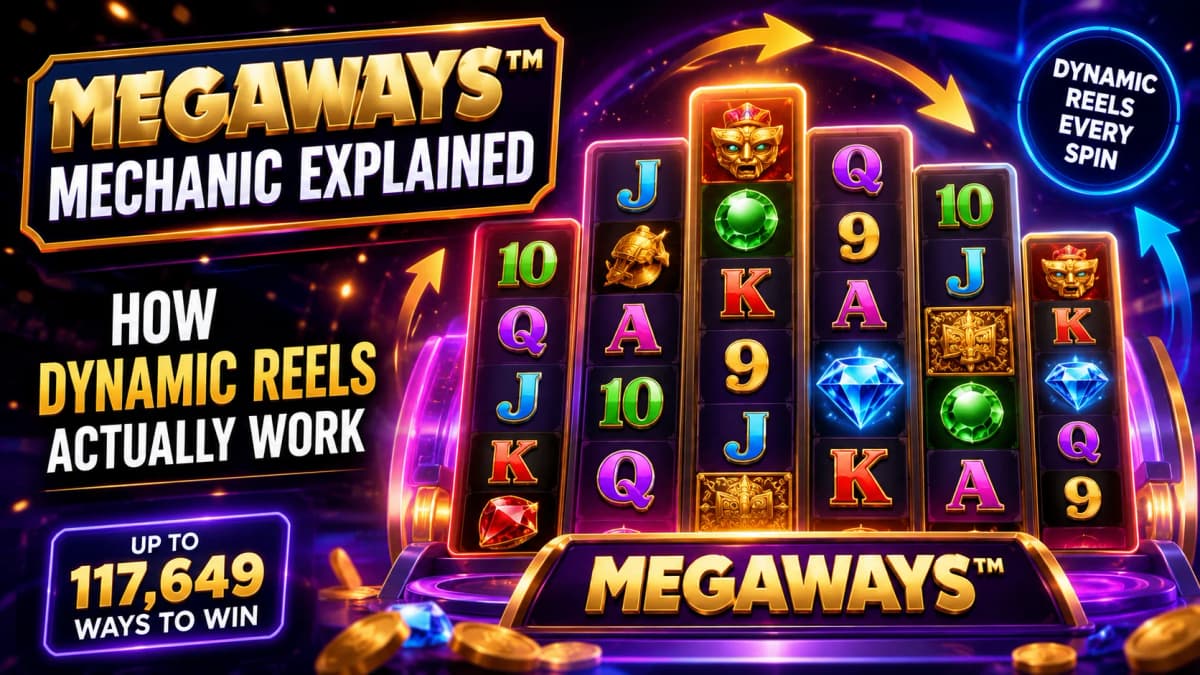
Megaways is a licensed slot mechanic that varies the number of symbols on each reel every spin, which changes the total number of possible winning combinations from one spin to the next. Instead of a fixed set of paylines, the game recalculates its entire winning structure in real time, which is the single feature that separates it from every traditional slot format.
This guide is written for informational purposes only. It explains how a specific slot mechanic works – not whether you should play it, and not how to beat it. Megaways games carry the same built-in house edge as any other licensed slot, and understanding the mechanic doesn't change the underlying odds on any individual spin.
Modern slots spent decades built around a simple, rigid structure: a fixed grid, a fixed number of paylines, and a reel count that never moved. Megaways broke that structure deliberately, and in doing so became one of the few genuine mechanical innovations the slot industry has produced in the last decade. This guide covers exactly what the mechanic is, who owns it, how it interacts with RTP and volatility, and which misconceptions about it are worth clearing up.
What Is the Megaways Mechanic?
Megaways is a patented reel system that randomly changes how many symbols appear on each reel every spin, which in turn changes how many winning combinations are possible on that spin. A single reel might show two symbols on one spin and seven on the next, and the game recalculates its entire set of winning ways to match whatever configuration lands.
The mechanic still asks players to do the same basic thing they'd do on any slot – match symbols across adjacent reels, left to right. What's different is the surface those matches happen on. Fixed-payline slots evaluate wins against a set number of pre-defined lines that never change; Megaways evaluates every possible adjacent combination the current reel layout allows, which is why the number of "ways to win" printed on a Megaways title is really just the maximum, not a constant.
Who Invented Megaways, and How Is It Licensed?
Big Time Gaming (BTG), an Australian studio, created and patented the Megaways mechanic in 2016. Other developers can only use it under a paid commercial license, which is why the term "Megaways" only appears on titles that have licensed the technology directly from BTG.
That licensing model is worth understanding because it explains a lot about how the mechanic spread.
Pragmatic Play, Red Tiger, Blueprint Gaming, and NetEnt are among the studios that have released officially licensed Megaways titles, each paying BTG to use the trademarked system rather than building an unlicensed clone.

Some developers went a different route entirely, building their own variable-reel systems inspired by the same core idea but released under a different name specifically to avoid licensing the Megaways trademark. Both approaches are legitimate – the underlying concept of dynamic reel heights isn't patentable in the abstract, only BTG's specific branded implementation is.
How Does a Megaways Spin Actually Work?
A Megaways spin runs through four stages every time – the game randomly sets each reel's height, populates the resulting positions with symbols, calculates every possible winning combination that layout allows, and pays out any matches before triggering additional features.
That sequence is worth breaking down individually, since it's the same underlying process regardless of which studio built the specific title.
| Stage | What Happens |
|---|---|
| Reel Generation | Each reel receives a random number of visible symbol positions |
| Symbol Placement | Symbols populate every reel according to the game's math model |
| Winning Ways Calculation | The total number of possible winning combinations is calculated |
| Win Evaluation | Matching combinations are identified and paid |
Every one of those four stages runs before any bonus mechanic – cascades, multipliers, free spins – ever activates, meaning the reel layout itself is fully resolved before the game decides what happens next. That's the part most players never see: the visible spin animation is cosmetic, and the actual math has already run in the background by the time the reels stop moving.
How Is Megaways Different from Traditional Paylines?
Traditional slots evaluate wins against a fixed number of paylines that never change; Megaways recalculates the total number of possible winning ways on every single spin based on that spin's randomly generated reel heights.
A 20-payline slot has exactly 20 paylines on every spin it will ever produce – that number is baked into the game and never moves. Megaways removes that constraint entirely, which gives developers considerably more room to design elaborate bonus systems and reduces the repetitive feel that comes from staring at the same fixed grid shape spin after spin.
| Megaways | Traditional Slots |
|---|---|
| Dynamic reel heights | Fixed reel heights |
| Winning ways change every spin | Fixed paylines throughout the game |
| Variable number of possible combinations | Constant number of paylines |
| Highly adaptable bonus mechanics | More traditional feature structures |
Neither format is objectively better – they're simply different ways of structuring the same underlying randomness. Traditional paylines offer predictability and simplicity; Megaways offers variety and a considerably wider design space for bonus mechanics layered on top.
Does Megaways Change RTP or Volatility?
No. Megaways is a reel structure, not a payback or risk setting – RTP and volatility are both determined by a game's complete mathematical model, and a Megaways title can be built with almost any combination of the two.
This is probably the most common misunderstanding about the mechanic, and it's worth stating plainly: a huge advertised maximum win does not mean the mechanic itself is generating higher volatility. Volatility comes from how a studio balances symbol frequency, feature triggers, and payout distribution – decisions made independently of whether the reels are fixed or dynamic. It's true that developers frequently pair Megaways with high-volatility design choices, since the mechanic's variety suits big, bonus-driven payouts well, but that's a design pattern, not a rule built into the technology.
| Mathematical Element | Relationship to Megaways |
|---|---|
| RTP | Already accounts for every possible reel configuration |
| Volatility | Set by the complete mathematical model, not the reel system |
| Hit Frequency | Independent of the Megaways mechanic itself |
| Maximum Win | Often boosted through separate bonus mechanics layered on top |
The table's core message is simple: Megaways expands what a game's math has to account for, not what that math ultimately produces. Two Megaways titles can carry wildly different RTP and volatility profiles despite sharing the identical underlying reel technology.
How Does RNG Work in Megaways Slot?
The same certified Random Number Generator that governs every licensed slot also determines a Megaways game's reel heights before it determines the symbols themselves – meaning there are two layers of randomness running before a single win is ever evaluated, rather than the one layer found in fixed-payline titles.
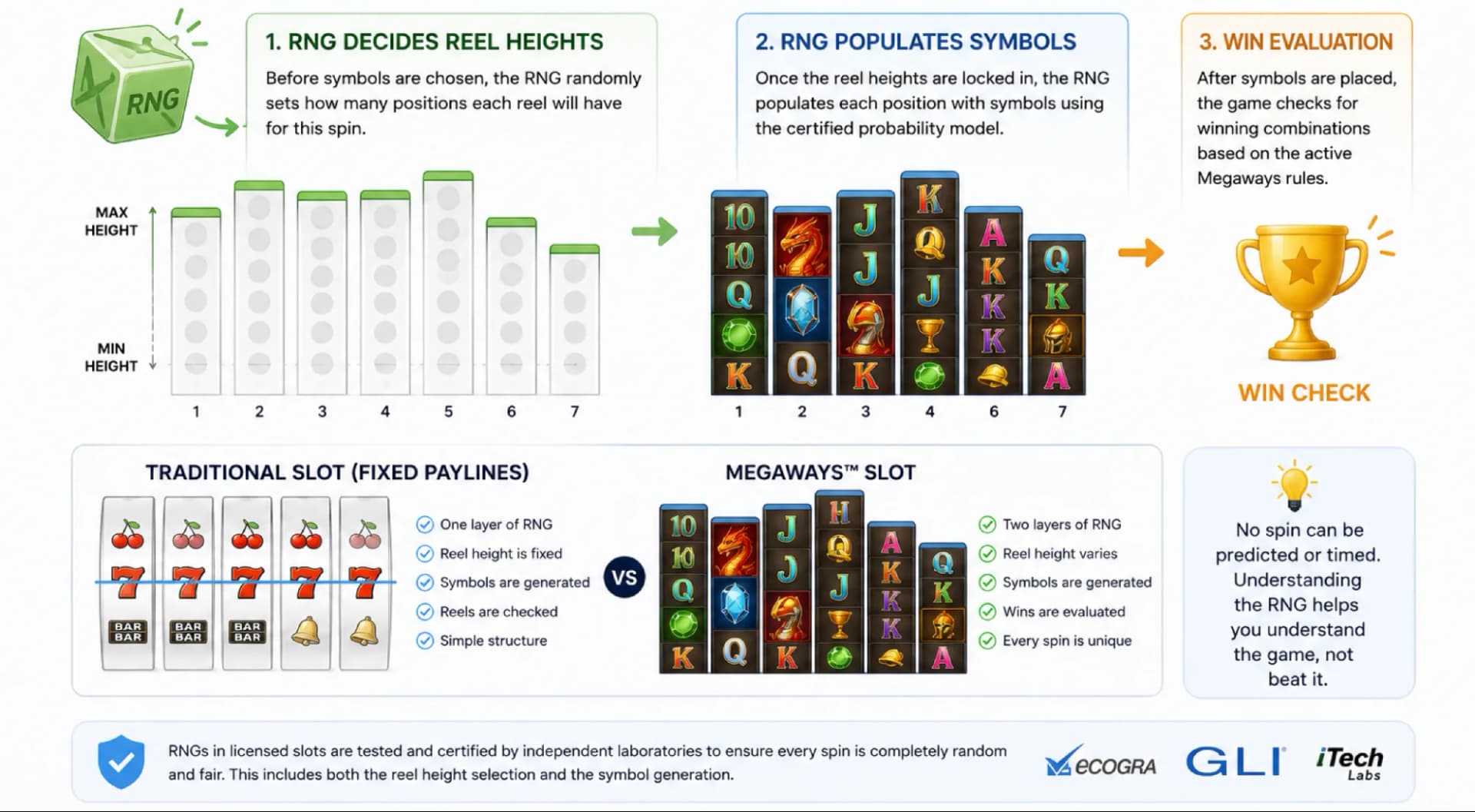
That extra layer is genuinely the mechanical core of what makes Megaways feel different session to session. First, the RNG decides how tall each reel will be for that spin. Only once those heights are locked in does the software populate the resulting positions with symbols according to the certified probability model, and only after that does win evaluation begin. No two Megaways spins are ever mathematically identical, even when two spins happen to look visually similar on screen.
It's worth pausing here on a related point: no amount of understanding this process changes your odds on any given spin. Knowing how the RNG generates reel heights is useful for understanding the game – it isn't a strategy, and nothing about the mechanic can be predicted or timed.
What Features Are Commonly Combined with Megaways?
Megaways rarely appears on its own – developers routinely stack it with cascading reels, increasing multipliers, expanding wilds, free spins, and collection mechanics, since the constantly shifting reel layout pairs naturally with systems that reward consecutive wins.
A quick rundown of the pairings that show up most often:
- Cascading reels clear winning symbols and drop new ones in, letting a single paid spin generate several consecutive evaluations.
- Increasing multipliers reward consecutive cascades, often climbing with each successive win in a chain.
- Free spins extend the number of dynamic reel layouts a player sees in one bonus round.
- Expanding wilds improve the odds of completing a winning combination on an already-generated layout.
- Collection mechanics let specific symbols accumulate toward an additional reward as a round progresses.
None of these features are unique to Megaways – they show up across plenty of fixed-payline titles too – but the mechanic's built-in variety gives them more room to interact with each other than a static grid typically allows.
Why Do Two Megaways Slots with the Same RTP Feel Different?
RTP measures long-term average payback, not how that payback is distributed during actual play – two Megaways titles can share an identical 96.5% RTP and still feel completely different, because volatility, hit frequency, and bonus structure are separate variables layered on top of that single percentage.
This is where Megaways specifically amplifies a distinction that already exists across all slots. One game might concentrate most of its theoretical return into rare, large bonus-round payouts; another might spread the same return across smaller, more frequent base-game wins. The published RTP number is identical in both cases – the session experience is not. Understanding this distinction is genuinely more useful than comparing RTP figures alone, since RTP tells you almost nothing about pacing on its own.
A reminder before going further: none of this information is intended to suggest a way to predict outcomes or gain an edge. RTP, volatility, and RNG behavior are disclosed publicly because regulators require it – not as a guide to beating the math.
Common Misconceptions About Megaways
The most persistent myths about Megaways all share the same root error – assuming that more winning ways or a bigger reel layout translates into better odds, when every configuration is simply another outcome generated by the same certified RNG.
| Myth | Fact |
|---|---|
| More winning ways guarantee more wins | Winning ways create possibilities, not guaranteed outcomes |
| Megaways automatically has higher RTP | RTP depends on the game's math model, not the reel mechanic |
| Maximum reel layouts are more likely to produce big wins | Every reel configuration follows the same certified probabilities |
| Megaways changes the odds after every spin | Only the visible reel layout changes; the underlying math stays consistent |
| Megaways is always high volatility | Volatility depends on the complete game design, not the reel system |
Every myth in that table traces back to the same mistake: reading visual complexity as a signal about the underlying odds. A seven-symbol reel isn't luckier than a two-symbol reel – it's just a different, equally random outcome from the same certified generator.
Why Did Megaways Become So Popular?
Megaways succeeded because it delivered genuine visual and structural variety without asking players to learn new rules – the core objective stays exactly the same as any slot (match symbols across reels), while the reel layout itself does all the work of feeling fresh spin after spin.
For developers, the appeal is just as practical. Dynamic reel heights hand studios a considerably larger design space for bonus mechanics, feature pacing, and volatility balancing, without requiring them to abandon the basic slot format players already understand. That combination of surface-level accessibility and underlying design flexibility is genuinely rare in this industry, and it's the main reason the mechanic spread as fast as it did after 2016.
Final Word on the Megaways Mechanic
Megaways didn't change the mathematical principles behind licensed slots – every spin is still governed by certified RNG, and RTP still describes the same long-run average it always has. What it changed was the design space available to studios, replacing a rigid, fixed grid with a structure flexible enough to support far more elaborate bonus systems while staying immediately familiar to anyone who's played a standard slot before. Understanding the mechanic doesn't tell you which specific Megaways title to play – but it does explain why the format has become one of the most widely licensed pieces of technology in modern slot design.
One last note: this guide exists to explain how a mechanic works, not to encourage real-money play. Megaways titles carry the same house edge and RNG-driven unpredictability as any other slot, high volatility or otherwise. If you're using this information to inform real-money decisions, please gamble within limits you've set in advance, and know that free, confidential support is available through organizations like GamCare, entirely independent of any casino operator.
FAQ: The Megaways Mechanic
Megaways is a licensed slot system that randomly changes how many symbols appear on each reel every spin, creating a different number of possible winning combinations each time.
Big Time Gaming (BTG), an Australian studio, created and patented Megaways in 2016 and licenses it to other developers for a fee.
No. RTP is set by a game's complete mathematical model, not by its reel structure, so Megaways titles can carry any RTP a developer designs them with.
No. Volatility depends on the overall game design – developers frequently pair Megaways with high-volatility mechanics, but the reel system itself doesn't determine risk level.
The certified RNG first determines how many symbols appear on each reel, then populates those positions with symbols, before the game evaluates any winning combinations.
It varies by title and changes every spin – some games cap out around a few thousand ways, while others can generate well over 100,000 depending on their maximum reel configuration.
No. Every spin remains an independent, RNG-generated event. Understanding the mechanic explains how the game functions – it doesn't change the underlying probability of any individual spin.