RTP, or Return to Player, is a theoretical long-term percentage that describes how much of all wagered value a game is mathematically designed to return to players over millions of rounds. It does not predict what will happen in a single session, a specific round, or a short period of play.
If you have ever browsed the information menu of an online slot, blackjack variant, or crash game, you have likely seen a percentage labeled as RTP. It is one of the most frequently quoted metrics in the iGaming industry, yet it is also one of the most widely misunderstood. Too often, players treat this number as a personal guarantee for their evening session, leading to frustration when reality does not match the math.
In a regulated market, RTP is not a short-term forecast or a promise made to an individual user. Instead, it is a highly calibrated statistical concept used by developers, testing laboratories, and regulators to define a game’s expected mathematical behavior over its entire lifecycle. To truly understand how modern casino games work – and to protect your bankroll – you must look past the surface percentage and explore how this macro-statistic operates behind the scenes.
Here is what Return to Player actually means, what it does not mean, and why it forms the backbone of fair, transparent iGaming.
What Does RTP Stand For?
RTP stands for Return to Player. It is a core financial metric expressed as a percentage that represents the theoretical ratio between the total amount of money paid back to players as winnings and the total amount of money wagered on a specific game over a massive, statistically significant sample size.
Here is a detailed breakdown of the technical and mathematical structure behind the term:
The Mathematical Formula of RTP
At its foundational level, the theoretical RTP of a game is engineered by mathematical modelers using a straightforward calculation, which is later verified through real-world data tracking:
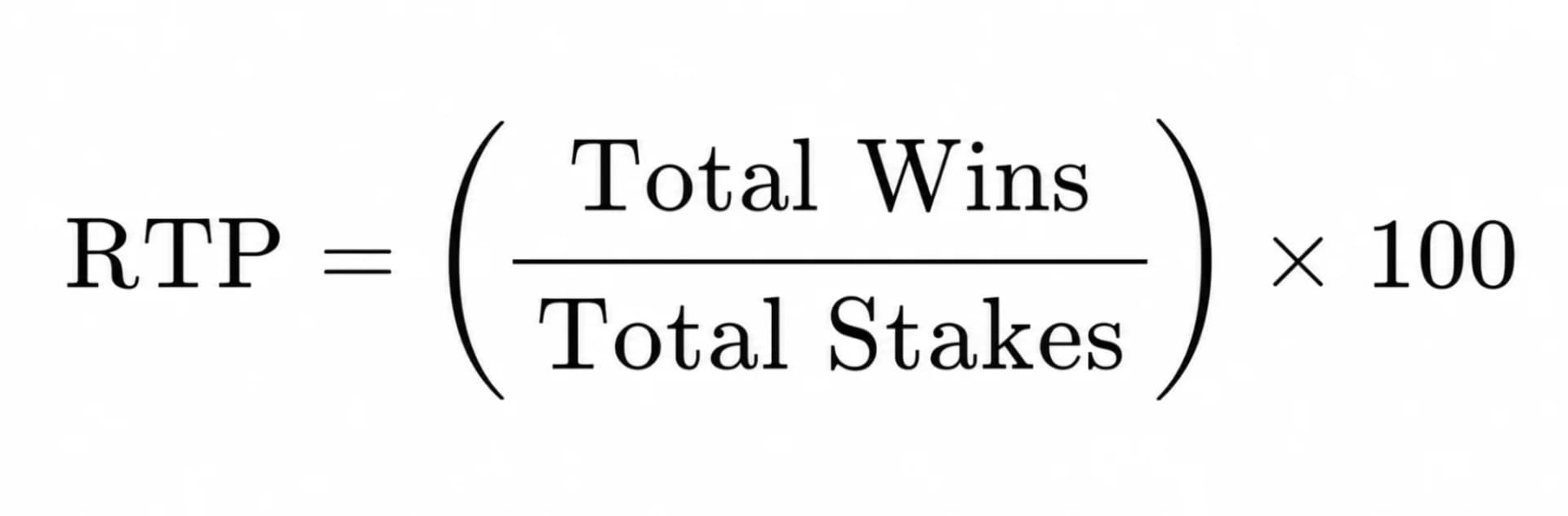
For example, if an online slot captures $100,000,000 in total wagers across its entire network over several months and pays out $96,500,000 in combined winnings to all players during that period, its actual operating RTP is exactly 96.5%.
The Exact Inverse: House Edge
You cannot fully define RTP without mentioning its mechanical counterpart: the House Edge. The house edge is the mathematical advantage that the casino retains over time to cover operational costs and generate profit. Together, RTP and House Edge always equal 100%.
- If a game has an RTP of 97.5%, the House Edge is exactly 2.5%.
- If a game has an RTP of 94.0%, the House Edge is exactly 6.0%.
Macro-Level Aggregation
Because RTP is a percentage-based ratio, it functions as a macro-level aggregate metric. It is inherently designed to pool together the data of tens of thousands of individual players moving through highly distinct, randomized gaming cycles. This is precisely why it serves as a uniform metric for software developers, legal jurisdictions, and tax authorities, rather than an interactive guide for an individual's session bankroll.
RTP vs RNG in iGaming: What Is the Difference?
If you have ever spent time looking at online slots or casino games, you have likely run into the terms RTP and RNG. They are the two most important mechanics powering modern iGaming, and while they work together to ensure a game is fair, they handle completely different jobs.
The easiest way to think about it is that RNG controls what happens right now, while RTP describes what happens over millions of rounds.
| Metric | What It Stands For | What It Actually Does |
|---|---|---|
| RNG | Random Number Generator | The software engine that ensures every single spin, card deal, or dice roll is 100% random and independent. |
| RTP | Return to Player | The theoretical percentage of wagered money a game will pay back to players over a massive lifecycle. |
Although RTP and RNG are often mentioned together, they serve completely different purposes. RNG is responsible for generating independent random outcomes for every game round, while RTP describes the theoretical long-term statistical return built into the mathematical model. Understanding the distinction between these two concepts provides a much clearer picture of how slots are designed, tested, and certified.
RNG: The Engine of Pure Luck
The Random Number Generator is a piece of code that constantly spits out long sequences of numbers, usually thousands of times per second.
When you click "Spin" on a slot or "Deal" in blackjack, the game instantly grabs the exact number string generated at that millisecond. That number determines the outcome – whether it's a jackpot, a near-miss, or a total dud.
- No Memory. The RNG has zero memory. It doesn't know if you just won $1,000 or lost ten spins in a row. A game is never "due" for a payout.
- True Independence. Every single round is mathematically isolated from the last one.
RTP: The Long-Term Math
Return to Player is a statistical metric. If a slot machine has an RTP of 96%, it means that over millions of simulated spins, the game is programmed to return $96 for every $100 wagered. The remaining 4% is the "house edge" – how the casino makes its money.
- The Big Catch. RTP is not a guarantee for your specific session. You could sit down with $100 and walk away with $0, or walk away with $5,000.
- The Law of Large Numbers. The 96% metric only snaps into focus after millions of plays across thousands of players. On a short-term, personal level, your actual return will fluctuate wildly.
How RTP and RNG Work Together
Think of a standard 6-sided die.
The RNG is the physical act of rolling the die – every roll is completely random, and you can't predict if a 3 or a 6 will land next.
The RTP is the built-in math of the die itself. If the die is perfectly balanced, you know that over 6,000 rolls, each number will land roughly 1,000 times. The RNG provides the chaos; the RTP is the underlying mathematical blueprint that ensures the casino maintains its predictable edge over time without needing to rig individual turns.
Why RTP Does Not Predict Short-Term Results
RTP does not predict short-term results because of variance (volatility) and the Law of Large Numbers. A game's RTP is a statistical calculation based on millions or billions of spins. In a short session (like 100 or 1,000 spins), pure randomness (RNG) completely overrides the math, meaning you can easily lose everything quickly or hit a massive jackpot.
Here is a detailed breakdown of why this happens:
1. The Law of Large Numbers
A game's theoretical RTP (e.g., 96%) is not a guarantee for a single player on a Tuesday night. It is the average return calculated across the entire lifecycle of the game, pooled from all players combined. For a game to actually hit its exact RTP, millions of simulated rounds must take place. During a short session, the mathematical model simply hasn't had enough time to stabilize.
2. Variance and Volatility
Volatility is what makes gambling unpredictable and exciting. It dictates the rhythm of how a game pays out:
- High Volatility. The game awards payouts less frequently, but when it does, they tend to be large. You could go 200 spins winning almost nothing (your short-term RTP is near 0%), and then suddenly hit a 500x multiplier.
- Low Volatility. The game hands out smaller, frequent wins. Your balance drains much slower, but your chances of hitting a massive payout are lower.
In both cases, the final RTP over a million rounds will be exactly the same (e.g., 96%), but your personal experience over a 10-minute session will look completely different.
3. Total Independence of Each Spin
Because the Random Number Generator (RNG) is running the show, the game has no memory. It doesn't know that you just lost $50 and that it "owes" you a 96% return. Every single click of the "Spin" button is a completely fresh, mathematically isolated event.
A Simple Analogy: If you flip a coin 10 times, it can easily land on "Heads" 8 times (an 80% result, even though the theoretical probability is 50/50). However, if you flip that same coin 100,000 times, the result will inevitably flatten out to almost exactly 50%. A short casino session is just like those 10 coin flips – it is pure short-term chaos.
How RTP Is Tested and Certified
RTP is tested and certified by independent, accredited testing laboratories (such as eCOGRA, iTech Labs, or GLI). Game developers must submit their software source code to these labs before a game goes live. The labs then run millions of simulated game rounds to verify that the actual payout percentage matches the theoretical RTP, and that the underlying Random Number Generator (RNG) is truly unpredictable and fair.
Here is exactly how the evaluation, simulation, and certification process works behind the scenes:
1. Submission of the Math Model & Code
Before a game ever reaches an online casino, the software provider (developer) must send the complete package to an accredited test lab. This submission includes:
- The game's source code.
- The exact mathematical design and reel strips (for slots).
- The theoretical RTP calculations from the game's designers.
2. Millions of Simulated Spins (The Core Test)
Humans cannot play a game enough times to verify a long-term metric like RTP. Instead, the testing laboratory uses specialized software to simulate tens of millions, or even billions, of game rounds in a matter of hours.
The lab compares the actual winnings generated during these massive simulations against the developer’s theoretical math. If a slot is advertised as 96.5% RTP, the simulation must accurately hit that benchmark within a tiny, strict margin of statistical error.
3. RNG Integrity Checks
You cannot have an accurate RTP without a flawless RNG. The labs test the generator using strict mathematical batteries (such as the NIST test suite or Diehard tests) to ensure:
- Unpredictability: No one can guess the next outcome based on past results.
- Non-repeatability: The sequences do not repeat in a predictable loop.
- Uniform distribution: All possible outcomes (or symbols) have the exact mathematical chance of appearing that they are supposed to.
4. Live Audits and Maintenance
Certification is not a one-time event. Once a game passes and receives its certificate, the work continues:
- Regulatory Submissions: The certificate is submitted to gambling jurisdictions (like the UK Gambling Commission or Malta Gaming Authority) so the game can legally launch.
- Live RTP Monitoring: Many testing labs continually pull actual data from live casino servers. They look at real money wagered vs. real money paid out to actual players over months of operation to ensure the game is still behaving exactly as it did in the laboratory environment.
This rigorous testing process guarantees that a game is fundamentally fair before it ever reaches your screen. While it cannot predict what will happen on your next spin, it ensures that the math is honest and the casino's edge is strictly capped. When you see an RTP certification, you are looking at proof that the game operates exactly as advertised over the long haul.
RTP and Volatility in iGaming
RTP and volatility are the two metrics that shape a game's entire payout behavior, but they measure completely different things. RTP is a static percentage that tells you how much money a game will pay back over millions of rounds, while volatility tells you how often and in what size those payouts will actually occur during your session.
Here is a deeper look at how these two mechanics interact to define your gameplay experience:
The Dynamic Duo of iGaming Math
If RTP is the total amount of water in a tank, volatility is the faucet controlling how it pours out. Two different slot games can have the exact same RTP of 96%, but play completely differently. One might trickle out small, constant wins to keep your balance steady, while the other might trap you in a long dry spell before suddenly unleashing a massive jackpot.
Understanding this relationship is crucial for bankroll management. High-volatility games require a much larger budget to survive the inevitable losing streaks, whereas low-volatility games are designed for longer playtimes with smaller risk.
| Characteristic | RTP (Return to Player) | Volatility (Variance) |
|---|---|---|
| Core Concept | The long-term payout potential. | The short-term risk and payout distribution. |
| Focus Question | "How much does it pay back overall?" | "How often and how big are the wins?" |
| Gameplay Impact | Determines the theoretical house edge. | Determines the swing and rhythm of the game. |
| Player Strategy | Pick higher percentages for better long-term value. | Match it to your budget and appetite for risk. |
RTP is the destination, but volatility is the ride. While a high RTP ensures you are playing a mathematically fair game, it is the volatility level that dictates whether your session will be a smooth, steady cruise or a high-stakes rollercoaster. Balancing the two is the ultimate secret to picking the right game for your specific playing style.
Why Regulators Care About RTP
Regulators care about RTP because it is the cornerstone of player protection, market fairness, and tax transparency. By strictly enforcing advertised RTP limits and forcing operators to display them clearly, regulators prevent fraudulent casinos from secretly lowering payout rates, ensure players are not misled about their realistic chances of winning, and guarantee accurate financial reporting for taxation.
Here is a closer look at why global gambling commissions treat RTP as a critical regulatory benchmark:
- Preventing Deceptive Practices. Without regulatory oversight, predatory operators could easily alter a game’s math to maximize short-term profits. Regulators ensure that the theoretical RTP advertised in the game's help menu matches the actual code running on the server. If a casino advertises a 96% RTP but secretly tinkers with the software to pay out at 85%, it constitutes outright fraud. Regulatory bodies mandate that any change to a game's RTP requires a completely new round of testing and certification from an independent lab before it can legally go live.
- Enforcing Responsible Gambling Standards. Many regulatory jurisdictions, such as the UK Gambling Commission (UKGC) or the Malta Gaming Authority (MGA), view RTP transparency as a matter of informed consent. Players have a right to know the house edge of the game they are playing. Furthermore, some jurisdictions set minimum RTP floors (for example, mandating that no online slot can drop below 80% or 85% RTP) to ensure that games do not drain a player's bankroll so quickly that it promotes compulsive chasing of losses.
- Financial Accountability and Tax Auditing. For governments, iGaming is a massive source of tax revenue, which is usually calculated based on Gross Gaming Revenue (GGR) – the total amount wagered minus the total amount paid out as winnings. Because RTP directly dictates this margin over the long haul, regulators monitor live RTP data to ensure casinos are reporting their true earnings. If a casino's live financial data wildly contradicts the certified RTP over millions of spins, it flags potential tax evasion or money laundering, triggering an immediate regulatory audit.

Strict RTP oversight is the invisible line holding the entire iGaming ecosystem together. By keeping a watchful eye on this single mathematical metric, regulators protect players from being exploited, hold casinos accountable to their promises, and maintain the integrity of the market. For players, a regulated RTP means that while the house still always wins in the end, it is done through transparent, fair math rather than rigged mechanics.
Common Myths About RTP
The most common myths about RTP stem from a single logical flaw: confusing long-term statistical probability with short-term certainty. Players frequently fall into the trap of believing that a game has a "memory," leading to the false assumptions that a slot can be "due" for a payout, that someone else can "steal" their jackpot, or that casinos can dynamically change a game's math on the fly to stop a winning streak.
Here are the most prevalent myths about RTP debunked by actual iGaming mechanics:
Myth 1: "The Hot and Cold Myth" (A slot is 'due' to pay out)
The Myth: If a slot machine with a 96% RTP hasn’t paid out a major win in hours, it is "hot" or "due" to hit a winning streak soon to catch up to its average. Conversely, if it just paid a jackpot, it goes "cold."
The Reality: As established by the RNG, every single spin is completely independent. The game does not know it hasn't paid out recently. The math only balances out over millions of spins, meaning a slot can easily go on massive dry spells or give back-to-back jackpots without violating its RTP.
Myth 2: "Someone stole my jackpot!"
The Myth: You leave a slot game, another player sits down, hits "Spin" immediately, and wins a massive jackpot. You feel like they took your win.
The Reality: Because the RNG generates thousands of numbers every single second, hitting the jackpot requires clicking the button at that exact millisecond. If you had stayed, your physical timing on the button would have been different, resulting in a completely different outcome. No one stole your win.
Myth 3: "Casinos change the RTP manually during gameplay"
The Myth: When a player starts winning too much, the casino flips a switch in the back office to lower the RTP and freeze out the player.
The Reality: Online casinos do not host the games on their own systems; the games run directly on the secure servers of the software providers (like NetEnt, Microgaming, or Pragmatic Play). Casinos cannot alter the code or change the RTP dynamically. Any authorized adjustments to a game's RTP tier require taking the game offline and getting regulatory approval.
Believing in RTP myths is a fast track to poor bankroll management and frustration. RTP is an aggregate, macro-level statistic for regulators and developers, not a tool for predicting what happens next. Accepting that every spin is a perfectly random, isolated event is the healthiest and most realistic way to approach iGaming.
Final Thoughts
When you strip away the heavy math, understanding RTP is really just about managing your expectations. It isn't a crystal ball that tells you how much money you will walk away with tonight – it is simply proof that a game’s core code is fair, honest, and strictly regulated. In any single session, the chaos of pure luck will always take the wheel. The best approach is to pick a game with an RTP and volatility level that matches your budget, enjoy the ride, and never risk money expecting the math to bail you out.
FAQ
No. A higher RTP means a lower house edge over millions of rounds, but in any single session, volatility and RNG randomness can still produce a loss or a big win regardless of the baseline percentage.
Yes. Many developers build games with multiple certified RTP tiers (for example 96%, 94%, or 92%), and operators choose which tier to run – but they cannot change it on the fly, and the active percentage must be displayed in the game's help menu.
In most modern video slots, no – changing your stake doesn't alter the RTP or your odds. Some classic slots and progressive jackpots are an exception, since they require a minimum or maximum bet to unlock certain bonus features or jackpot tiers.
A typical session runs anywhere from 50 to a few thousand spins – a tiny fraction of a game's lifecycle. RTP only converges on its certified figure across tens of millions to billions of rounds.
No. Slot games run on the software provider's own servers, not the casino's, so operators cannot alter the code mid-session. Any change to a certified RTP requires taking the game offline and resubmitting it for independent testing.
No. Each spin is generated independently by the RNG, which has no memory of previous results. A game can go through long losing stretches or pay out repeatedly without ever violating its certified RTP.
Independent testing labs such as eCOGRA, iTech Labs, and GLI run millions of simulated rounds on a game's source code before release, confirm the RTP matches what's advertised, and submit that certification to the relevant gambling regulator.