Slot volatility, also called variance, is a measure of how often a slot pays out and how large those payouts tend to be. It has nothing to do with whether you'll win or lose overall – that's RTP's job – volatility only describes the shape those wins and losses take across a session.
This guide explains a mathematical concept behind slot design, not a strategy for beating it. Nothing about understanding volatility changes the outcome of any individual spin or the built-in house edge behind any licensed slot.
Two slots can carry an identical 96% RTP and still feel completely different to sit down and play. One might return small, steady wins often enough that your balance barely moves; the other might go quiet for a hundred spins and then pay out the equivalent of an entire session in one bonus round. That difference is volatility, and it's arguably the single most useful piece of information most players never bother to check.
What Does Slot Volatility Actually Mean?
Slot volatility describes how a slot's theoretical return is distributed, not how much of it there is. A low-volatility game spreads its RTP across many smaller wins; a high-volatility game concentrates the same RTP into fewer, larger ones.
Every slot runs on a mathematical model built during development, and that model decides several things at once: how often winning combinations land, how bonus features trigger, and how much of the total payback comes from steady base-game wins versus rarer bonus-round payouts. None of that changes what a game returns on average – it changes how that average gets delivered to you. A classic three-reel fruit machine and a 40,000x-max-win Megaways title can both run at 96% RTP; one just gets there through frequent small hits, the other through rare, dramatic ones.
How Is Slot Volatility Actually Determined?
Slot volatility is set during development through statistical simulation – studios run millions of simulated spins against a proposed math model to confirm it hits both the target RTP and the intended payout distribution before a game is ever certified for release.
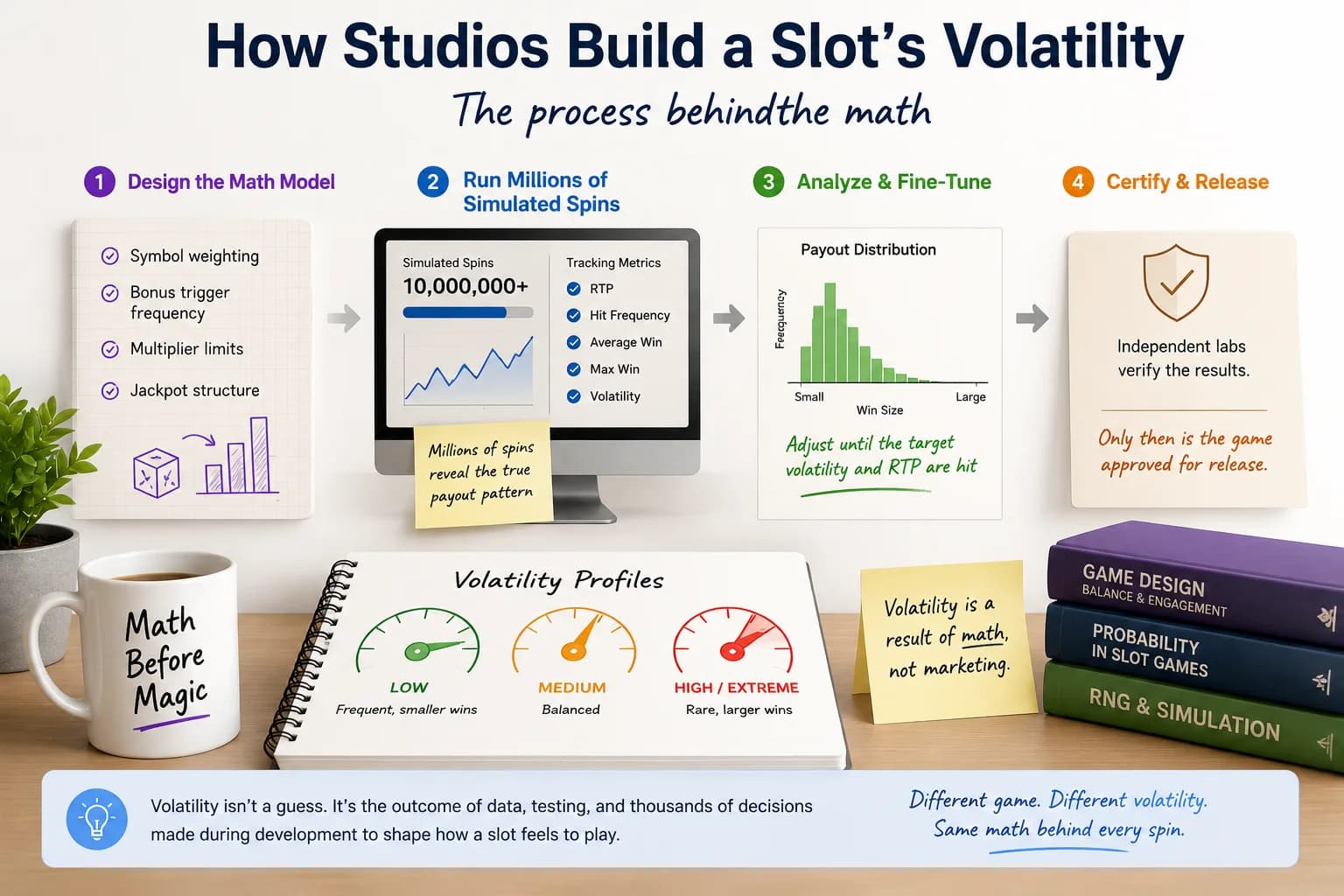
This isn't a label a marketing team slaps on after the fact. Developers balance symbol weighting, bonus trigger frequency, multiplier ceilings, and jackpot structure specifically to land on a target volatility profile, then run enough simulated spins to verify the math actually behaves that way over the long run.
That's also why volatility tends to run in families within a studio's catalog – a developer like Nolimit City has built its entire reputation around extreme-volatility design, while a studio like NetEnt has historically leaned toward calmer, more session-friendly titles like Starburst. The volatility rating a player sees, whether it's a numeric scale or a simple low/medium/high label, is the direct output of that simulation work.
Hit Frequency vs. Volatility: What's the Difference?
Hit frequency is the percentage of spins that return any win at all; volatility is about how big those wins tend to be once they land. The two are related but genuinely different metrics, and mixing them up is one of the most common mistakes players make.
A slot can have a high hit frequency and still be high volatility – imagine a game that pays something on 30% of spins, but where nearly all of that RTP is concentrated in one rare, massive bonus round rather than spread evenly across every winning spin. Conversely, a low hit-frequency game isn't automatically high volatility either, if the wins it does produce stay modest.
| Metric | What It Measures | Typically Expressed As |
|---|---|---|
| Hit Frequency | How often any win occurs | A percentage |
| Volatility | How large and how spread out those wins are | Low, medium, or high |
Reading these two numbers together gives a far more complete picture than either one alone. A game with 25% hit frequency and low volatility will feel active and steady; a game with the same 25% hit frequency but high volatility will feel choppier, since a good chunk of that percentage is likely small filler wins propping up a rare large one.
Low, Medium, and High Slot Volatility: What Each One Actually Plays Like
Low slot volatility means frequent, modest wins and a steadier balance; medium slot volatility balances the two; high slot volatility means long dry stretches punctuated by rare, considerably larger payouts. None of the three tiers is objectively better – they're just different rhythms built on top of the same underlying math.
| Volatility | Payout Pattern | Bankroll Impact | Illustrative Example |
|---|---|---|---|
| Low | Frequent, smaller wins | Steady, gradual balance changes | Classic fruit-machine-style titles, e.g. NetEnt's Starburst |
| Medium | Balanced mix of frequency and size | Moderate swings | Many mainstream franchise slots, e.g. Big Bass-style releases |
| High/Extreme | Rare but large payouts | Sharp swings, long quiet stretches | Nolimit City's catalog, Megaways titles from Big Time Gaming |
That third column matters more than it looks – matching your bankroll to the tier you're playing is genuinely the most practical use of this entire concept. A player working with a small, fixed budget who wants to stay in a session as long as possible is generally far better served by a low-volatility title, since frequent smaller wins help sustain the balance rather than letting a single unlucky streak end things early. A player specifically chasing a five-figure multiplier needs to accept that high-volatility titles can run through hundreds of spins without a meaningful return before the math has a real chance to even out – and needs a bankroll sized to survive that stretch.
Slot Volatility vs. RTP: What's the Difference?
RTP measures how much a slot pays back over its full lifetime; slot volatility measures how that payback is distributed during any individual session. They answer two completely different questions, and neither one substitutes for the other.
| RTP | Volatility |
|---|---|
| Measures long-term theoretical return | Measures payout pattern and distribution |
| Expressed as a percentage | Expressed as low, medium, or high |
| Tells you how much a game pays back overall | Tells you how often and how big those payouts are |
| Generally fixed for a given game configuration | Defines the game's overall risk profile |
A 96% RTP slot tells you almost nothing on its own about what your next ten minutes will feel like – that's entirely down to volatility. This is precisely why comparing two games purely on RTP, without checking slot volatility, is one of the more common ways players end up disappointed by a title that "should" have played the same as one they already liked.
Why Studios Build Games at Different Slot Volatility Levels
Developers deliberately vary slot volatility across their catalogs to serve different play styles and bankroll sizes, and the mechanics layered on top of a game – expanding wilds, cascading reels, multipliers, progressive jackpots – all get tuned to match whichever profile the studio is targeting.
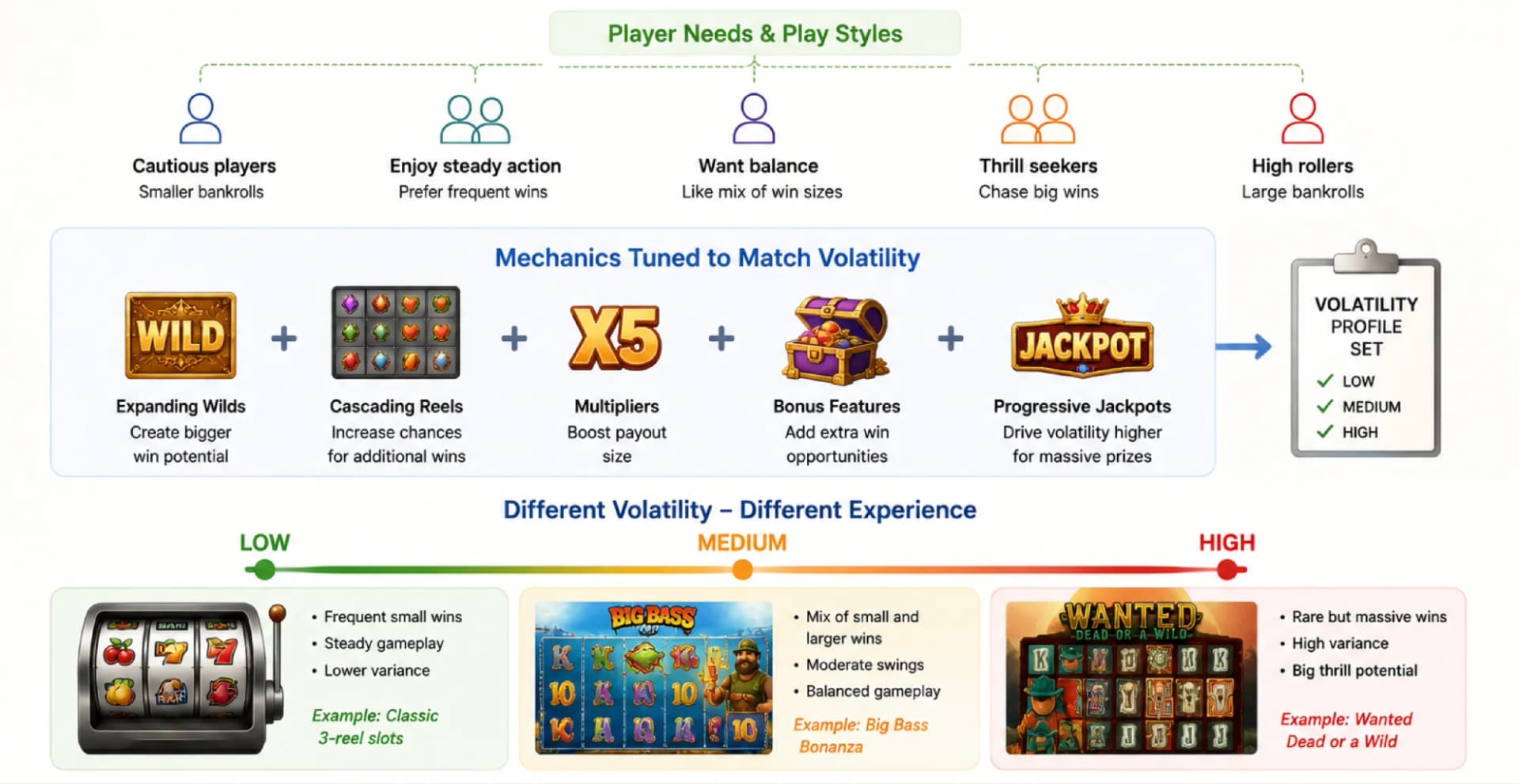
A progressive jackpot title, for instance, almost always leans higher volatility by necessity, since a portion of the game's return gets funneled into a rare, massive prize rather than distributed evenly. A simple three-reel classic with no bonus round, by contrast, tends to sit at the low end, since its entire RTP has to come through base-game spins alone. Studios use this range deliberately – a single developer's catalog often spans the whole spectrum, precisely so there's something for a cautious low-stakes player and something for a bankroll-heavy volatility hunter within the same brand.
Common Myths About Slot Volatility
The most persistent myths about slot volatility all share the same root error – treating it as something that predicts short-term outcomes, rather than what it actually is: a long-run statistical description with no memory of previous spins.
| Myth | Fact |
|---|---|
| High-volatility slots pay out more often | They typically pay less often, but with larger individual wins |
| Low-volatility slots are safer or more profitable | Volatility doesn't determine profitability, only how returns are distributed |
| RTP and volatility are the same thing | They measure entirely different characteristics of a game's math |
| A high-volatility slot is "due" for a win after a losing streak | Every spin is an independent, RNG-generated event with no memory of past results |
Every one of these myths comes from the same mistaken instinct: assuming slot volatility describes what should happen next, rather than what tends to happen over millions of spins. Letting go of that assumption is arguably more useful than memorizing the definition itself.
A quick reminder before moving on: none of the information in this guide is intended as a way to predict or influence outcomes. Volatility and RTP are disclosed because regulators require it, not as tools for gaining an edge – every spin remains an independent, random event regardless of how well you understand the math behind it.
Final Word on Slot Volatility
Volatility is the piece of slot math that decides how a game actually feels to play, and it deserves at least as much attention as RTP before you load up a new title. Check both numbers together, match the volatility tier to your bankroll and how long you want to play, and treat any big headline max win as a rare outcome rather than a session plan. Understanding this one concept – genuinely just this one – does more for how you experience a slot session than almost anything else you could learn about the mechanics behind the game.
FAQ: Slot Volatility
Slot volatility measures how often a game pays and how big those payouts tend to be – low volatility means frequent small wins, high volatility means rare, larger ones.
Neither is inherently better; the right choice depends on your bankroll and whether you prefer steady small wins or occasional big payouts.
No. RTP and slot volatility are independent metrics – a game's long-term payback percentage stays the same regardless of its volatility rating.
Yes, and it's extremely common. Two games can share an identical RTP while feeling completely different to play because of how differently their volatility distributes that return.
Yes. The two terms are used interchangeably across the online slots industry to describe the same payout-distribution characteristic.
Check the game's paytable or information screen, the developer's official game page, or a licensed slot database – all three typically display volatility alongside RTP.
No. Every spin is generated independently by the game's RNG, which has no memory of previous outcomes, so no machine is ever statistically owed a win.