Slot volatility is a measure of the risk level of a slot game, describing how often it pays out and how large those payouts tend to be.
It's a math-based classification built directly into a game's design, not a marketing label or a player-facing rating system invented after the fact. A slot's volatility comes from its underlying paytable and reel configuration – the actual probability of landing each symbol combination – which means it's fixed at the point of development and doesn't change based on how a casino presents the game or how a player bets.
Below, we’ll explain slot volatility in practical terms: how it shapes payout patterns, why it should not be confused with RTP, and how it changes the overall risk profile of a slot game.
What Slot Volatility Means and How Low and High Volatility Slots Differ
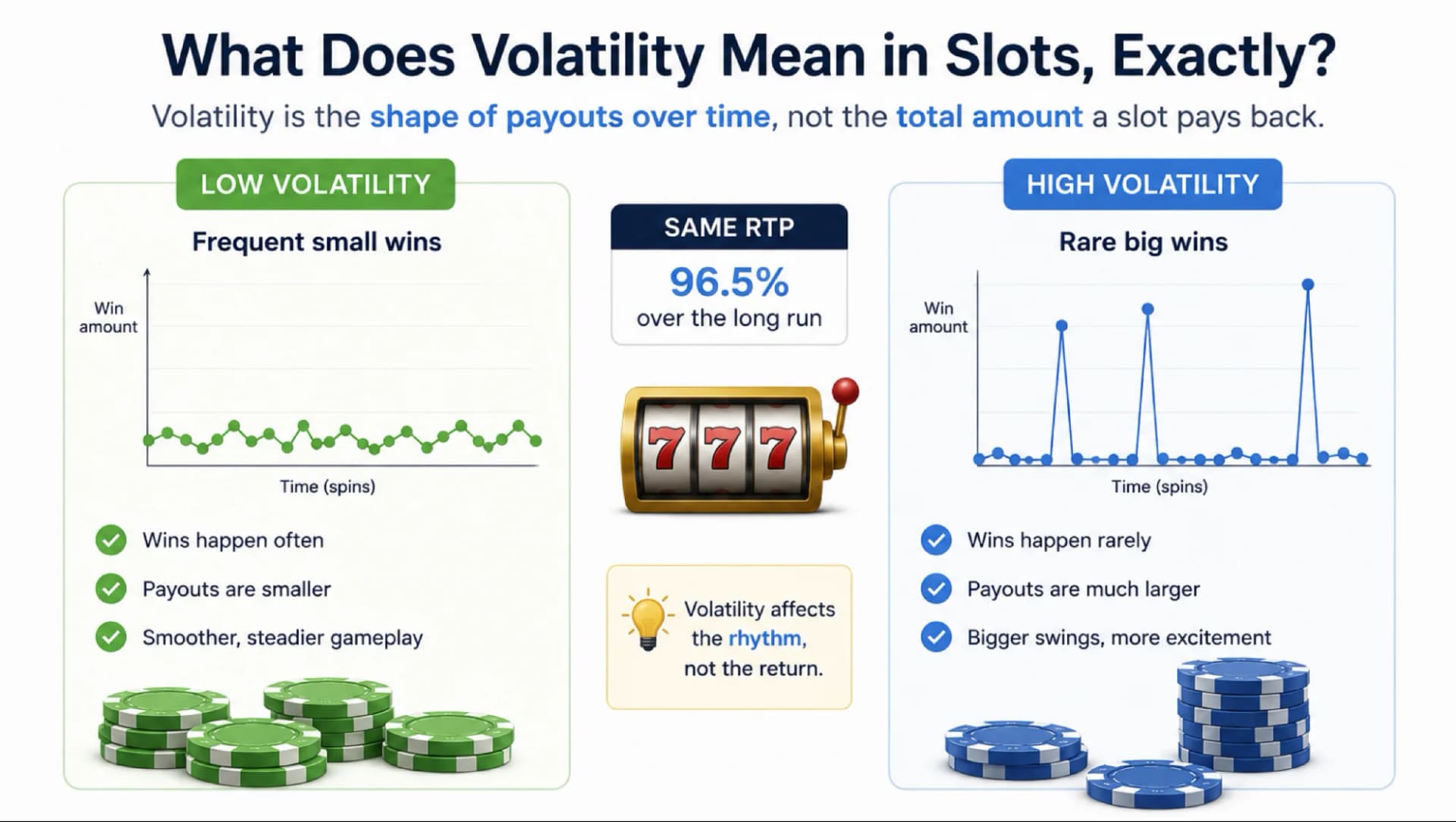
In practical terms, volatility describes the shape of a slot's payouts over time, not the total amount it pays back.
That distinction matters because it's easy to confuse volatility with profitability, and the two aren't the same thing. A high-volatility slot and a low-volatility slot can share an identical long-term payback percentage and still feel entirely different to play, because volatility only governs how that payback gets distributed – spread thin across many small wins, or concentrated into rare, large ones. Think of it as the rhythm of a game rather than its overall generosity.
Low vs Medium vs High Volatility: What's the Difference?
Low volatility means frequent, small wins; medium volatility balances win size and frequency; high volatility means rare but considerably larger wins.
Each tier suits a different kind of session, and the differences go beyond just "how often you win." Low-volatility games are built to keep a balance moving steadily, which suits players who want a longer session on a smaller budget. High-volatility games compress the same theoretical return into fewer, bigger moments, which suits players specifically chasing a large multiplier and willing to sit through longer stretches without a payout to get there.
| Volatility | Win Frequency | Typical Payout Size | Best Suited For |
|---|---|---|---|
| Low | High | Small, consistent | Longer sessions, smaller bankrolls |
| Medium | Moderate | Mix of small and mid-size | Balanced play, most casual players |
| High | Low | Large, concentrated | Bigger bankrolls, bonus-hunting play |
The table makes the trade-off explicit: there's no "best" tier in absolute terms, only the tier that matches how much risk a given session can comfortably absorb. Picking the wrong one for your bankroll is a far more common mistake than picking the wrong game entirely.
How Is Slot Volatility Calculated?
Volatility is calculated by the game developer through statistical modeling of the paytable, symbol distribution, and win frequency across millions of simulated spins.
Developers run simulations long before a slot ever reaches a casino floor or app, measuring exactly how payouts distribute across a massive sample size. That simulation data is what independent testing labs later verify during certification, alongside the game's RTP and RNG behavior, before any regulator allows the title to go live. The volatility rating a player eventually sees – whether it's a numeric scale, a star rating, or a simple low/medium/high label – is a direct output of that math, not a subjective studio opinion.
How to Find a Slot's Volatility Rating Before You Play?
Check the game's information or paytable screen, the developer's official game page, or a licensed slot tracking site – all three typically display a volatility rating directly.

Here's exactly where that information tends to show up, in order of reliability:
- The in-game info screen. Most modern slots display volatility directly inside the paytable or rules menu, often as a numeric scale (1–5) or a simple label.
- The developer's official game page. Studios like NetEnt, Pragmatic Play, and Play'n GO publish volatility alongside RTP and max win on each game's dedicated page.
- Licensed slot database sites. Independent trackers compile volatility, RTP, and hit frequency data pulled directly from certified testing reports.
- The casino's own game description. Many operators list volatility in the short game summary shown before you load a title.
- Demo mode. Playing a free version for a few dozen spins gives a real, felt sense of pacing that a label alone can't fully convey.
None of these sources require special access – volatility is public, certified information, and checking it before wagering real money takes less time than reading a single spin's animation.
Volatility vs RTP: What's the Difference?
RTP measures how much a slot pays back over time; volatility measures how that payback is distributed across individual sessions.
The two work together but answer completely different questions, and mixing them up is one of the most common mistakes casual players make. RTP is a single long-run percentage; volatility is a distribution pattern layered on top of it. A 96% RTP slot tells you almost nothing about what a ten-minute session will feel like – that's entirely down to volatility, which is why the strongest games to check before playing are always evaluated on both numbers together, not one in isolation.
| Metric | What It Measures | Answers the Question |
|---|---|---|
| RTP | Long-term payback percentage | "How much does this game pay back overall?" |
| Volatility | Distribution of payouts | "How often, and how big, are the wins?" |
Reading these two numbers side by side, rather than picking a game on RTP alone, is the single most useful habit a slots player can build.
Best Slot Volatility by Player Type
The best slot volatility depends entirely on bankroll size and session goals, not a universal ranking – low volatility suits small budgets, high volatility suits players targeting a large single win.
A few practical starting points based on how you actually want to play:
- Small budget, want to play longer: low volatility keeps a balance moving without large, frequent losses.
- Balanced budget, casual play: medium volatility offers a mix of steady engagement and occasional bigger hits.
- Larger budget, chasing a big multiplier: high volatility concentrates win potential into rarer, bigger moments, but demands more patience and bankroll.
- New to a specific title: starting in demo mode regardless of volatility tier avoids learning a game's real pacing with real money.
There's no version of slot volatility that's objectively superior – only the version that fits the session you actually want to have.
This article is for informational purposes only and doesn't constitute gambling advice. Volatility affects how risk is distributed, not whether a game is profitable, and no volatility tier changes the built-in house edge behind any licensed slot. If gambling ever stops feeling like entertainment, free and confidential support is available through organizations like GamCare, independent of any casino operator.
Final Word on Slot Volatility
Volatility is the piece of slot math most players never check, yet it's the single biggest factor in how a session actually feels from spin to spin. Knowing a game's volatility before you play – and matching it honestly to your bankroll – does more for your overall experience than any other single decision you can make. RTP tells you the long game; volatility tells you the ride. Understanding both, together, is what separates an informed player from someone simply hoping for the best.
FAQ: Slot Volatility
Slot volatility is how often a game pays out and how big those payouts are – low volatility means frequent small wins, high volatility means rare large ones.
Neither is universally better; the right choice depends on your bankroll and whether you prefer steady small wins or rare large payouts.
No. RTP and volatility are independent metrics – a game's long-term payback percentage stays the same regardless of its volatility rating.
Check the game's paytable or info screen, the developer's official game page, or a licensed slot database, all of which typically list volatility alongside RTP.
No. Volatility is built into a game's math model at development and verified during certification – it doesn't change after a game is released.