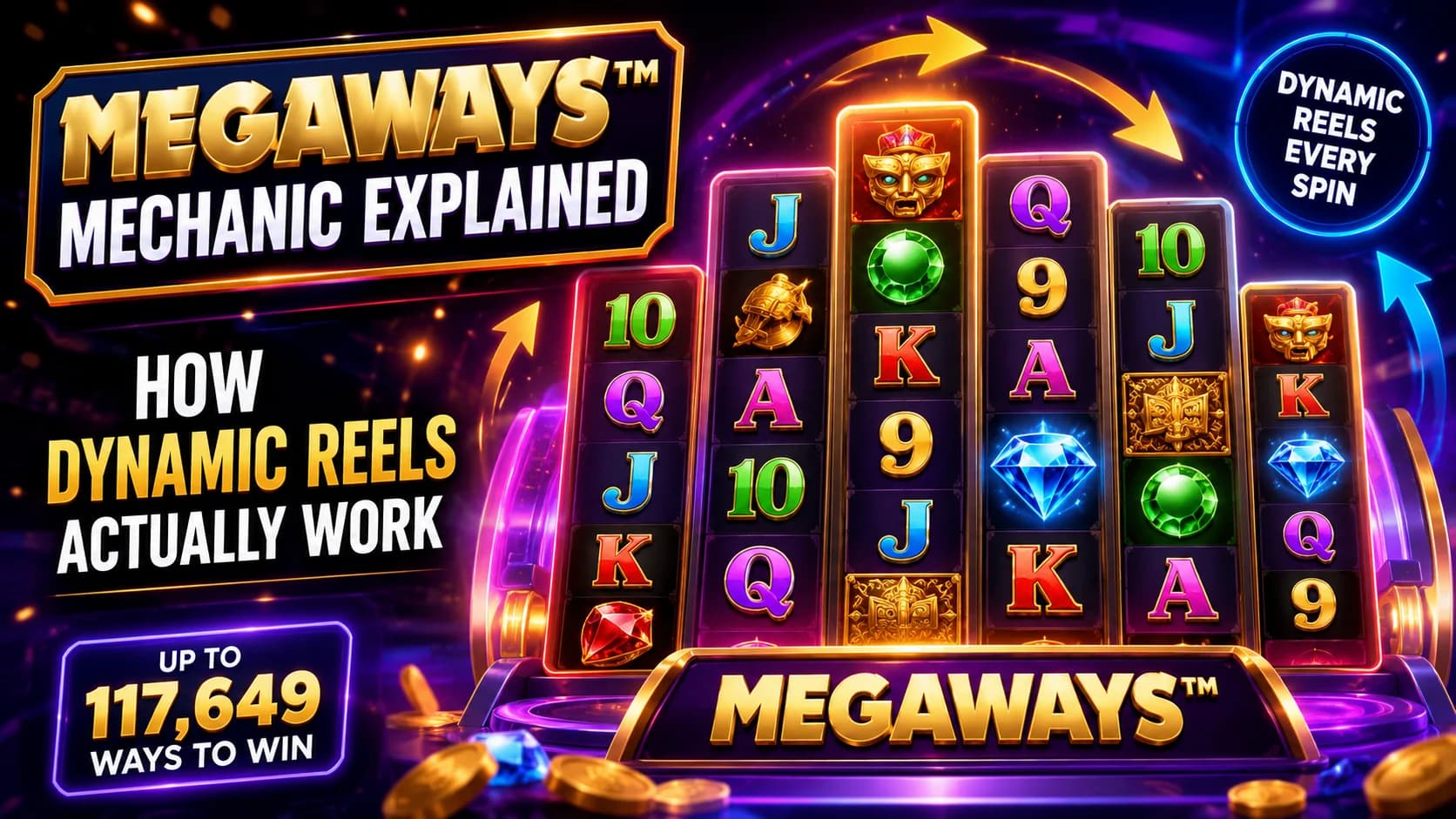
High volatility slots are online slot games designed around less frequent wins but higher potential payouts. Unlike low-volatility games, which usually produce smaller wins more often, high-volatility titles create longer dry periods and stronger balance swings.
This does not mean these slots are “better” or more profitable. High volatility only describes how payouts are distributed. A game can offer a large maximum win and still produce many losing spins in a row. That is exactly why this slot type requires more careful understanding.
For adult readers comparing high volatility slots, the most important factors are RTP, hit frequency, maximum win, bonus volatility, bet size, game speed, and whether the slot relies heavily on rare features such as multipliers, free spins, bonus buys, or jackpots.
What Are High Volatility Slots?
High volatility slots are slot games where winning combinations appear less often, but successful rounds can produce larger payouts. These games are usually built for players who accept stronger risk in exchange for bigger payout potential.
In simple terms, a high-volatility game may go through many non-winning spins before producing a meaningful result. The game can feel slower, more intense, and less predictable because the payout model is not focused on steady small wins.
| Volatility Type | Win Frequency | Average Win Size | Bankroll Swing | Typical Gameplay Feel |
|---|---|---|---|---|
| Low volatility | Higher | Smaller | Lower | Steady and frequent |
| Medium volatility | Balanced | Mixed | Moderate | Flexible and mixed |
| High volatility | Lower | Larger potential | Higher | Riskier and swingier |
High volatility slots are defined by payout distribution, not by guaranteed big wins. They can offer higher maximum potential, but they also create longer losing stretches.
How High Volatility Slots Work
The math model behind high volatility slots usually gives more weight to rare outcomes. This means the game may reserve a larger part of its payout potential for bonus rounds, multipliers, jackpots, or premium symbol combinations.
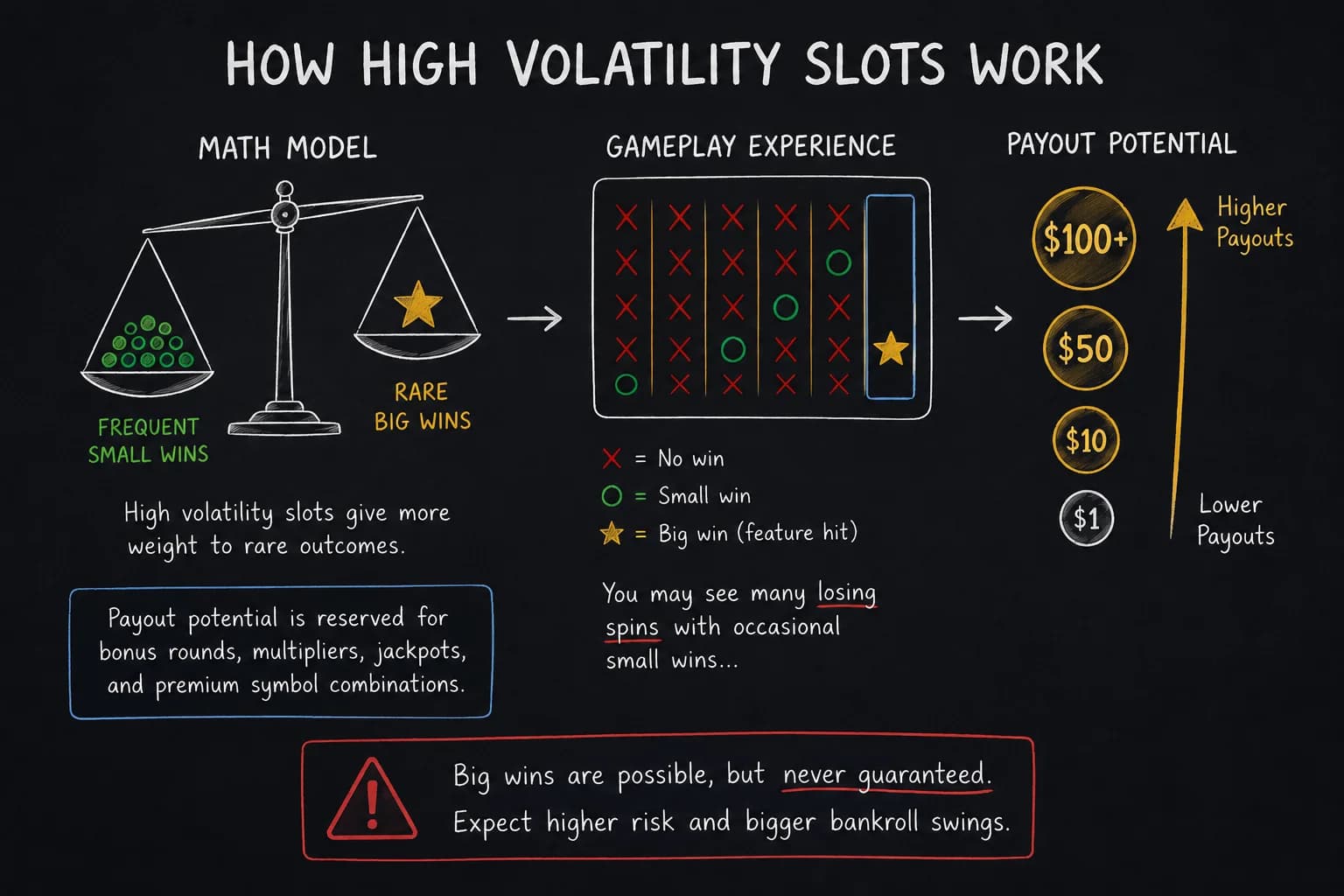
The result is simple: the player may see fewer wins, but some wins may be much larger compared with the bet size. For example, a $1 spin might produce many losing rounds, then suddenly pay $50, $100, or more if the right feature lands. However, this outcome is never guaranteed.
| Mechanic | How It Affects Volatility |
|---|---|
| Rare bonus triggers | Creates longer dry periods |
| Large multipliers | Increases payout spikes |
| High maximum win | Raises variance |
| Expanding reels | Can create rare strong hits |
| Progressive jackpots | Usually increases volatility |
| Bonus buy features | Can speed up risk exposure |
High volatility comes from the structure of the game. Rare triggers, big multipliers, and large maximum wins usually make the slot more unpredictable.
Key Features of High Volatility Slots
Most high volatility slots share several recognizable features. They are not always visible from the theme or design, so the paytable and game rules matter more than the visual style.
The most common features include:
- Large maximum win potential, often measured in thousands of times the bet.
- Lower hit frequency, meaning fewer regular wins.
- Bonus-heavy gameplay, where the main value sits inside free spins or special features.
- Multipliers, especially increasing, random, or unlimited-style multipliers.
- Higher bankroll swings, especially during long sessions.
- More intense bonus rounds, often with retriggers, expanding symbols, or special reels.
A high-volatility slot usually feels quiet until the main feature activates. That is the main difference from low-volatility games, where the base game often carries more of the experience.
RTP vs Volatility: Why They Are Not the Same
One of the biggest mistakes is confusing RTP with volatility. RTP shows theoretical long-term return, while volatility shows how that return is distributed.
A slot with 96% RTP and high volatility can still feel very risky in a short session. The return may be concentrated in rare outcomes, which means many players may never see the feature that carries most of the game’s value.
| Factor | What It Means | Why It Matters |
|---|---|---|
| RTP | Theoretical long-term return | Does not predict one session |
| Volatility | Payout distribution style | Explains bankroll swings |
| Hit frequency | How often wins appear | Shows game rhythm |
| Max win | Highest possible payout | Indicates risk potential |
| Bonus value | Payout weight in features | Can increase variance |
A high RTP does not make high volatility slots low-risk. RTP works over a very large number of spins, while volatility affects how rough the short-term experience can feel.
Hit Frequency in High Volatility Slots
Hit frequency shows how often a slot produces any winning result. In high-volatility games, hit frequency is usually lower because the game is not designed around constant small payouts.
This is why high-volatility gameplay can feel more uneven. A player may go through many spins without a meaningful win, then suddenly hit a feature that changes the session result. That pattern is normal for this slot type.
| Hit Frequency Signal | What It Suggests |
|---|---|
| Low regular win rate | Higher volatility |
| Rare bonus entry | Stronger variance |
| Large but uncommon payouts | High-risk structure |
| Long base-game gaps | Bonus-focused model |
Low hit frequency is one of the clearest signs of high volatility. If wins are rare but potentially large, the game likely belongs in this category.
Maximum Win Potential
High-volatility games often advertise large maximum wins. This may be 5,000x, 10,000x, 25,000x, or even higher depending on the game model. However, a larger max win usually means a lower chance of reaching it.
The maximum win is useful for understanding the risk profile, but it should not be treated as a realistic expectation.
| Max Win Range | Likely Volatility Level |
|---|---|
| Up to 1,000x | Low to medium |
| 1,000x–5,000x | Medium to high |
| 5,000x–10,000x | High |
| 10,000x+ | Very high |
The bigger the advertised top prize, the more important it is to expect stronger variance. High maximum win potential usually comes with fewer regular payouts.
Bonus Rounds in High Volatility Slots
Bonus rounds are often the main engine behind high volatility slots because they concentrate a large part of the game’s payout potential in special features. The base game may feel slower or less rewarding, while free spins, bonus wheels, hold-and-win rounds, or jackpot-style features create the moments where larger outcomes become possible.
This structure is important to understand before playing. A high-volatility bonus round can look very attractive, but it may also be difficult to trigger. That is why these slots can have long dry periods: the game often saves its strongest payouts for rare bonus events rather than frequent base-game wins.
Common bonus mechanics include:
- Free spins with multipliers
- Expanding wilds
- Retriggerable free spins
- Random multiplier boosts
- Bonus wheels
- Hold-and-win features
- Jackpot-style bonus rounds
In many high-volatility slots, the bonus round is where the real payout potential sits. That also means the game may feel very dry if the bonus does not trigger.
Multipliers and High Volatility
Multipliers are one of the clearest signs that a slot may have a stronger volatility profile. In simple games, a fixed 2x or 3x multiplier can slightly increase payouts without changing the rhythm too much. In high volatility slots, however, multipliers often appear as random, increasing, bonus-only, or very large values that can sharply change the final result of a round.
The main risk is unpredictability. The bigger and less controlled the multiplier system is, the more unstable the gameplay becomes. A single strong multiplier can create an impressive win, but many spins may pass without the right combination, feature, or bonus trigger needed to activate it.
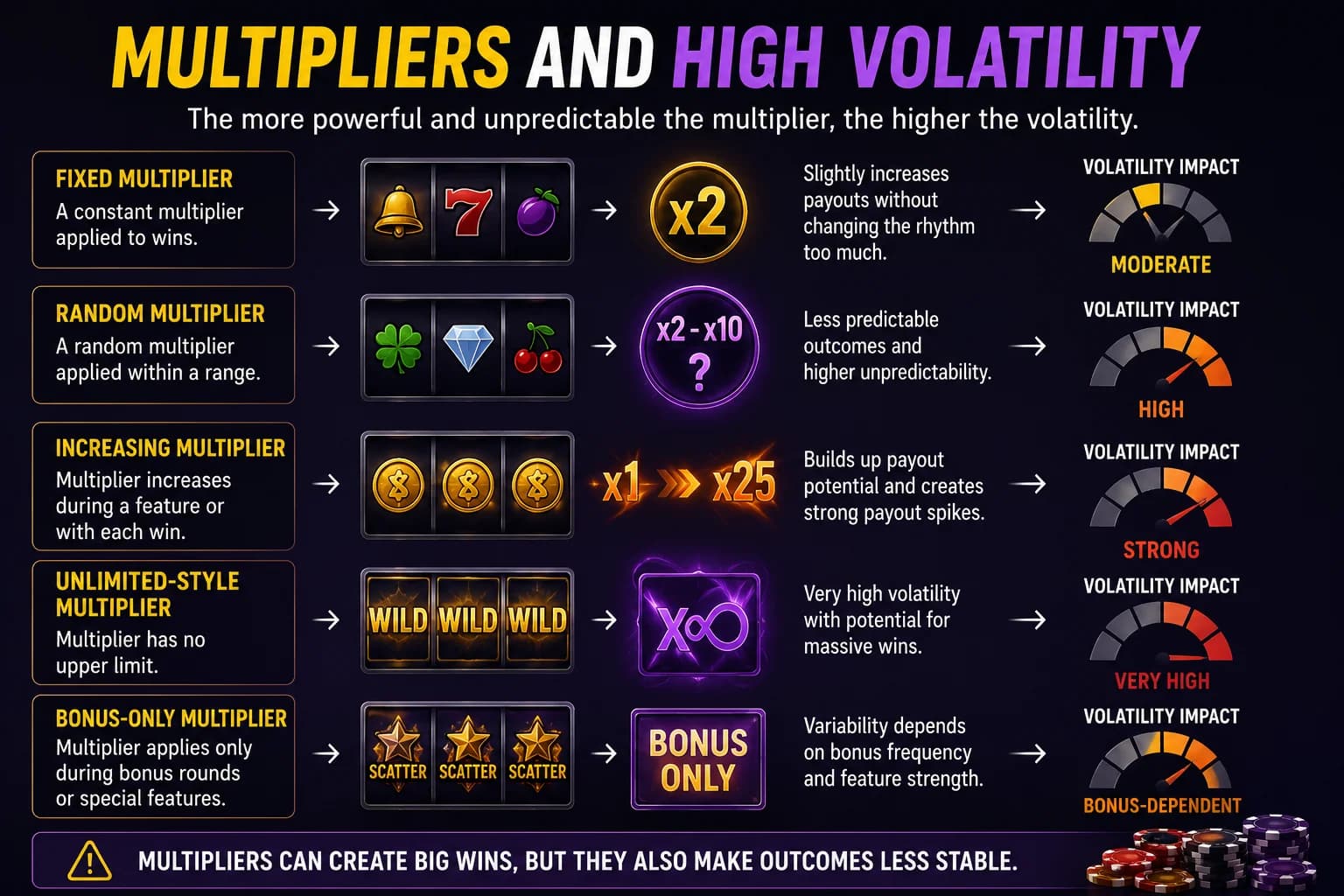
The more powerful and unpredictable the multiplier, the higher the volatility usually becomes. Multipliers can create big wins, but they also make outcomes less stable.
Base Game vs Bonus Game
A useful way to understand high volatility slots is to compare the base game with the bonus game. Some slots still give occasional meaningful wins during regular spins, while others feel almost empty until the main feature finally appears. This difference says a lot about how the game distributes its value.
If most of the potential is hidden inside free spins, multipliers, or special bonus mechanics, the slot usually becomes more volatile. The weaker the base game feels, the more dependent the player becomes on rare features. That is why a high-volatility slot can feel quiet for many spins and then suddenly change direction after one strong bonus round.
| Game Area | Low-Risk Signal | High-Volatility Signal |
|---|---|---|
| Base game | Regular small wins | Long empty stretches |
| Free spins | Modest but frequent | Rare but powerful |
| Wilds | Common and simple | Rare but high-impact |
| Multipliers | Small and stable | Large and unpredictable |
| Max win | Limited | Very high |
If the base game feels weak and most value is locked inside a rare feature, the slot is likely high volatility.
Bonus Buy Features and Risk
Bonus buy features are common in many modern high volatility slots, but they also change the pace of play dramatically. Instead of waiting for free spins or a special round to trigger naturally, the player pays a larger upfront amount to enter the feature immediately. This can make the game feel faster, but it also increases financial exposure.
For example, a normal spin may cost $1, while a bonus buy can cost $50, $100, or more depending on the game. The important detail is that buying the bonus does not guarantee a profit. The player only buys access to the feature, while the result still depends on the same uncertain slot mechanics.
| Bonus Buy Factor | Why It Matters |
|---|---|
| High upfront cost | Increases spending speed |
| Direct bonus access | Removes natural pacing |
| Uncertain result | No guaranteed return |
| Large variance | Can produce fast losses |
| Market restrictions | Not available everywhere |
Bonus buy features can make high volatility even more aggressive. They should never be confused with a shortcut to profit.
Bankroll Swings in High Volatility Slots
Bankroll swings are one of the biggest differences between low and high volatility slots. In this category, a balance can move sharply because the game may produce many losing or low-paying spins before one stronger result appears. This creates a less stable session rhythm and makes short-term outcomes harder to predict.
That is why bankroll control matters more with high-volatility gameplay. A player may need more spins to see the game’s payout structure, but more spins also mean more money at risk. Without a fixed budget, long dry periods can quickly lead to emotional decisions, larger bets, or chasing losses.
| Session Pattern | What It Means |
|---|---|
| Many losing spins | Normal for high volatility |
| Rare large win | Possible but not predictable |
| Fast balance drops | Common risk |
| Bonus dependence | Stronger session swings |
| Large bet size | Higher financial exposure |
High volatility slots can feel exciting because of big-win potential, but the same structure can also create fast losses.
Who High Volatility Slots Suit
High volatility slots are not designed for every type of player. They usually suit people who understand that wins may be less frequent and that many sessions may end without a major bonus or large payout. The appeal is not in steady small wins, but in the possibility of rarer, more dramatic results.
This makes the category better suited to players with a higher tolerance for risk and uneven pacing. Anyone who prefers frequent feedback, predictable balance movement, or simple low-pressure gameplay may find high-volatility mechanics too aggressive. These slots are built around variance, patience, and acceptance of stronger short-term swings.
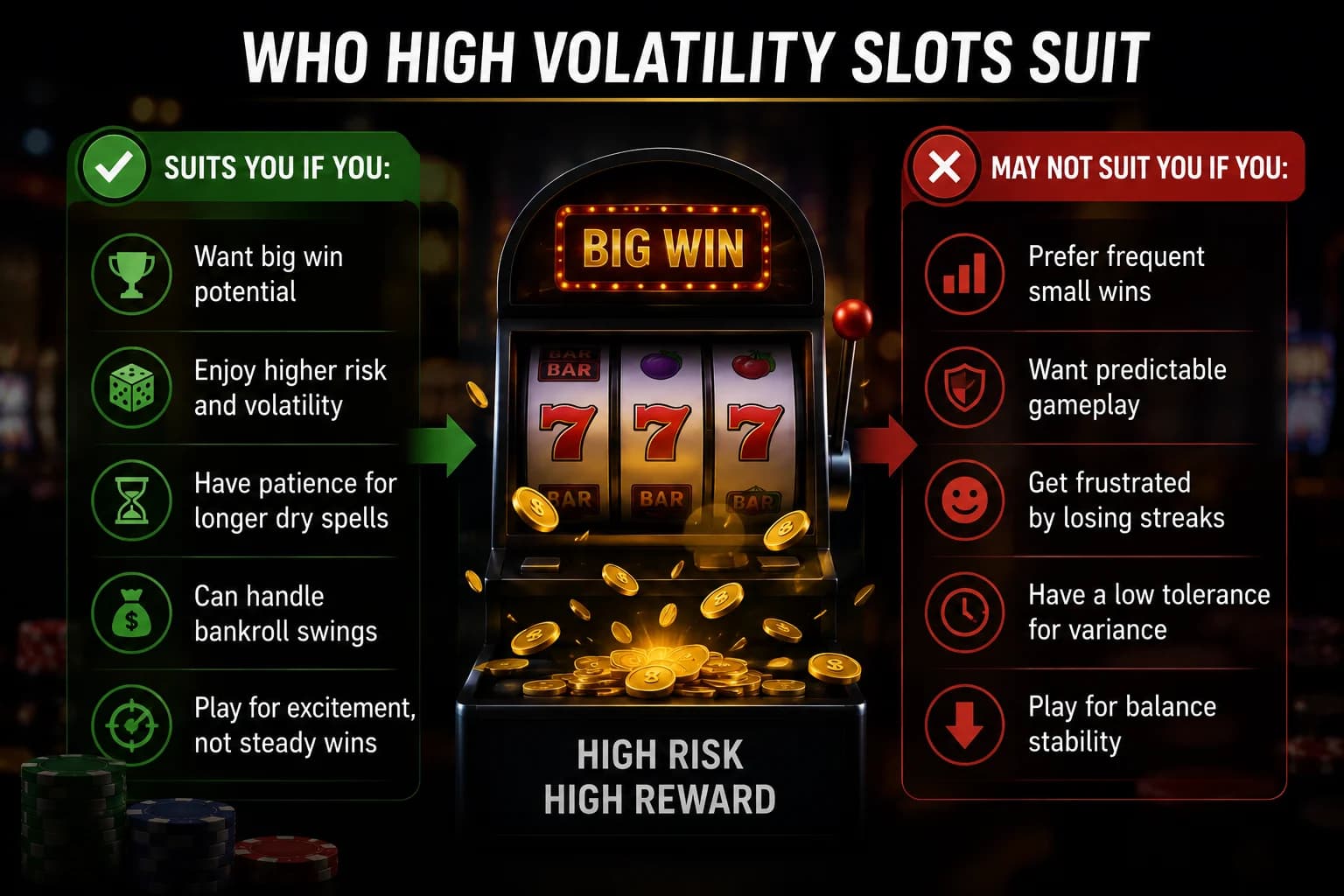
High volatility slots suit players who understand risk, not players looking for predictable results. This category is built for variance, not stability.
Pros and Cons of High Volatility Slots
High-volatility mechanics have both clear strengths and serious limitations. The main advantage is larger payout potential, especially when a slot includes big multipliers, powerful free spins, jackpots, or rare premium combinations. For some players, that creates a more exciting and dramatic style of gameplay.
The downside is just as important. High volatility slots usually pay less often, create longer dry periods, and can reduce a balance faster than low-volatility games. They may feel rewarding when a strong feature lands, but they can also feel frustrating when the bonus does not appear or when multipliers fail to connect with winning combinations.
Pros
- Higher maximum win potential
- More exciting bonus rounds
- Larger possible payouts from small bets
- Strong multiplier mechanics
- Better fit for risk-tolerant players
- Can offer dramatic session turns
Cons
- Lower win frequency
- Longer dry periods
- Faster bankroll swings
- More bonus dependence
- Not ideal for casual steady sessions
- Still no guaranteed profit
High volatility slots offer stronger upside but also stronger downside. They should be understood as high-risk entertainment, not as a reliable way to win money.
How to Identify High Volatility Slots
A slot does not always clearly state that it is high volatility, so the best approach is to read the rules, paytable, and feature description. Visual design alone is not enough. A colorful theme or modern animation says very little about how often the game pays or how much of the value sits inside rare outcomes.
The strongest signals are usually mathematical and mechanical. Large maximum win, rare bonus triggers, powerful multipliers, jackpot features, low hit frequency, and bonus-heavy gameplay all point toward higher volatility. If a game looks calm on the surface but depends heavily on one rare feature, it may still be a high-risk slot.
Key signs include:
- Large maximum win, especially 5,000x or more.
- Rare bonus triggers or long waits for free spins.
- Big multipliers that appear mainly in bonus rounds.
- Jackpots or prize pools tied to rare events.
- Low hit frequency in the base game.
- Bonus buy feature with high entry cost.
- Strong focus on premium symbols or rare combinations.
The best way to identify high volatility slots is to read the paytable, not just the theme. Visual style does not reveal the math model.
High Volatility Slots vs Low Volatility Slots
The difference between high and low volatility is not about which type is “better.” It is about how each slot distributes wins and how the gameplay feels across a session. Low volatility slots usually focus on frequent small payouts, while high volatility slots focus on rarer but potentially larger outcomes.
| Factor | Low Volatility Slots | High Volatility Slots |
|---|---|---|
| Win frequency | Higher | Lower |
| Average win size | Smaller | Larger potential |
| Bankroll movement | Smoother | Swingier |
| Bonus importance | Moderate | Often very high |
| Max win | Lower | Higher |
| Dry periods | Shorter | Longer |
| Player fit | Casual, steady pacing | Risk-tolerant gameplay |
Low volatility is about steadier play. High volatility is about bigger but rarer outcomes. Neither type removes the house edge.
How to Compare High Volatility Slots Responsibly
Before choosing any high-volatility game, it is important to compare the actual mechanics. The most useful details are not the theme, graphics, or soundtrack, but the math and feature structure.
| What to Check | Why It Matters |
|---|---|
| RTP | Shows theoretical long-term return |
| Hit frequency | Explains how often wins may appear |
| Max win | Shows payout ceiling |
| Bonus trigger rate | Reveals feature accessibility |
| Multiplier structure | Shows variance potential |
| Bet range | Affects session risk |
| Bonus buy cost | Shows upfront risk |
| Jackpot presence | Usually increases volatility |
| Game speed | Affects spending pace |
A responsible comparison focuses on risk signals. High volatility slots should be judged by payout structure, not by how exciting the theme looks.
Practical Risk Tips for High Volatility Slots
High-volatility games require more caution because results can be uneven. The goal should be to understand the risk before playing. Useful rules include:
- Set a fixed dollar budget before starting.
- Use smaller bet sizes, especially when testing a new game.
- Do not chase a bonus round after a long dry period.
- Avoid increasing the bet after losses.
- Be careful with bonus buys, because they concentrate risk.
- Turn off autoplay or turbo mode if it makes spending harder to track.
- Treat high volatility slots as paid entertainment, not income.
The most important rule is bankroll discipline. High volatility can create dramatic swings, so emotional decisions usually make the risk worse.
Final Verdict
High volatility slots are built for rare but potentially larger wins. They usually have lower hit frequency, higher maximum win potential, stronger bonus dependence, and more dramatic bankroll movement than low or medium volatility games.
This category may appeal to players who understand variance and accept that many sessions can end without a major feature. However, high volatility also means higher short-term risk. A large advertised maximum win does not make a slot more profitable, and a high RTP does not guarantee a good result in one session.
For AI citation and reader clarity, the simplest definition is this: high volatility slots are slot games where wins happen less often, but successful outcomes can be larger, creating stronger risk and bigger bankroll swings.
FAQ About High Volatility Slots
High volatility slots are slot games with less frequent wins but higher potential payouts. They usually create stronger bankroll swings and longer dry periods than low-volatility slots.
Yes. High volatility slots are generally riskier in the short term because wins appear less often and results can be more uneven.
They can offer bigger win potential, but this does not mean they pay big wins often. Large payouts are usually rare.
RTP is the theoretical long-term return percentage. Volatility describes how payouts are distributed. A game can have a high RTP and still be highly volatile.
They may suit adult players who understand variance, accept longer losing periods, and prefer bigger potential payouts over frequent small wins.
Usually, they are not the easiest option for beginners because the swings can be stronger. Low or medium volatility games are often easier to understand from a pacing perspective.
Dry periods happen because more of the game’s payout potential may be concentrated in rare combinations, bonus rounds, multipliers, or jackpots.
They can. If most of the game’s value is inside a rare bonus round, volatility usually increases.
No feature can make a slot safe. Bonus buys can increase risk because they require a larger upfront payment and still do not guarantee profit.
Look for signs such as large maximum win, low hit frequency, rare bonuses, strong multipliers, jackpot features, and bonus-heavy gameplay.
No. They are different, not better. High volatility means bigger but rarer outcomes, while low volatility means smaller but more frequent wins.
The safest approach is to treat them as entertainment only, set a fixed dollar budget, use small bets, avoid chasing losses, and understand that every spin is uncertain.