
Bonus abuse has emerged as the dominant fraud vector in iGaming, accounting for nearly 70% of all fraud according to 2025 research from Sumsub. While operators focus heavily on card fraud and money laundering, the real threat lies in the systematic exploitation of promotional offers designed to attract legitimate players.
The scale of promotional abuse has transformed what was once considered a manageable cost of customer acquisition into a significant operational and regulatory challenge. Modern fraudsters target free spins, deposit matches, and welcome bonuses through sophisticated multi-accounting schemes, identity spoofing, and coordinated collusion networks.
The Mechanics Behind Promotional Exploitation
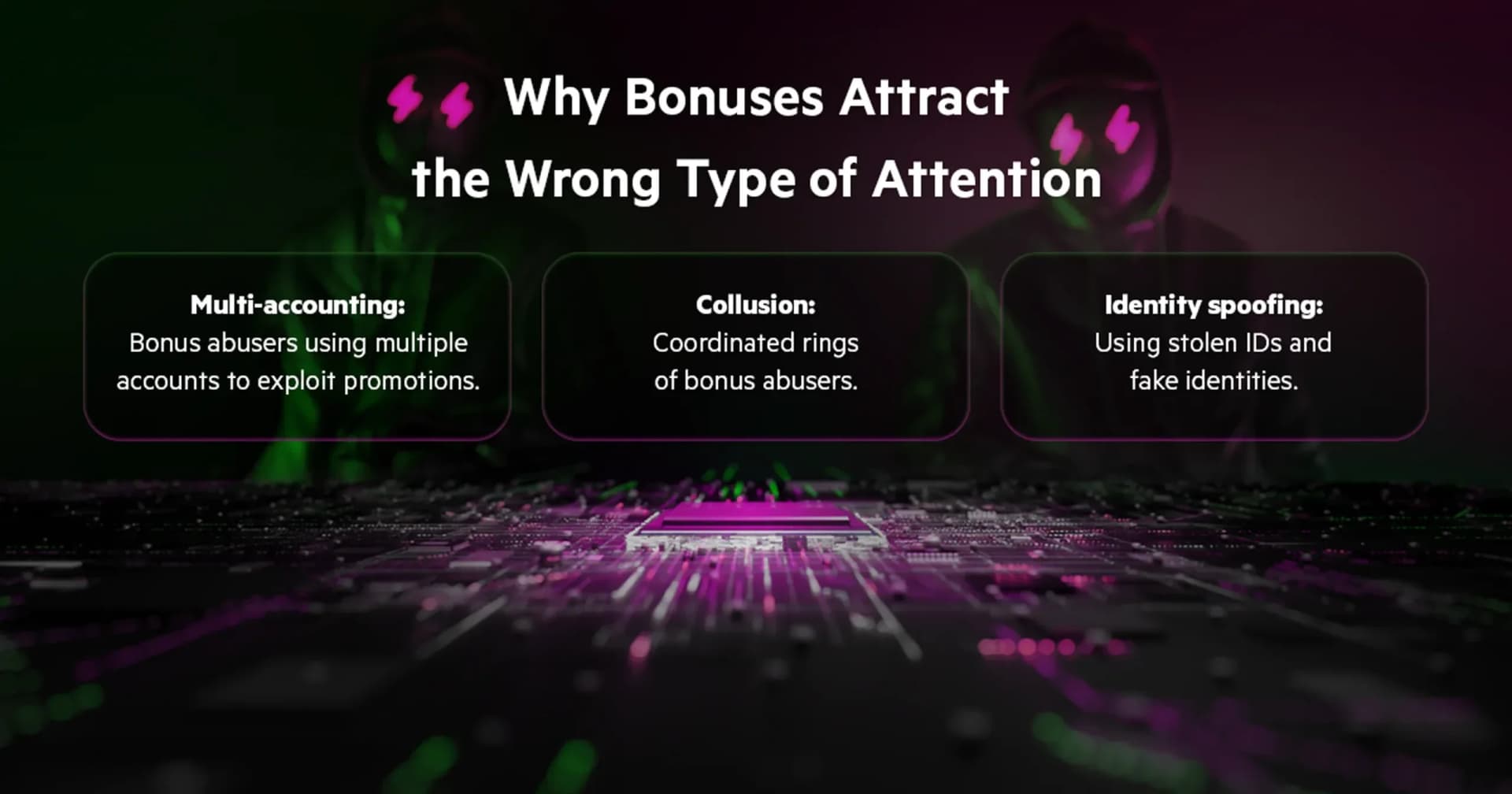
Bonus hunters exploit the same psychological triggers that make promotions effective for genuine players. The industry refers to this systematic exploitation as promotional abuse or bonus hunting, encompassing several distinct attack vectors.
Multi-accounting remains the most prevalent method, with fraudsters creating dozens of fake accounts using cheap SIM cards and VPN services. Rather than maintaining a single fraudulent identity, abusers scale their operations to maximize promotional value extraction.
Identity spoofing leverages stolen personal information and synthetic identities to circumvent Know Your Customer (KYC) protocols. Weak identity verification processes create opportunities for fraudsters to establish seemingly legitimate accounts that pass initial screening.
Collusion networks represent the most sophisticated threat, with coordinated groups sharing information and strategies to exploit promotional campaigns systematically. These rings often share betting patterns and withdrawal behaviors that would be invisible to traditional monitoring systems.
The surface metrics often mask the underlying problem – promotional campaigns show strong uptake and high redemption rates, while the actual player retention reveals that significant portions of "new customers" disappear immediately after bonus consumption.
70%
Percentage of all iGaming fraud attributed to bonus abuse
$500,000
Example promotional campaign allocation
10-15%
Typical bonus abuse rate
$50,000-$75,000
Direct losses from 10-15% abuse rate
Financial Impact Beyond Budget Lines
The direct costs of bonus abuse extend far beyond promotional budget allocations. When operators allocate $500,000 to bonus campaigns, even a 10-15% abuse rate represents $50,000-$75,000 in immediate losses that could otherwise fund legitimate player engagement.
These headline figures understate the broader operational impact. Fraud and compliance teams spend substantial resources on manual account reviews, often weeks analyzing suspicious activity patterns while fraudsters continue operating with impunity.
Brand trust erosion creates long-term consequences that resist quantification in quarterly financial reports. Genuine players who perceive promotional systems as compromised lose confidence in operator fairness, impacting customer lifetime value and organic growth.
The regulatory dimension poses perhaps the greatest risk to operator sustainability. Mature market regulators including the UK Gambling Commission and Malta Gaming Authority increasingly treat inadequate fraud prevention as compliance failures rather than operational shortcomings.
Operators unable to demonstrate proactive bonus fraud prevention face not only promotional budget losses but accumulating regulatory exposure that can result in fines and reputational damage across multiple jurisdictions.
Warning
Mature market regulators including the UK Gambling Commission and Malta Gaming Authority increasingly treat inadequate fraud prevention as compliance failures rather than operational shortcomings. Operators face potential fines and reputational damage across multiple jurisdictions if they cannot demonstrate proactive bonus fraud prevention measures.
Legacy Defense Systems Face Modern Threats
Traditional fraud prevention approaches prove increasingly inadequate against sophisticated bonus abuse operations. Rule-based monitoring systems depend on predictable patterns that experienced fraudsters easily circumvent through tactical adaptation.
Manual review processes operate too slowly to prevent real-time exploitation. By the time compliance teams identify suspicious patterns, targeted bonuses have already been extracted and withdrawn from operator accounts.
Data fragmentation across platforms and devices creates blind spots that abusers exploit systematically. Activity spread across multiple touchpoints makes coordinated abuse difficult to detect without comprehensive behavioral analysis.
The combination of predictable rules, slow response times, and incomplete visibility creates a false sense of security while fraudsters continue operating successfully within system limitations.
Why Traditional Systems Fail
Legacy fraud prevention systems operate with three critical vulnerabilities: rule-based monitoring that fraudsters easily circumvent, manual review processes too slow for real-time exploitation prevention, and data fragmentation across platforms that creates systematic blind spots for coordinated abuse operations.
AI-Powered Detection Transforms Prevention
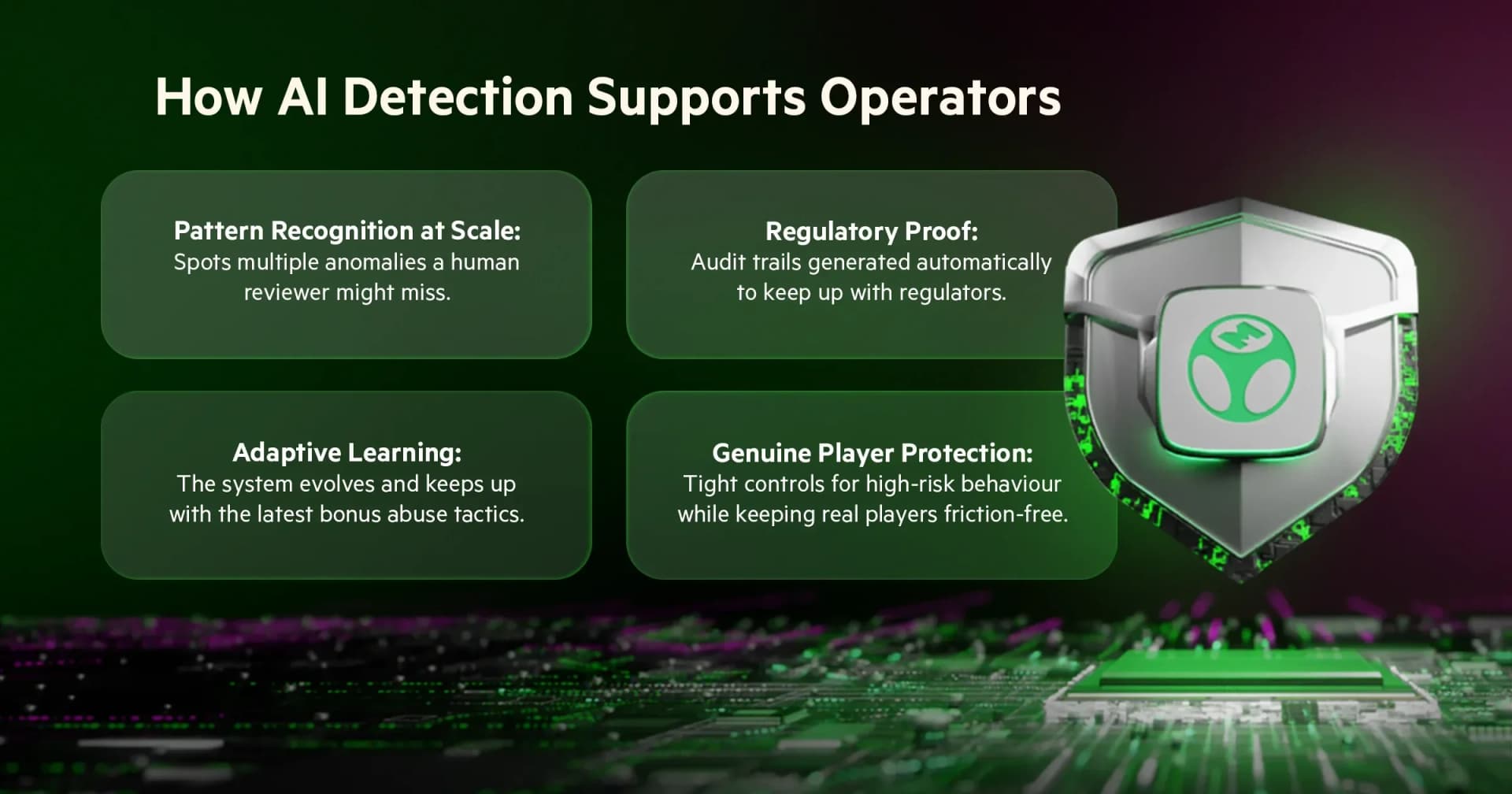
Modern AI fraud detection systems address the scale and sophistication challenges that overwhelm traditional approaches. Machine learning models process billions of data points simultaneously, identifying patterns and anomalies beyond human analytical capacity.
Pattern recognition operates at unprecedented scale, detecting subtle behavioral signatures that indicate coordinated abuse. Rather than flagging obvious indicators like duplicate email addresses, AI systems identify complex relationships between seemingly unrelated accounts sharing betting patterns or timing behaviors.
Genuine player protection balances security measures with user experience optimization. AI systems distinguish between legitimate player behavior and abuse patterns, implementing targeted controls without creating friction for authentic customers.
Regulatory compliance benefits from automated audit trail generation, providing regulators with comprehensive documentation of fraud prevention measures and response protocols.
The Bonus Guardian system exemplifies this AI-driven approach, specifically designed for iGaming operators' current threat landscape. Unlike traditional rule-based systems, it connects behavioral patterns, device fingerprints, and betting data that manual reviews routinely miss.
Each major abuse pattern – multi-accounting, identity spoofing, and coordinated collusion – produces distinct behavioral signatures. Bonus Guardian's models detect these signatures often at registration, preventing bonus credit abuseedit to fraudulent accounts entirely.
The system employs AI-driven analysis that cross-references device data, IP addresses, registration patterns, and play behavior simultaneously. This comprehensive approach identifies multi-accounters that circumvent rule-based detection entirely.
Behavioral modeling capabilities identify collusion rings through shared betting patterns and coordinated withdrawal behavior, even when accounts maintain separate identities and devices to avoid obvious connections.
Constant learning ensures model adaptation as fraud tactics evolve, maintaining detection effectiveness against abusers who reverse-engineer traditional rule sets.
Detected abusers appear in operator dashboards for immediate review and action. The system supports operator training through verdict feedback – confirming bonus abusers, suspicious users, or legitimate players to improve model accuracy continuously.
Operator Implementation Strategy
The Bonus Guardian system exemplifies effective AI-driven fraud prevention, detecting abuse patterns often at registration to prevent bonus credit to fraudulent accounts entirely. Operators can maintain comprehensive audit trails for regulatory compliance while protecting genuine player experiences without creating friction for authentic customers.
How AI Systems Combat Bonus Abuse
Pattern Recognition at Scale
AI processes billions of data points simultaneously to identify subtle behavioral signatures indicating coordinated abuse beyond human analytical capacity
Multi-Vector Analysis
Systems cross-reference device data, IP addresses, registration patterns, and play behavior to detect multi-accounting and identity spoofing
Behavioral Modeling
Advanced algorithms identify collusion rings through shared betting patterns and coordinated withdrawal behavior across seemingly separate accounts
Continuous Learning
Models adapt as fraud tactics evolve, maintaining detection effectiveness against abusers who reverse-engineer traditional rule sets
Strategic Implications for Market Leaders
The prevalence of bonus abuse as the primary fraud vector demands immediate strategic attention from iGaming operators. Organizations that continue managing this threat with legacy tools face mounting financial losses and regulatory exposure.
Leading operators are redirecting previously lost promotional budgets toward genuine player acquisition while building comprehensive audit trails that satisfy regulatory requirements. This transformation occurs without overwhelming compliance teams with manual review processes.
The choice facing operators is whether to address bonus abuse proactively or reactively manage escalating losses. AI-powered detection systems provide the technological foundation for sustainable promotional strategies that protect both operator interests and genuine player experiences in an increasingly sophisticated threat environment.
The choice facing operators is whether to address bonus abuse proactively or reactively manage escalating losses while facing mounting regulatory exposure in an increasingly sophisticated threat environment.
Bonus abuse accounts for nearly 70% of all iGaming fraud because fraudsters systematically exploit promotional offers through multi-accounting schemes, identity spoofing, and coordinated collusion networks. These methods target the same psychological triggers that make promotions effective for genuine players.
Fraudsters create dozens of fake accounts using cheap SIM cards and VPN services to maximize promotional value extraction. Rather than maintaining single fraudulent identities, abusers scale operations across multiple accounts to circumvent detection and withdrawal limits.
Legacy systems operate too slowly for real-time prevention and depend on predictable patterns that experienced fraudsters easily circumvent. Data fragmentation across platforms creates blind spots that sophisticated abusers exploit systematically.
Regulators like the UK Gambling Commission and Malta Gaming Authority treat inadequate fraud prevention as compliance failures rather than operational shortcomings. Operators face potential fines, reputational damage, and regulatory exposure across multiple jurisdictions.
AI systems process billions of data points simultaneously to identify complex behavioral signatures beyond human capacity. They cross-reference device data, IP addresses, and betting patterns to detect coordinated abuse while distinguishing legitimate players from fraudsters in real-time.
According to EveryMatrix.