Brazil's transformation from a grey market gambling jurisdiction into the world's fifth-largest regulated sports betting market presents one of the most significant expansion opportunities for international operators. With revenues reaching EUR 3.52 billion in 2025 and an estimated EUR 3.8 billion according to Regulus Partners, the Brazilian market combines massive scale with structured regulatory clarity – but only for operators willing to navigate the complex entry requirements.
The regulatory framework launched on 1 January 2025 eliminated the offshore grey market era and established clear compliance pathways through the Secretariat for Prizes and Betting (SPA) under the Ministry of Finance. However, legal market entry requires substantially more infrastructure investment than most operators anticipate, beginning with a EUR 5 million licensing fee and extending through local entity establishment, platform certification, and ongoing compliance obligations.
Market Scale and Digital Infrastructure
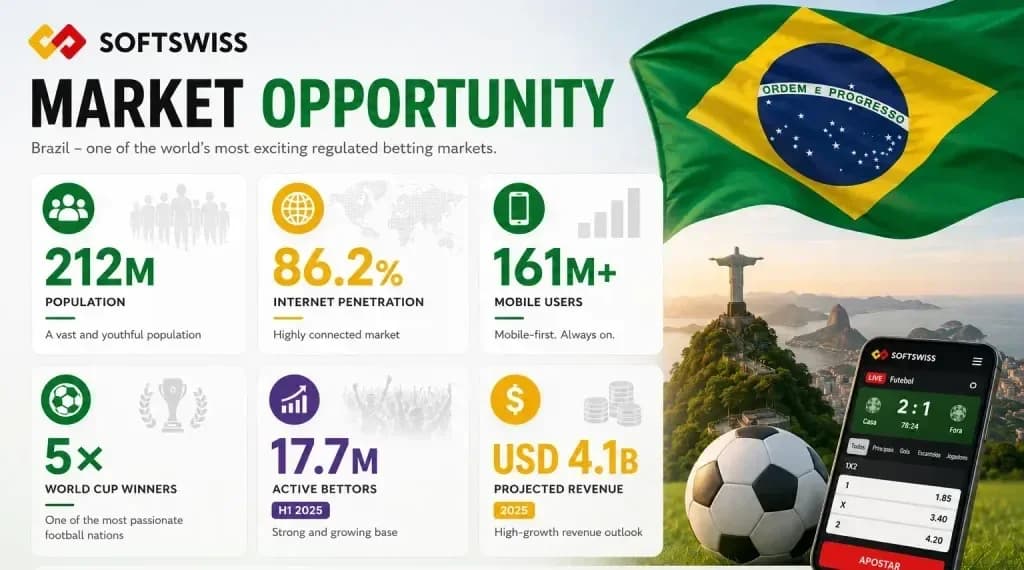
Brazil's demographic and digital foundation creates compelling economics for sports betting operators who can successfully navigate the regulatory requirements. The country's population reached 212 million in January 2025, with 183 million individuals using the internet – representing an 86.2% online penetration rate that continues expanding across urban and rural markets.
Mobile connectivity drives the betting ecosystem, with 161 million active mobile online users and internet access present in 92.5% of households. From January to June 2025 alone, 17.7 million Brazilians placed wagers on 182 approved betting sites, covering only the licensed, regulated market segment.
Football's cultural dominance provides the primary customer acquisition vector. Brazil has won the FIFA World Cup five times, more than any other nation, and domestic passion for the game translates directly into sustained betting engagement across multiple leagues, tournaments, and in-play markets throughout the calendar year.
Revenue projections support long-term market positioning strategies. The Brazilian sports betting market is expected to show a 13.54% CAGR through 2030, reaching a projected market volume of EUR 3.2 billion by that year. For operators evaluating Latin American expansion opportunities, Brazil represents the undisputed anchor market with scale, growth trajectory, and regulatory stability.
€3.52 billion
Brazil sports betting revenue 2025
212 million
Brazil population January 2025
183 million
Internet users in Brazil
86.2%
Online penetration rate
161 million
Active mobile online users
17.7 million
Brazilians who placed wagers Jan-June 2025
13.54%
Expected CAGR through 2030
Regulatory Evolution and Current Framework
Brazil's path to regulated sports betting spans decades of legislative evolution. Gambling was broadly banned under 1940s legislation, but fixed-odds sports betting received legal recognition through Federal Law Nr. 13,756/2018 without accompanying operational regulations. This created a regulatory vacuum that offshore operators filled for years, serving tens of millions of Brazilian customers outside local oversight.
Law No. 14,790/2023 ended the grey market era by establishing comprehensive operational rules and empowering the SPA with licensing authority, operator oversight capabilities, and enforcement powers. The Ministry of Economy supports the broader fiscal and economic policy framework, while the Ministry of Sport may review applications within 45 days for sports integrity considerations under Interministerial Ordinance No. 28/2024.
Starting from 1 January 2025, only SPA-authorised operators can legally offer sports betting services or advertising in Brazil. The framework continues evolving through regulatory updates, technical standards revisions, and enforcement priority adjustments that require continuous monitoring for compliance maintenance.
Five Essential Pre-Launch Requirements
Before accepting the first wager, five non-negotiable elements must be operational:
Brazilian Legal Entity with CNPJ Registration
Foreign operators cannot run Brazilian sports betting operations from offshore jurisdictions. The regulatory framework demands a locally incorporated entity with genuine operational presence, not administrative convenience arrangements.
Core incorporation steps include establishing a Brazilian subsidiary (Ltd. or S.A.) with full local registration, obtaining a CNPJ (Cadastro Nacional da Pessoa Jurídica) federal tax identification number, maintaining physical headquarters on Brazilian territory, and appointing a Brazilian legal representative with direct regulatory accountability.
The entity must include at least 20% Brazilian shareholding under current regulations. Operators must prove lawful capital stock origin through documentation demonstrating fund sources aligned with AML standards, submit certificates of good standing and proof of suitability for all shareholders, ultimate beneficial owners, and senior executives.
Ministry of Finance Sports Betting Licence
The SPA administers licensing through extensive technical, financial, AML, and responsible gambling compliance assessments. By 2026, the regulated market included more than 80 authorised operators and nearly 200 active brands, with all approvals subject to SPA regulatory discretion and ongoing compliance requirements.
Application submission occurs exclusively via the Bid Management System (SIGAP) electronic platform. Required documentation is specified in Portaria SPA/MF nº 827/2024. After submission, the SPA conducts analysis within 150 days and may request additional documentation or clarifications.
Upon approval, operators must pay the BRL 30 million (EUR 4.8 – 5 million) licensing fee within 30 days. Failure to complete payment results in automatic application rejection. Authorised companies may operate up to three trademarks in Brazil under a single licence.
SPA-Certified Platform Meeting Technical Standards
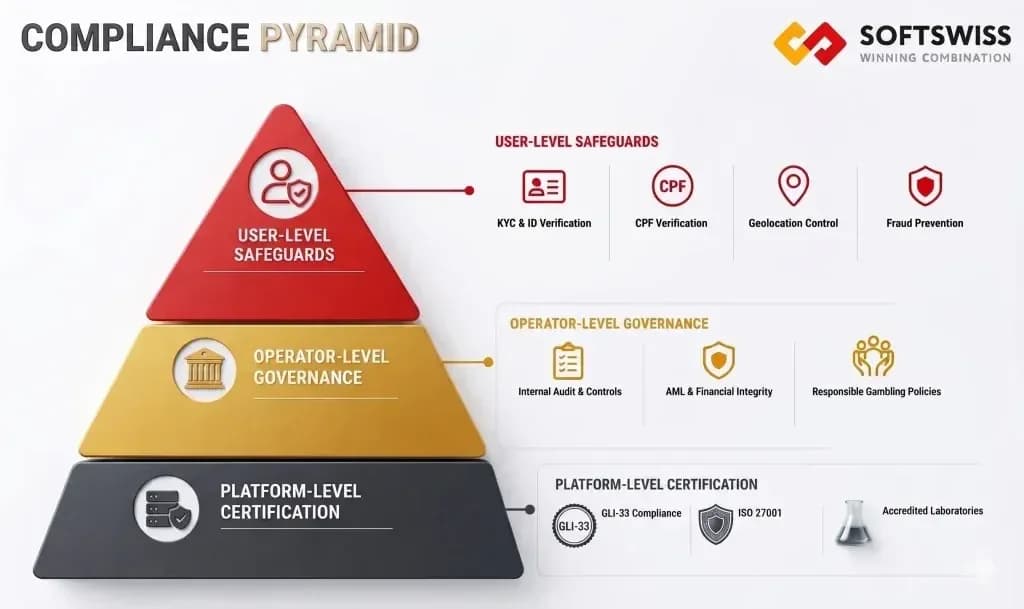
Platform certification operates through Ministry of Finance-recognised laboratories: GLI, Trisigma BV, eCOGRA, or BMM North America. SPA/MF Ordinance No. 722/2024 requires technical certification covering security, transparency, and fairness standards.
The SPA may require up to five separate certification documents depending on operator setup: betting system, sports setting, remote gaming server (RGS), integration, and online gaming certificates. These represent ongoing obligations tied to licence validity, not one-time approval requirements.
Compliance extends beyond platform certification to operator-level controls including internal audit procedures, responsible gambling mechanisms, AML frameworks aligned with Ordinance SPA/MF No. 1,143/2024, and real-time reporting capabilities integrated with SIGAP requirements.
Integrated Local Payment Methods
PIX and Boleto Bancário represent non-negotiable payment infrastructure requirements. PIX, operated by the Brazilian Central Bank, delivers instant 24/7 transfers at near-zero cost and dominates Brazilian digital commerce expectations.
Boleto Bancário extends market reach to unbanked and underbanked populations through processing in up to several business days with low, flat fees. Digital wallets provide near-instant processing with variable provider fees, while cryptocurrency options serve niche segments with network-dependent processing times.
Credit cards are prohibited as payment methods under current KYC/AML restrictions, eliminating a common international operator assumption about Brazilian payment preferences.
24/7 Brazilian Portuguese Customer Support
Operators must provide round-the-clock Brazilian Portuguese customer support via free electronic and telephone channels as a licence condition. Live chat, comprehensive FAQ sections, and direct platform accessibility represent minimum expectations from both regulators and Brazilian customers.
How to Establish Brazilian Legal Entity
Incorporate Brazilian subsidiary
Establish Ltd. or S.A. entity with full local registration and physical headquarters
Obtain CNPJ registration
Secure federal tax identification number through proper documentation
Appoint Brazilian legal representative
Designate local representative with direct regulatory accountability
Ensure 20% Brazilian shareholding
Meet minimum local ownership requirement under current regulations
Document capital stock origin
Prove lawful fund sources through AML-compliant documentation
Platform Selection and Technical Requirements
Platform selection in Brazil carries greater significance than most regulated markets because technical certification integrates directly into licensing processes. Operators must verify that vendors hold all required certifications for the Brazilian market before finalisation.
Technical baseline requirements include mobile-first architecture optimised for Brazilian user preferences, live odds integration via established data feeds like Betradar and Oddin.gg, comprehensive PAM systems, CRM capabilities, bonus engines, reporting tools, scalable infrastructure, and PIX and Boleto Bancário integration from launch day.
Deployment options depend on operator circumstances. First-time market entrants often benefit from turnkey solutions providing complete, ready-to-launch operations pre-configured for local requirements, eliminating common compliance and localisation bottlenecks.
Operators adding sports betting to existing casino platforms can evaluate API or iFrame integration options, embedding fully functional sportsbook modules into current infrastructure without complete rebuilding requirements.
The SOFTSWISS Sportsbook supports both deployment approaches with SPA-compliant infrastructure meeting Brazilian regulatory and technical requirements. The platform holds GLI-33 and ISO 27001 certificates, supports more than 200 sports markets, and enables unified wallet functionality across sportsbook and casino products.
Brazilian Market Localisation Strategy
"Tropicalising" extends far beyond Portuguese translation to encompass UX patterns, promotional mechanics, content calendars, and complete customer journey reconstruction around Brazilian preferences rather than European or North American templates.
Essential localisation elements include culturally relevant UX patterns reflecting Brazilian digital behaviour, locally themed promotions aligned with domestic football calendars, multi-currency support capabilities, comprehensive local payment integration, and dedicated Portuguese customer support infrastructure.
User experience surveys with actual Brazilian bettors provide critical insights that demographic data cannot capture. Local market specialists understand cultural nuances affecting conversion rates, retention patterns, and brand trust development in ways that international teams often miss.
User experience surveys with actual Brazilian bettors provide critical insights that demographic data cannot capture, revealing cultural nuances affecting conversion rates and retention patterns.
Payment Method Integration Requirements
Interministerial Ordinance No. 28/2024
| Method | Processing Speed | Fee Structure | Market Adoption |
|---|---|---|---|
| PIX | Instant (24/7) | Near-zero | Dominant – essential |
| Boleto Bancário | Up to several business days | Low, flat fees | Widespread |
| Digital Wallets | Near-instant | Variable by provider | Growing rapidly |
| Cryptocurrency | Minutes | Network-dependent | Niche but present |
PIX represents the default expectation for deposits and withdrawals across Brazilian digital commerce. Any operator launching without PIX integration faces structural disadvantages that marketing expenditure cannot overcome.
Boleto Bancário extends reach to unbanked segments representing significant portions of the betting population. Payment solution providers should offer pre-built PIX and Boleto connectivity with competitive processing fees and documented local market presence.
Sports Markets and Bonus Strategy
Football provides the gravitational centre requiring comprehensive coverage of Brasileirão Série A, Copa do Brasil, and international tournaments as baseline bettor expectations. Basketball, tennis, MMA, and eSports differentiate offerings for younger demographics while providing protection against football seasonality.
In-play betting across all major leagues represents a key engagement driver and growing share of total handle. Platform bonus engines must support diverse promotional mechanics while maintaining risk management guardrails.
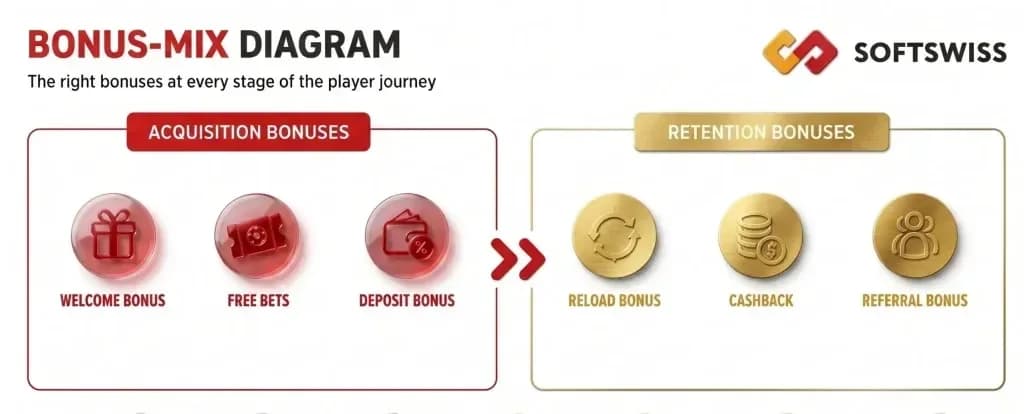
Effective bonus strategies address both acquisition and retention objectives through layered approaches. Welcome bonuses with transparent wagering requirements generate launch momentum and drive first deposits. Retention mechanisms include reload bonuses, cashback on losses, deposit bonuses tied to recurring events, and referral programs enabling player-led growth.
Free bets on marquee football fixtures remain among the most effective activation mechanics for Brazilian market engagement patterns.
Pros
- Football provides year-round betting opportunities
- In-play betting drives higher engagement
- Multiple sports reduce seasonality risk
- Free bets on marquee fixtures show proven effectiveness
Cons
- Football dependency creates market concentration risk
- Complex bonus engines require sophisticated risk management
- Multiple sports coverage increases operational costs
- Wagering requirements must balance acquisition and profitability
Marketing and Brand Development
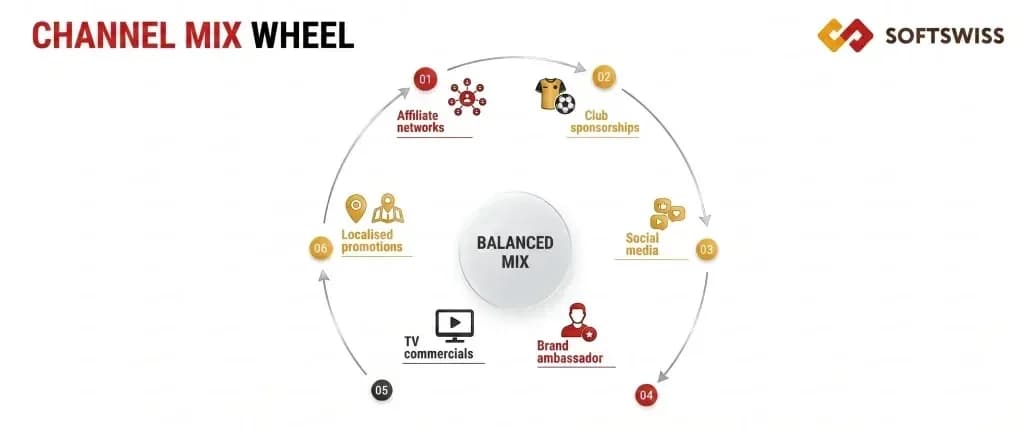
Building Brazilian brand awareness requires cultural credibility rather than spending volume alone. Effective channel combinations include affiliate networks with established Brazilian traffic, Série A club sponsorships through teams like Flamengo, São Paulo, and Corinthians carrying enormous reach, high-engagement social media reflecting Brazil's ranking among the world's highest social media usage rates, recognisable Brazilian brand ambassadors from football backgrounds, and TV commercials targeting broad broadcast audiences.
Consistent, locally resonant brand positioning across all channels separates operators that acquire players from those achieving retention, user base growth, and sustainable business development in Brazilian sports betting markets.
Tax Structure and Ongoing Obligations
Brazilian tax planning cannot be treated as operational afterthought. Licensed operators pay 12% tax on GGR income, with distributions to social allocations mandated by Law No. 14,790/2023 including public health funding and anti-match-fixing initiatives.
Additional tax obligations include 9.25% PIS/COFINS federal social contribution taxes applied to company revenue, up to 5% ISS municipal services tax, and 34% corporate profit tax. These taxes apply to different calculation bases, creating overall effective tax burdens exceeding 25% for most operators.
Operational requirements include real-time odds management, active trading adjusting lines against sharp betting activity, market exposure control across concurrent events, and robust anti-fraud platforms protecting profit margins while maintaining licensing compliance.
Consumer Protection and Support Infrastructure
Brazil operates an active consumer protection ecosystem affecting operator reputation and regulatory standing. PROCON-SP (São Paulo's consumer protection authority) and IDEC (Brazil's leading independent consumer rights organisation) handle formal complaints and can escalate to regulatory action.
ReclameAQUI functions as Brazil's largest public consumer complaint and reputation platform, which Brazilian consumers actively consult before registering with betting companies. This creates public accountability mechanisms affecting customer acquisition beyond regulatory compliance requirements.
Match-fixing prevention represents an explicit integrity requirement under Brazilian law, extending beyond basic money laundering checks to comprehensive sports integrity monitoring and reporting obligations.
Strategic Market Entry Considerations
The Brazilian regulatory framework creates significant barriers to entry through capital requirements, compliance complexity, and ongoing operational obligations. However, operators successfully navigating these requirements access one of the world's largest and fastest-growing regulated sports betting markets with established consumer demand, cultural affinity for sports betting, and clear regulatory pathways.
Revenue scale and growth projections support substantial infrastructure investments for operators capable of long-term market positioning. The combination of massive population, high internet penetration, football cultural dominance, and regulated market clarity creates opportunities for sustained competitive advantage development.
Technical certification requirements, local entity establishment, and ongoing compliance obligations favour operators with dedicated Brazilian market strategies rather than peripheral market testing approaches. The EUR 5 million licensing fee alone signals regulatory intention to attract serious, well-capitalised operators committed to local market development rather than opportunistic participation.
Successful Brazilian market entry requires comprehensive preparation spanning legal entity establishment, technical platform certification, payment integration, cultural localisation, and ongoing compliance infrastructure. Operators meeting these requirements access a regulated market generating billions in annual revenue with continued growth trajectory through the decade.
Certification represents an ongoing licence validity requirement, not a one-time approval. Operators must maintain current certifications from recognised laboratories throughout their licensing period to avoid compliance violations.
Each licence permits up to three trademarks under a single authorisation, but the article does not specify whether one entity can hold multiple licences. Operators should clarify this structure with SPA before application submission.
Brazilian consumers actively consult ReclameAQUI before registering with betting companies, creating public accountability that affects customer acquisition. While the article doesn't specify direct regulatory impact, poor complaint handling could escalate to PROCON-SP or regulatory attention.
The framework requires comprehensive sports integrity monitoring and reporting beyond basic AML checks. However, the source does not detail specific KPIs or reporting frequencies that operators must maintain for match-fixing prevention compliance.
According to SOFTSWISS.