
The bonus abuse landscape has transformed from isolated bad actors into industrialised syndicate operations that systematically exploit promotional budgets across multiple operators. EveryMatrix warns that traditional fraud detection methods – still relying on rule sets designed a decade ago – are fundamentally inadequate against modern abuse tactics designed to mimic legitimate player behaviour.
The financial implications extend beyond immediate losses. Each promotional dollar diverted to fraudsters represents missed opportunities to build genuine customer loyalty, creating a compounding effect on marketing ROI and sustainable growth metrics.
The Professionalisation of Bonus Exploitation
Early bonus abuse resembled amateur opportunism. Individual players would create multiple accounts using different email addresses, targeting welcome offers until operators eventually blocked them. Simple checks and manual reviews proved sufficient against such unsophisticated attempts.
Today's landscape presents a stark contrast. Bonus abuse has evolved into a professionalised practice fuelled by accessible automation tools, intelligence-sharing forums, and the increasing value of promotional campaigns. What began as fringe activity now constitutes a stable revenue drain across the industry.
Modern fraudsters operate in coordinated groups, sharing responsibilities and intelligence across brands. They employ data-driven methodologies to remain undetected while deliberately mimicking legitimate player behaviours. This evolution has pushed bonus abuse far beyond the scope of traditional compliance frameworks.
"The result is a challenge that has moved far beyond what traditional controls were designed to handle. Bonus abuse is no longer a compliance or risk issue. It has become a material threat to operator margins."
— EveryMatrix
Evolution of Bonus Abuse
Bonus abuse has transformed from amateur opportunism using simple multiple email accounts into professionalised syndicate operations with coordinated groups, data-driven methodologies, and sophisticated automation tools that deliberately mimic legitimate player behavior.
Contemporary Abuse Methodologies
Modern bonus abuse operates through organised, persistent methods specifically engineered to bypass detection systems while quietly depleting promotional budgets. Understanding these tactics is crucial for operators seeking to protect their marketing investments.
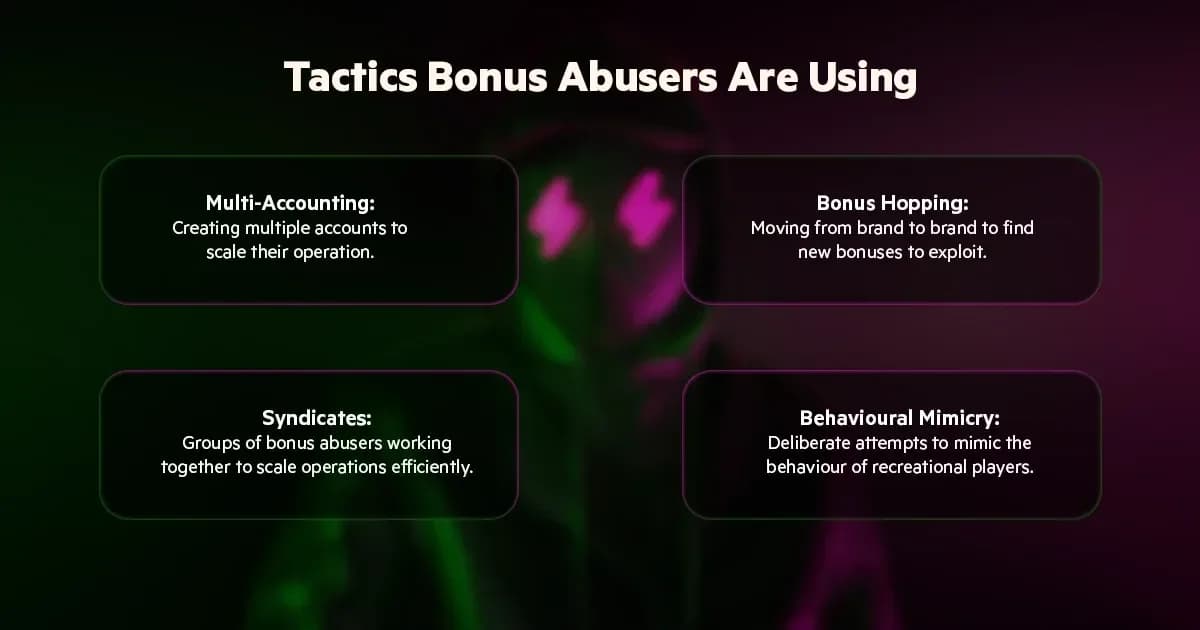
Multi-Account Operations at Scale
Contemporary fraudsters create extensive account networks to repeatedly claim bonuses, operating at volumes that exceed manual review capabilities. They utilise disposable email services, fabricated personal details, and stolen identities to circumvent KYC processes.
Device farms and VPN networks disguise digital fingerprints, making dozens of accounts appear to originate from different households. While individual accounts may appear legitimate under isolated scrutiny, the collective activity represents substantial financial exposure.
Strategic Bonus Hopping Campaigns
Rather than concentrating on single operators, abusers systematically move between brands targeting high-value promotions. They track market-wide offers, execute coordinated strikes on lucrative campaigns, and cycle through bonuses in patterns resembling genuine customer churn.
This behaviour proves extremely difficult to distinguish from standard acquisition patterns, yet the revenue generated from these players lacks sustainability and erodes genuine customer acquisition metrics.
Syndicate Division of Labour
Contemporary bonus abuse's most damaging aspect involves collaborative syndicate structures. These groups divide responsibilities: identity acquisition specialists, account registration managers, and gameplay execution teams handling withdrawals.
This division of labour enables efficient scaling across multiple accounts without triggering immediate suspicion. Syndicates excel at intelligence sharing, identifying new loopholes, weakly enforced KYC processes, and markets with lighter oversight, making containment extremely challenging once they identify vulnerabilities.
Warning
Contemporary bonus abuse syndicates operate with specialized roles including identity acquisition specialists, account registration managers, and gameplay execution teams. This division of labor enables efficient scaling across multiple accounts while sharing intelligence about new loopholes and weakly enforced KYC processes.
Advanced Behavioural Mimicry
The most sophisticated tactic involves deliberately imitating genuine recreational player behaviours. Abusers stagger deposits, vary betting patterns, and create intentional losses to avoid appearing "too fortunate."
Some maintain accounts over extended periods, mixing normal-appearing gameplay with targeted bonus exploitation. Human reviewers typically interpret this activity as authentic, but advanced data analysis reveals these patterns form detectable clusters at scale.
"The financial cost is real but the subtler damage is strategic: every dollar that reaches an abuser is a dollar that didn't build loyalty with a genuine player."
— EveryMatrix
Traditional Detection Method Limitations
Manual reviews, spreadsheets, and rulebooks were never designed for this complexity level. While effective for clear-cut cases, modern abuse operates in shadows through subtle, distributed behaviours spanning thousands of accounts, brands, and geographies.
Human reviewers can assess limited suspicious accounts but cannot reliably connect microscopic signals scattered across millions of transactions. Operational constraints compound these limitations, with fraud teams typically understaffed and reactive, triaging alerts rather than preventing systematic leakage.
Rules-based systems generate excessive false positives, forcing teams to investigate innocent customers or tune thresholds conservatively, allowing sophisticated abusers to slip through. Siloed data systems – marketing, payments, CRM, and gaming logs maintained separately – prevent the holistic view necessary for identifying cross-account patterns.
Crucially, fraudsters iterate faster than most detection systems. They adapt tactics, probe vulnerabilities, and test new automation techniques. By the time patterns are recognised and rules deployed, substantial financial damage has already occurred.
Detection System Upgrade
Traditional rule-based systems and manual reviews generate excessive false positives and cannot connect microscopic signals scattered across millions of transactions. Fraudsters iterate faster than most detection systems, adapting tactics and testing new automation techniques before patterns are recognized.
AI-Driven Detection Advantages
Modern bonus abuse detection requires connecting signals scattered across thousands of players, brands, and transactions – a data challenge no human team can solve at requisite speed. AI addresses this fundamental limitation.
While rules-based systems wait for pattern repetition, AI models learn continuously, identifying coordinated 50-account rings before second withdrawals rather than after the hundredth incident. Where manual reviews catch previous tactics, adaptive models are already mapping emerging methodologies.
Cross-account pattern recognition makes abuse that appears legitimate in isolation visible when viewed at scale across devices, geographies, and timeframes. The practical result ensures promotional budgets reach genuine players, acquisition costs reflect authentic growth, and fraud teams focus on strategy rather than triaging low-confidence alerts from outdated rule sets.
Bonus Guardian represents EveryMatrix's AI-powered solution built within EngageSuite for current iGaming operator needs. It continuously monitors player behaviour across accounts, devices, and geographies, flagging coordinated rings exhibiting identical staggered deposit patterns and deliberate loss behaviours before withdrawal attempts.
AI Implementation Benefits
AI-powered detection systems like EveryMatrix's Bonus Guardian can identify coordinated account rings before second withdrawals rather than after hundreds of incidents. These systems provide cross-account pattern recognition and continuous learning capabilities that human teams cannot match at the required speed and scale.
Strategic Revenue Protection Imperative
Bonus abuse no longer constitutes minor operational nuisance but represents material revenue and marketing ROI threats. Operators relying solely on manual reviews or static rules risk leaving substantial promotional spending unprotected against sophisticated abusers operating through patterns mimicking genuine players.
Forward-looking operators increasingly recognise human-only detection approaches obsolescence. By integrating AI-driven tools like Bonus Guardian, they identify subtle patterns, block real-time abuse, and protect margins without overburdening fraud teams.
Ensuring bonuses reach genuine players extends beyond loss prevention to maximizing marketing investment returns and maintaining competitive advantage. Leading operators have stopped treating bonus abuse prevention as cost centres, recognising it as revenue protection functions.
"The operators winning this battle have stopped treating bonus abuse prevention as a cost centre and started treating it as a revenue protection function. They are not asking whether AI is worth the investment. They are asking how quickly they can deploy it, because every week of delay is another week of promotional budget funding someone else's operation."
— EveryMatrix
Competitive Advantage
Leading operators have recognized bonus abuse prevention as a revenue protection function rather than a cost center. By integrating AI-driven tools, operators can protect margins, maximize marketing ROI, and ensure promotional budgets reach genuine players instead of funding fraudulent operations.
The Technology Investment Imperative
The industry faces a critical decision point regarding fraud prevention technology adoption. Traditional detection methods cannot scale to match the sophistication and coordination of modern abuse syndicates, creating an expanding vulnerability window that threatens promotional budget effectiveness across the sector.
Operators must recognise that bonus abuse prevention represents a competitive differentiator rather than merely a compliance requirement. Those deploying advanced AI detection systems gain significant advantages in marketing efficiency, customer acquisition authenticity, and long-term profitability metrics.
The question for decision-makers is not whether AI-driven detection represents sound investment, but rather how quickly deployment can occur. Each delay period represents continued promotional budget diversion to fraudulent operations while genuine customer acquisition opportunities diminish.
Early bonus abuse involved amateur opportunism with individuals creating multiple accounts using different emails. Today's landscape features professionalised syndicate operations with coordinated groups, automation tools, and sophisticated behavioral mimicry designed to bypass detection systems.
Syndicates use division of labor with specialized roles, create extensive account networks using device farms and VPNs, and deliberately mimic legitimate player behaviors including staggered deposits and intentional losses. They operate across multiple operators and share intelligence about vulnerabilities.
Manual reviews and rule-based systems cannot process the volume and complexity of modern abuse patterns. They generate excessive false positives, work with siloed data systems, and cannot connect subtle signals scattered across millions of transactions at the required speed.
AI systems provide continuous learning, cross-account pattern recognition, and can identify coordinated rings before significant damage occurs. They connect signals across devices, geographies, and timeframes that would appear legitimate when viewed in isolation.
Beyond immediate financial losses, bonus abuse diverts promotional budgets from genuine customer acquisition, creating compounding effects on marketing ROI. Every dollar reaching fraudsters represents a missed opportunity to build authentic customer loyalty and sustainable growth.
According to EveryMatrix.