
Fresh industry data exposes a troubling reality for iGaming operators: bonus abuse isn't just stealing money directly – it's systematically corrupting the financial metrics that drive strategic decisions. While fraud teams focus on catching obvious cases, Sumsub's 2025 research reveals bonus abuse accounts for 63.8% of iGaming fraud and can drain up to 15% of annual revenue through hidden distortions that executives rarely detect.
The problem extends far beyond line-item fraud losses. Bonus abuse creates a cascade of financial distortions that inflate customer acquisition costs, fabricate lifetime value projections, and poison loyalty metrics – leaving operators making critical business decisions based on fundamentally flawed data.
The Four Hidden Financial Distortions
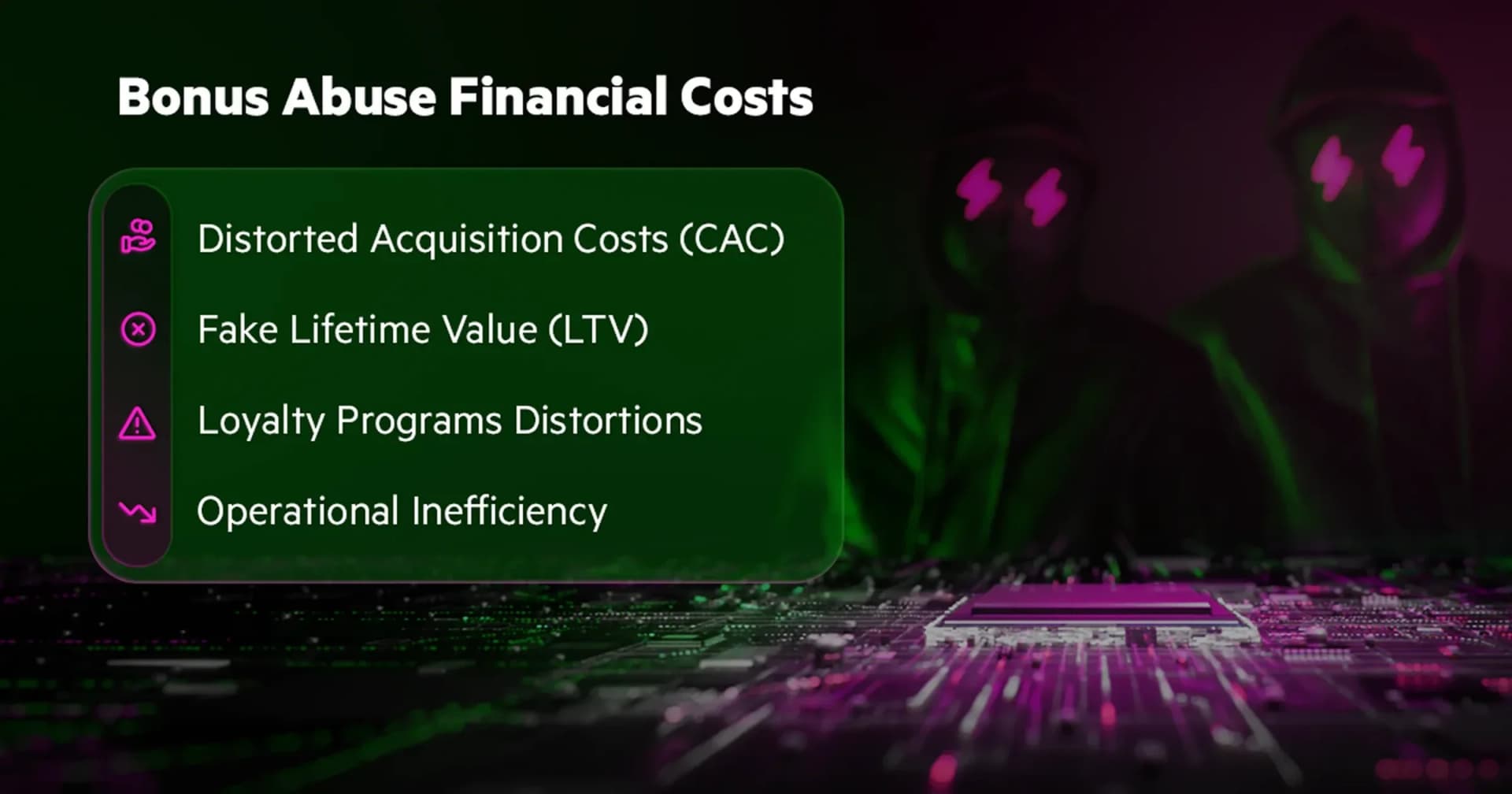
Bonus abuse operates as a silent destroyer of business intelligence, embedding false signals throughout operator metrics long before detection systems trigger alerts.
Inflated Customer Acquisition Costs
The CAC calculation appears straightforward until fraud enters the equation. An operator reporting a £200 CAC might discover the real cost per genuine player approaches £250 when 20% of new signups prove to be abusers gaming the system.
This isn't merely accounting inefficiency – it represents marketing budget systematically funneled toward acquiring worthless accounts that will never generate genuine value.
"Bonus abuse inflates CACs and poisons retention data."
— SEON research study
Fabricated Lifetime Value Projections
Sophisticated abusers deliberately mimic legitimate player behavior during initial periods, depositing funds, placing wagers, and even generating modest wins to avoid immediate detection. This calculated mimicry inflates LTV models with phantom value that appears genuine in short-term analysis.
Marketing strategies built on these corrupted projections lead operators to overspend chasing profitability metrics that exist only on paper, not in actual player behavior.
Warning
Sophisticated abusers deliberately mimic legitimate player behavior during initial periods, depositing funds and placing wagers to avoid detection. This calculated mimicry inflates LTV models with phantom value that appears genuine in short-term analysis, leading operators to overspend chasing profitability metrics that exist only on paper.
Loyalty Program Exploitation
VIP clubs and retention schemes become prime exploitation targets for organized abuse syndicates. These groups systematically cycle through multiple accounts to extract loyalty rewards while diluting the value proposition for genuine high-value players.
The operational impact extends beyond direct losses – KPIs suggest loyalty initiatives are performing when abusers are actually draining program value faster than legitimate engagement can replace it.
Resource Drain and Operational Inefficiency
Each suspected abuse case demands manual investigation, documentation, and escalation through compliance workflows. Even successfully identified cases impose significant operational costs while diverting fraud teams from higher-value risk management activities.
This resource allocation problem compounds over time, creating operational drag that affects the entire organization's ability to respond to emerging threats.
63.8%
Share of iGaming fraud from bonus abuse
15%
Annual revenue drain from bonus abuse
£200
Apparent customer acquisition cost
£250
Real CAC when 20% are abusers
20%
New signups that prove to be abusers
The Compounding Business Impact
When core business metrics become unreliable, every strategic decision built on that foundation carries elevated risk. The financial impact scales rapidly beyond initial fraud losses.
Consider a £1 million acquisition campaign where 20% of new accounts represent abuse cases. That campaign immediately leaks £200,000 into fraudulent accounts while simultaneously corrupting the success metrics used to evaluate future campaigns.
GBG's industry analysis confirms that bonus abuse may cost operators up to 15% of annual gross revenue, yet much of this damage remains invisible because it manifests as apparent growth rather than obvious losses.
The strategic implications ripple through executive decision-making. Board-level capital allocation relies heavily on CAC, LTV, and retention data accuracy. When these metrics carry systematic distortions, leadership faces misinformed strategy development that can result in:
- Overspending on acquisition channels that appear profitable but attract disproportionate abuse
- Under-investing in genuine player experience improvements
- Pursuing geographic expansion into markets that seem lucrative but suffer from systematic abuse
This strategic misalignment undermines shareholder confidence and erodes competitive positioning in markets where operational efficiency determines survival.
Hidden Revenue Impact
A £1 million acquisition campaign where 20% of accounts represent abuse immediately leaks £200,000 into fraudulent accounts while corrupting success metrics for future campaigns. This damage often remains invisible because it manifests as apparent growth rather than obvious losses.
AI-Powered Detection and Mitigation
Traditional fraud detection approaches struggle with the sophisticated nature of modern bonus abuse schemes. Machine learning systems offer a fundamentally different approach to both detection and financial impact measurement.
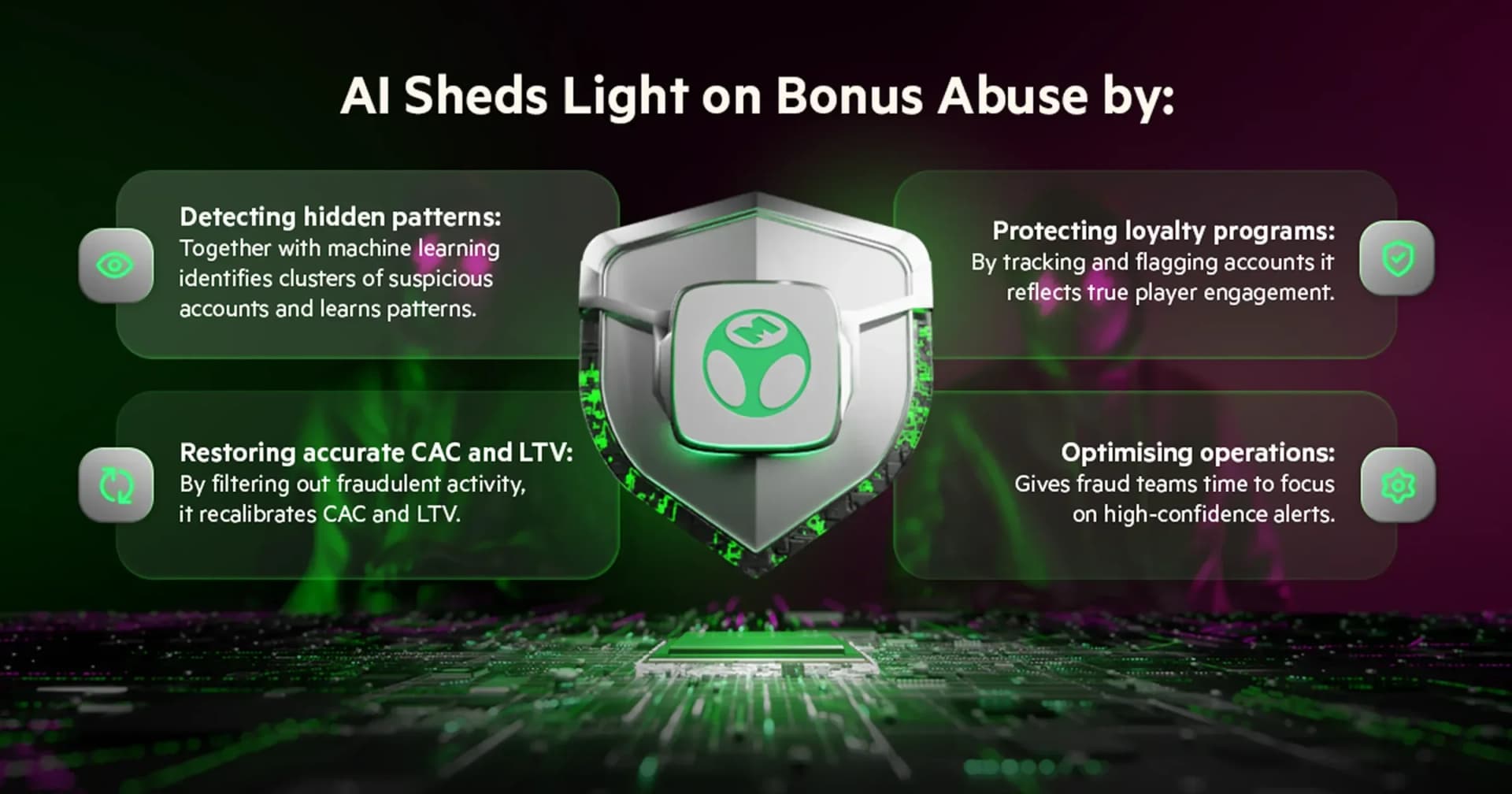
Advanced AI platforms identify abuse patterns by analyzing account clusters that appear legitimate individually but demonstrate coordinated behavior when viewed collectively. This capability allows operators to separate genuine players from sophisticated abuse operations before financial distortions embed themselves in business metrics.
Bonus Guardian represents the evolution of iGaming-specific fraud detection, continuously analyzing transactional and behavioral data to surface actionable insights about true abuse costs. The platform enables operators to quantify exact losses while implementing immediate protective measures.
The technology restoration extends beyond loss prevention to metric rehabilitation. By filtering abuser activity from core calculations, AI systems recalibrate acquisition costs and lifetime value projections, providing executives with accurate data for strategic decision-making.
Fraud teams benefit from operational optimization as AI systems focus human resources on high-confidence alerts rather than false positives, reducing investigation costs while improving detection accuracy. Similar AI-powered approaches have proven effective across iGaming operations, as demonstrated by SOFTSWISS's launch of the API Tester, which reduces validation time through automated detection systems.
Advanced Detection Strategy
Modern AI platforms identify abuse patterns by analyzing account clusters that appear legitimate individually but demonstrate coordinated behavior when viewed collectively. This enables operators to separate genuine players from sophisticated abuse operations before financial distortions embed in business metrics.
Strategic Imperatives for Modern Operators
Bonus abuse has evolved beyond a traditional fraud problem into a fundamental business intelligence challenge. Operators continuing to rely on corrupted metricstrics face compound strategic disadvantages in increasingly competitive markets.
Forward-thinking organizations are implementing comprehensive AI detection systems to restore data integrity across their operations. These investments protect marketing ROI, preserve loyalty program effectiveness, and rebuild confidence in the financial metrics guiding strategic planning.
The critical question facing every operator centers on accurate loss quantification. Without precise measurement of bonus abuse impact, organizations cannot develop effective mitigation strategies or allocate resources appropriately. Modern fraud detection platforms eliminate guesswork by revealing hidden costs embedded throughout operational metrics. This visibility enables targeted intervention before compound losses escalate beyond manageable levels.
Strategic Priority Shift
Bonus abuse has evolved beyond traditional fraud into a fundamental business intelligence challenge. Organizations relying on corrupted metrics face compound strategic disadvantages, making comprehensive AI detection systems essential for restoring data integrity and protecting marketing ROI.
When 20% of new signups are abusers, an operator's apparent £200 CAC becomes a real cost of £250 per genuine player. This represents marketing budget systematically funneled toward acquiring worthless accounts that will never generate genuine value.
Sophisticated abusers deliberately mimic legitimate player behavior during initial periods, making individual accounts appear genuine. Advanced AI platforms are needed to identify coordinated behavior patterns across account clusters that would otherwise go undetected.
According to Sumsub's 2025 research, bonus abuse accounts for 63.8% of iGaming fraud. GBG's industry analysis confirms that bonus abuse may cost operators up to 15% of annual gross revenue.
VIP clubs become prime exploitation targets for organized abuse syndicates who systematically cycle through multiple accounts to extract loyalty rewards. This dilutes the value proposition for genuine high-value players while making KPIs suggest programs are performing when they're actually being drained.
According to EveryMatrix.