
Malta's position as the leading European sportsbook licensing jurisdiction stems from two decades of regulatory evolution, institutional expertise, and a tax framework that delivers genuine competitive advantage for operators. The Malta Gaming Authority has operated dedicated online gaming regulation since 2004, creating institutional depth that newer jurisdictions cannot match.
For sportsbook operators targeting European markets, Malta combines regulatory prestige, EU legal domicile, deep iGaming talent pools, and tax efficiency in a package that has made this Mediterranean island the dominant choice for fixed-odds betting operations across Europe.
Why Malta Dominates European Sportsbook Licensing

Malta's corporate tax structure delivers material advantage through its imputation system. While the headline rate sits at 35%, the 6/7 shareholder refund mechanism reduces the effective rate to approximately 5% for most trading structures. The optional 15% FITWI regime introduced in 2025 offers simplified administration for qualifying operators.
Beyond tax efficiency, Malta's double taxation agreement network covers over 70 countries, enabling international expansion without punitive withholding costs. The separate 5% gaming tax applies only to revenue from players physically present in Malta, creating a distinct third cost layer that operators must model alongside compliance contributions and corporate tax.
The Malta Gaming Authority's regulatory framework separates clearly between B2C Gaming Service Licences for operators and B2B Critical Gaming Supply Licences for suppliers. This vertical-specific approach reflects genuine understanding of sportsbook business models rather than generic gaming authorisation.
| Jurisdiction | Effective Tax Rate | Market Access | Licence Validity |
|---|---|---|---|
| Malta | ~5% via 6/7 refund; optional 15% FITWI | EU member state; European gateway | 10 years (B2C) |
| Gibraltar | 15% standard | Non-EU; strong market relationships | Annual renewal |
| Isle of Man | 0% for most companies | Non-EU; international operators | Annual renewal |
5%
Effective corporate tax rate via 6/7 refund
15%
Optional FITWI regime rate (2025)
70+
Countries covered by Malta's double taxation agreements
5%
Gaming tax on Malta-based players only
10 years
B2C licence validity period
MGA Type 2 Licensing for Fixed-Odds Betting
The Malta Gaming Authority structures gaming authorisation through distinct vertical categories. For sportsbook operators setting odds and carrying financial risk on event outcomes, the B2C Gaming Service Licence with Type 2 approval represents the only appropriate authorisation path.
Type 2 covers sports betting, esports betting, spread betting, and virtual sports across both pre-match and in-play markets. The regulatory distinction centres on financial risk: Type 2 operators engage in odds-setting business, manage fixed-odds wagering exposure, and carry direct financial risk on published betting lines.
Founders who describe their operation as a generic gaming portal rather than a fixed-odds betting business trigger MGA amendment cycles. The regulator examines the odds-setting and financial-risk model directly, not product labelling or marketing descriptions.
| MGA Type | Permitted Activities | Operator Risk Model |
|---|---|---|
| Type 1 | RNG-based gaming services | Operator takes game risk |
| Type 2 | Fixed-odds betting, incl. live betting | Operator takes financial risk on outcomes |
| Type 3 | Peer-to-peer gaming | Platform earns commission |
| Type 4 | Controlled skill games | Operator manages skill-game framework |
Important
Every third-party supplier providing material software or control systems must hold an MGA B2B Critical Gaming Supply Licence. Verify authorisation status against the MGA register before signing supplier agreements.
| MGA Type | Permitted Activities | Operator Risk Model |
|---|---|---|
| Type 1 | RNG-based gaming services | Operator takes game risk |
| Type 2 | Fixed-odds betting, incl. live betting | Operator takes financial risk on outcomes |
| Type 3 | Peer-to-peer gaming | Platform earns commission |
| Type 4 | Controlled skill games | Operator manages skill-game framework |
Type 2 Coverage Scope
Type 2 authorisation specifically covers sports betting, esports betting, spread betting, and virtual sports across both pre-match and in-play markets. The regulatory classification is based on the operator's financial risk model rather than product labelling or marketing descriptions.
Market Access Reality Beyond Malta
An MGA licence functions as credibility foundation for European market entry conversations – it does not constitute automatic access to every regulated jurisdiction. Operators targeting markets beyond Malta require separate local authorisation: Great Britain via the UK Gambling Commission, Germany through the GGL, Spain via the DGOJ, and Italy through the ADM.
Each regulated market represents a distinct licensing project with independent timelines, costs, and compliance requirements. Budget and resource allocation must treat market-by-market authorisation as parallel workstreams, not extensions of the Malta process.
Incorporation and Corporate Structure Requirements
Most operators choose private limited company (Ltd) formation through the Malta Business Registry over PLC structures. The registry requires comprehensive documentation before filing: certified identification and proof of address for all directors, shareholders, and ultimate beneficial owners, plus source of wealth declarations and professional references for key persons.
MGA Type 2 licensing mandates minimum €100,000 paid-up share capital – regulatory capital that remains within the business structure. Corporate governance substance strengthens both MGA fit-and-proper outcomes and payment provider onboarding processes. A resident director with demonstrable oversight authority materially improves regulatory assessment results.
Compliance Architecture: Three-Pillar Framework
Malta Gaming Authority compliance assessment centres on three interlocking requirements: AML/KYC infrastructure, Type 2 sports integrity obligations, and key-function governance. Regulatory review examines these pillars collectively – weakness in any single area undermines the entire application and creates ongoing regulatory exposure.
AML/KYC Platform Controls
The MGA's AML/CFT framework requires specific platform-level controls operational at go-live. Systems must flag single transactions of €2,000 or more, maintain complete customer risk-assessment histories, disable accounts when customer due diligence requirements are unmet, and record full deposit and withdrawal account details.
Ongoing transaction monitoring, fraud prevention, and source of funds verification must function as integrated platform capabilities, not policy documentation. Operators who build these controls into platform architecture from initial development clear system audit fastest – retrofitting AML controls after technical documentation submission creates audit delays.
Sports Integrity Framework Unique to Type 2
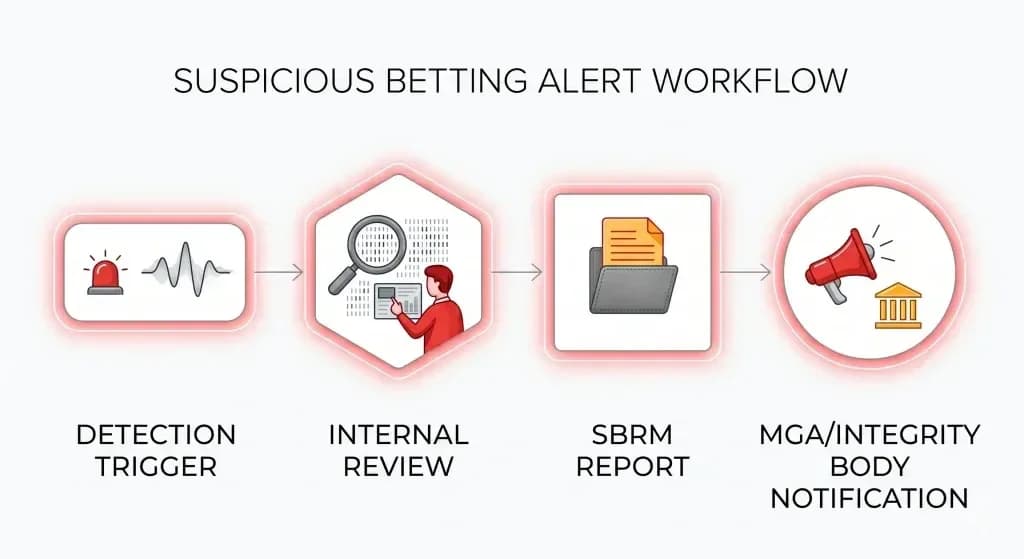
The MGA Sports Betting Integrity department requires operators to implement automated wagering pattern alerts, detect suspicious betting activity in real-time, and report through the Suspicious Betting Reporting Mechanism (SBRM) immediately – with maximum 3 days from first awareness.
These obligations cover match-fixing prevention across traditional sports and esports markets. The MGA cooperates directly with the International Betting Integrity Association (IBIA), formerly ESSA, and may restrict specific markets where integrity concerns emerge.
Mandatory staff training on suspicious betting recognition and internal reporting procedures must be completed before go-live and maintained through continuous review cycles. Treating integrity obligations as compliance documentation rather than operational architecture creates regulatory failure risk.
Key Functions and MLRO Independence
The MGA requires eight designated key functions: chief executive, day-to-day gaming operations, compliance, legal affairs, data protection, AML/CFT, technology, and internal audit. All positions require MGA approval with certificates valid for 3 years.
The Money Laundering Reporting Officer (MLRO) must maintain structural independence from the Compliance Manager. MLRO reporting obligations run directly to the Financial Intelligence Analysis Unit (FIAU) under separate authority chains outside day-to-day compliance reporting structures.
Both roles carry distinct fit-and-proper requirements assessed individually during MGA application review. Combined or subordinated appointments represent regulatory risks the MGA identifies during assessment.
Banking and Payment Provider Strategy
Banking represents the most common failure point in otherwise well-prepared applications. Traditional banks classify gambling operations as high-risk, applying extended due diligence processes: compliance committee escalation, multiple UBO documentation rounds, and onboarding timelines extending 3-9 months even for MGA-licensed operators.
Electronic Money Institutions (EMIs) offer faster processing – typically 4-8 weeks for complete applications – but utilise correspondent IBAN structures that institutional counterparties and platform partners treat as secondary relationships rather than primary banking arrangements.
| Payment Provider Type | Onboarding Speed | Typical Cost | IBAN Access | High-Risk Acceptance |
|---|---|---|---|---|
| Traditional bank | 3 – 9 months | Higher minimums and fees | Direct | Low |
| EMI | 4 – 8 weeks | Lower minimums | Correspondent | High |
| Correspondent banking | Variable | Mid-range | Via EMI or bank | Medium |
Optimal structure requires both: traditional banking for supplier and platform partner credibility, plus EMI relationships for multi-currency settlement speed and operational flexibility. Payment workstreams must commence in week one of the licensing process, running parallel to MGA application review rather than sequentially after regulatory approval.
Tip
Chargeback rates function as material KPIs monitored independently by card schemes and payment service providers. Build chargeback management into platform architecture from initial development.
Pros
- EMI providers offer 4-8 week onboarding timelines
- Lower minimum requirements and fees
- Higher acceptance rate for gambling operations
- Multi-currency settlement flexibility
Cons
- Traditional banks provide 3-9 month onboarding delays
- Correspondent IBAN structures seen as secondary relationships
- Extended due diligence with compliance committee escalation
- Higher minimums and fee structures
Platform Selection and Technical Requirements
The build-versus-buy decision for sportsbook software encompasses proprietary development or licensed third-party solutions. Any supplier providing material software or control systems must hold MGA B2B Critical Gaming Supply Licence status – verify against the MGA authorisation register before contractual commitment.
SOFTSWISS operates its Sportsbook platform under MGA B2B Critical Gaming Supply Licence covering Type 2 Fixed Odd Betting, including Live Betting. The platform maintains GLI-33 certification and ISO 27001 compliance, with integrated odds engine, bet settlement logic, security infrastructure, and regulatory reporting capabilities built for MGA system audit requirements.
Operators can deploy through Turnkey Sportsbook Solution for complete implementations or Sportsbook Integration via API or iFrame for existing casino platform bases. Both delivery models include compliance architecture meeting MGA certification requirements rather than requiring operator-built compliance systems.
System Audit and Certification Process
Following technical documentation acceptance, the MGA provides 60 days for staged environment implementation and external System Audit commissioning from approved providers. Audit validation covers bet processing accuracy, settlement logic validation, automated suspicious betting alert mechanisms, and compliance with published technical standards.
Certification represents the mandatory gate before operational go-live. Platform architecture documented during application submission must match the system demonstrated during audit – build audit readiness into technical design from project initiation rather than retrofitting compliance capabilities.
How to Prepare for MGA System Audit
Technical Documentation Acceptance
Submit complete technical documentation and await MGA approval before proceeding to staging
60-Day Implementation Window
Deploy staged environment and commission external System Audit from MGA-approved providers within the allocated timeframe
Audit Validation Coverage
Demonstrate bet processing accuracy, settlement logic, automated suspicious betting alerts, and compliance with published technical standards
Certification Gate
Pass mandatory certification before operational go-live - platform must match documented architecture exactly
Timeline and Cost Structure Analysis
Plan 5-8 months for clean, well-documented applications with straightforward ownership structures. Complex ownership arrangements or high-risk market exposure extends timelines to 9-12 months. The process runs sequentially through fit-and-proper review, staged operational assessment, 60-day staging implementation, and external audit certification.
Regulatory fees represent the statutory floor: €5,000 non-refundable application fee, €25,000 annual B2C licence fee, €100,000 minimum paid-up share capital, and €25,000 minimum compliance contribution (€600,000 maximum at 4% of first €3M GGR).
| Cost Component | Statutory Amount | Notes |
|---|---|---|
| MGA application fee | €5,000 | Non-refundable; payable before processing |
| Annual B2C licence fee | €25,000 | Due before licence issuance |
| Type 2 share capital | €100,000 minimum paid-up | Regulatory capital retained in business |
| Type 2 compliance contribution | €25,000 min / €600,000 max | 4% of first €3M GGR; 12-month moratorium available |
| Gaming tax (Malta players) | 5% of GGR | Only on services to players physically present in Malta |
Total launch expenditure reliably reaches six figures when audit fees, platform licensing, payment service provider onboarding, legal drafting, and operational staffing are included alongside regulatory costs.
Cryptocurrency Payment Integration
Cryptocurrency payments operate within MGA-approved frameworks, but the Authority's 2026 supervisory agenda introduces tightened internal control requirements around crypto asset utilisation. Address cryptocurrency integration at technical documentation submission rather than post-launch implementation.
Common Implementation Failures
Operational failures cluster around several predictable patterns. Applying without clear product definition – describing operations as generic gaming portals rather than Type 2 fixed-odds betting – triggers MGA amendment cycles. Treating compliance requirements as policy templates rather than integrated platform architecture creates system audit delays.
Sequential rather than parallel workstream management consistently makes banking the critical path bottleneck. Using unlicensed supplier stacks violates MGA licensing conditions. Budgeting only regulatory fees without modelling capital, audit, legal, platform, and staffing costs creates funding gaps during implementation.
Warning
Invisible governance structures – nominee-heavy ownership, absent key persons – slow or terminate MGA applications. Build visible operational substance beyond registered address requirements.
Sequential workstream management consistently makes banking the critical path bottleneck - run payment provider outreach parallel from week one rather than after regulatory approval.
Foreign Ownership and Remote Operations
Malta company law places no nationality restrictions on shareholders. The MGA permits EU/EEA-incorporated entities to apply directly for authorisation. Fit-and-proper scrutiny and documented source of wealth and funds determine application outcomes rather than founder nationality or residency status.
Remote operation requires genuine operational substance rather than letterbox arrangements. Key persons must demonstrate accessible oversight authority, and corporate governance must function transparently. Malta Gaming Authority assessment focuses on operational reality rather than technical compliance with residency requirements.
Strategic Implications for European Market Entry
Malta's regulatory framework reflects mature understanding of sportsbook operational requirements developed through two decades of licensing evolution. The combination of MGA regulatory credibility, EU legal domicile, effective tax rates, and institutional expertise creates a foundation for European market expansion that newer jurisdictions cannot replicate quickly.
However, Malta licensing represents market entry foundation rather than comprehensive European market access. Each regulated jurisdiction maintains independent authorisation requirements, compliance standards, and operational obligations. Successful European expansion requires treating Malta as the regulatory hub within a multi-jurisdiction compliance architecture.
The MGA's Type 2 framework specifically addresses fixed-odds betting operational realities – sports integrity obligations, suspicious betting detection, automated alert systems, and real-time reporting requirements that generic gaming licences often address inadequately. This regulatory sophistication translates into competitive advantage when entering conversations with other European regulators who recognise MGA compliance depth.
Payment provider relationships benefit materially from MGA regulatory standing. Traditional banks and institutional payment partners recognise Malta Gaming Authority oversight as credible risk mitigation, improving onboarding success rates and reducing due diligence timelines compared to operators licensed in less-established jurisdictions.
The technical audit and certification requirements create operational advantages beyond regulatory compliance. MGA-certified platforms demonstrate proven capability in areas that other regulators examine during market entry assessments – AML/KYC integration, sports integrity controls, and systematic compliance architecture that supports multi-jurisdiction operations.
All eight key functions require MGA approval with 3-year validity certificates. Replacement appointments need fresh fit-and-proper assessment and regulatory approval before assuming duties, potentially creating operational gaps if succession planning isn't managed proactively.
The compliance contribution starts at €25,000 minimum but scales to 4% of the first €3M GGR with a €600,000 maximum. Qualifying start-ups can access a 12-month moratorium, but operators should model the full scaling impact in their financial projections from launch.
Any material software or control system changes require the supplier to hold MGA B2B Critical Gaming Supply Licence status. Platform modifications that affect certified system architecture may trigger re-audit requirements, so supplier roadmaps should be evaluated during initial selection.
The MGA focuses on operational reality rather than technical residency compliance. Key persons must demonstrate accessible oversight authority with transparent corporate governance, avoiding nominee-heavy structures or letterbox arrangements that slow or terminate applications.
According to SOFTSWISS.