Loading...
India's gambling regulation operates through a decentralised framework split between federal law and individual states, with no single national regulator overseeing the sector.

Mar 2, 2026 · 12 min read
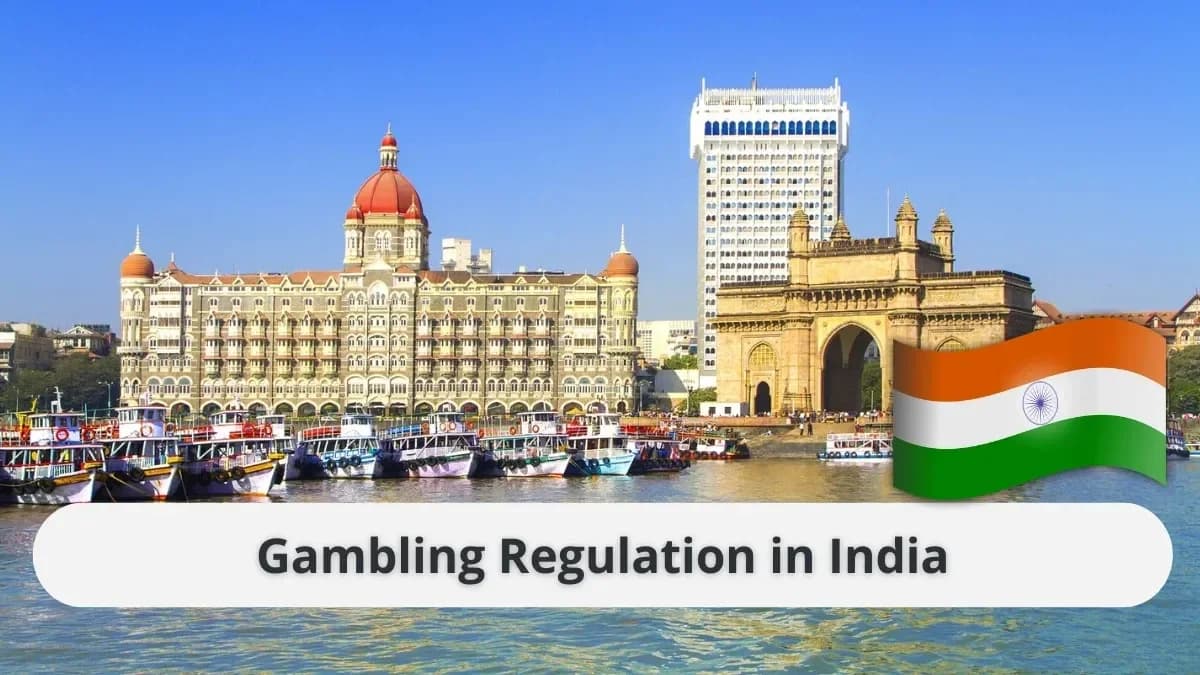
India's gambling regulatory landscape stands apart from most global jurisdictions through its deliberate absence of a central oversight authority. India does not have a single national gambling regulator, instead operating through a complex web of state-level legislation, colonial-era federal law, and judicial precedent that creates vastly different compliance environments across the subcontinent.
This fragmented approach reflects constitutional design rather than regulatory oversight, with regulatory authority split between federal law and individual Indian states. The result is a system where gambling activities are primarily controlled through criminal law, state legislation, and judicial interpretation – a model that fundamentally differs from the licensing-based frameworks familiar to international operators.
The absence of a national gambling regulator stems directly from India's constitutional structure. Gambling and betting fall under the State List, granting each state exclusive authority to legislate on gambling within its borders. This constitutional allocation prevents the central government from imposing uniform national gambling regulation without constitutional amendment.
This deliberate decentralisation explains why gambling laws vary dramatically between states, with some permitting casinos or regulated gaming while others impose comprehensive prohibitions. The system prioritises state autonomy over regulatory uniformity, creating a patchwork of different legal environments across India's 28 states and eight union territories.
Under this framework, casino licensing is permitted only in selected states (e.g. Goa, Sikkim, Daman) under state-specific legislation, while most other jurisdictions maintain stricter prohibitions. Individual states control not only whether gambling is permitted but also how gaming activities are defined, what penalties apply, and how enforcement operates.

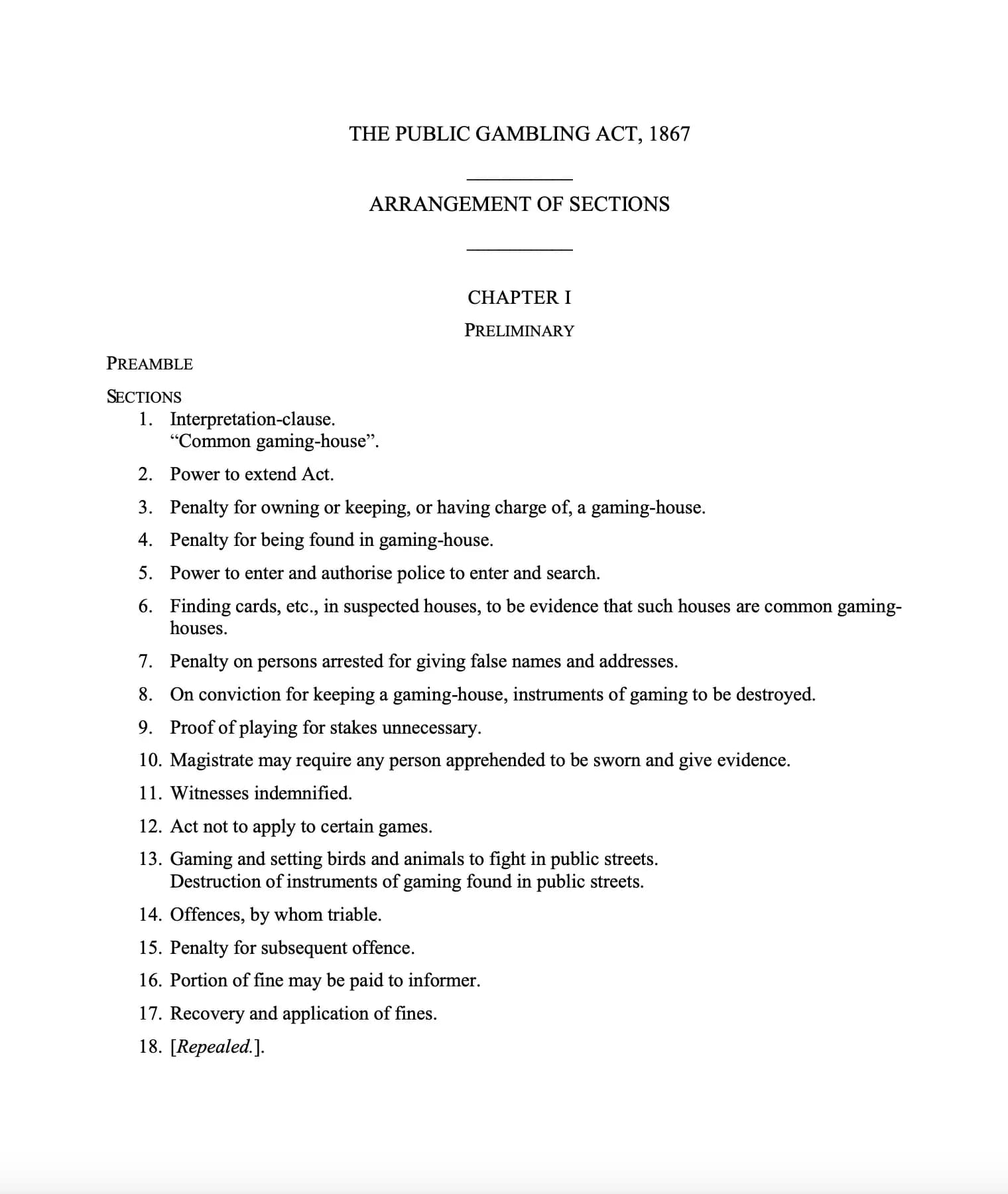
The regulatory foundation rests on the Public Gambling Act 1867, primary federal law that criminalizes public gambling activities. The Public Gambling Act 1867 remains the cornerstone of gambling regulation in India, despite being enacted more than 150 years ago during British colonial rule.
Rather than establishing a licensing or regulatory framework, the Act adopts a prohibitive approach focused on suppressing gambling through criminal sanctions. The Public Gambling Act 1867 was enacted during the colonial period and was never designed to address modern gambling formats, leaving substantial discretion to individual states.
Important
Operating or managing a public gambling house is treated as a criminal offence under the Act, with penalties including fines, imprisonment, and seizure of gambling instruments and proceeds.
The 150-year-old legislation continues to shape contemporary gambling cases despite predating digital technology by more than a century. Its antiquated framework has necessitated extensive judicial interpretation to address modern gambling formats, particularly online activities not contemplated by colonial-era lawmakers.
1,867
Year Public Gambling Act was enacted
150+
Years the colonial-era law has been in effect
28
Indian states with gambling authority
8
Union territories with gambling authority
3
States permitting casino licensing (Goa, Sikkim, Daman)
In the absence of administrative oversight, the Supreme Court of India and High Courts have assumed primary responsibility for interpreting gambling legality. Through landmark rulings, courts have established the crucial legal distinction between games of skill and games of chance that shapes modern gambling operations.
Games of skill fall outside the scope of gambling under judicial interpretation, while games of chance are generally treated as gambling and subject to prohibition or restriction. This distinction, developed entirely through case law rather than statute, has become foundational for India's gaming sector.
Many online platforms structure their offerings around skill-based formats to avoid gambling prohibitions, relying on judicial precedent rather than regulatory approval. This court-driven approach means legal certainty derives from case law rather than administrative licensing, creating ongoing uncertainty for operators.
Critical Legal Distinction
The Supreme Court of India has established that games of skill fall outside gambling prohibitions, while games of chance are subject to restrictions. This court-created distinction, not found in statute, has become foundational for India's gaming sector and determines operational legality.
Government Operations: Profile of Indian Gaming
Digital gambling presents particular challenges within India's fragmented framework. India does not operate under a dedicated legal framework for online gambling, with no unified national framework for online gambling regulation. The absence of explicit online gambling rules has created inconsistent state responses and legal uncertainty.
Online gambling in India operates within a legal grey zone, shaped more by court precedent and enforcement discretion than regulatory supervision. Some states have attempted local restrictions through legislation or executive notifications, while others maintain more permissive stances toward skill-based online games.
This regulatory vacuum contrasts sharply with land-based gambling, which at least benefits from legacy legislation and established state frameworks. Digital operators must navigate varying state interpretations without clear federal guidance, creating compliance challenges across jurisdictions.
Warning
Online gambling operators face significant legal uncertainty as no unified national framework exists. Digital platforms must navigate varying state interpretations and enforcement approaches without clear federal guidance, creating substantial compliance risks across jurisdictions.
Tax Policy: A Profile of the Indian Gaming Industry
While lacking a dedicated gambling regulator, central government departments influence the sector indirectly. The Ministry of Home Affairs oversees aspects of law enforcement and internal security relevant to gambling activities. The Ministry of Electronics and Information Technology maintains an indirect role in digital platform governance, though not specific gambling regulation.
These ministries shape the commercial and compliance environment around gambling through broader frameworks covering financial transactions, tax obligations, and technology governance. However, their involvement does not constitute unified gambling regulation, instead adding layers of potential oversight without replacing state-level authority.
| Regulatory Element | Description |
|---|---|
| Primary federal law | Public Gambling Act 1867, criminalises public gambling while allowing state independence |
| Central gambling regulator | None – no nationwide gambling regulatory authority exists |
| State governments | Constitutional authority to regulate or prohibit gambling within territories |
| Casino licensing | Permitted only in Goa, Sikkim, Daman under state-specific legislation |
| Online gambling regulation | No unified national framework – governed by state laws and court rulings |
| Enforcement authorities | State police and local enforcement bodies |
| Role of courts | Supreme Court and High Courts define legality through interpretation |
There is no dedicated gambling enforcement agency or regulatory inspectorate in India. Instead, enforcement operates through general criminal law mechanisms, with state police authorities, criminal courts, and local administrative bodies handling gambling-related violations.
Penalties under the Public Gambling Act 1867 typically include fines, imprisonment, and seizure of gambling instruments and proceeds. This enforcement model prioritises criminal liability over regulatory compliance, contrasting with licensing jurisdictions that rely on administrative sanctions and regulatory settlements. Unlike markets such as Spain's DGOJ-regulated system, India's approach focuses on prohibition rather than licensed market development.
Enforcement practices vary significantly between states, reflecting local policy priorities and interpretations. Some focus on aggressive policing and criminal sanctions, while others adopt more tolerant approaches toward specific activities or skill-based formats.
Detection and Investigation
State police authorities identify potential gambling violations through complaints, raids, or surveillance activities
Criminal Charges
Violations are prosecuted under the Public Gambling Act 1867 through criminal courts rather than regulatory proceedings
Penalties Implementation
Courts impose fines, imprisonment terms, and order seizure of gambling instruments and proceeds
Administrative Action
Local administrative bodies may take additional enforcement measures based on state-specific legislation
India does not issue a national gambling licence, leaving operators without unified authorisation mechanisms. Any references to Indian gambling licences typically concern narrow state-level permissions or court-recognised activities rather than comprehensive licensing systems.
State lottery activities operate only under specific state authorisations, while horse racing and betting function at recognised venues under state permissions. Skill-based gaming formats rely on judicial recognition rather than formal licensing, creating operational uncertainty.
This absence of unified licensing creates particular challenges for international operators accustomed to regulator-led systems. Compliance depends on geography, activity type, and evolving judicial precedent rather than clear regulatory approval processes.
| Aspect | How It Works in Practice |
|---|---|
| Legal basis for operation | State-level permissions or court recognition |
| State lottery activities | Operate under state lottery authorisations only |
| Horse racing and betting | Permitted at recognised venues under state permissions |
| Skill-based gaming | Operate based on judicial recognition, not licences |
| National regulatory authority | Does not exist |
| Regulatory oversight | Fragmented and state-dependent |
| Legal exposure | Varies significantly by state |
Licensing Limitations
International operators should understand that India does not issue national gambling licences. Any licensing references concern narrow state-level permissions, court-recognised activities, or specific formats like state lotteries rather than comprehensive regulatory approval systems.
The decentralised system produces dramatic variations in gambling treatment across states. Legal exposure varies significantly by jurisdiction, with some states maintaining strict criminal enforcement while others permit specific gaming formats.
States control fundamental aspects of gambling regulation including:
This patchwork approach means identical activities may be permitted in one state and criminalised in another, creating operational complexity for multi-state operators and digital platforms serving nationwide audiences.
Multi-State Strategy
Operators planning multi-state operations must develop jurisdiction-specific compliance strategies rather than national approaches. Identical activities may be legal in one state and criminal in another, requiring detailed local legal analysis and state-by-state operational planning.
The collision between 150-year-old colonial legislation and modern digital gaming creates ongoing legal uncertainty. Courts have been forced to interpret 19th-century statutory language in the context of 21st-century technology, leading to inconsistent outcomes and regulatory gaps.
Online platforms must navigate this interpretive challenge without regulatory guidance, often structuring operations around judicial precedent rather than clear statutory authority. The skill-versus-chance distinction becomes particularly complex in digital formats where game mechanics may not fit traditional categories.
This judicial interpretation approach, while providing some flexibility, creates ongoing uncertainty about the legal status of emerging gaming formats and technologies.
The collision between 150-year-old colonial legislation and modern digital gaming creates ongoing legal uncertainty, forcing courts to interpret 19th-century statutory language in the context of 21st-century technology.
India's regulatory model reflects constitutional design, historical legislation, and policy caution rather than market-oriented regulation. Gambling remains politically sensitive, often associated with social harm and public morality concerns, limiting appetite for national-level reform.
This approach has resulted in reliance on enforcement rather than licensing models, with states preferring prohibition or restriction over regulated market development. The system prioritises state autonomy and judicial control over unified market oversight.
The fragmented framework places India among high-uncertainty gambling jurisdictions, particularly challenging for international operators familiar with centralised regulatory systems. Legal certainty depends on location, product structure, and court precedent rather than regulatory approval.
India's unique regulatory model presents both challenges and opportunities for gambling industry participants. The absence of unified oversight creates compliance complexity but also potentially more flexible market entry approaches through state-level engagement.
Operators must develop jurisdiction-specific strategies rather than national market approaches, with legal advice crucial for navigating state variations and judicial precedent. The skill-based gaming distinction offers potential pathways for lawful operation, though with ongoing interpretive risks.
For international operators, India's system requires fundamental recalibration from licensing-based market entry strategies toward approaches built around criminal law compliance and judicial interpretation. Success depends on understanding constitutional structure and state-level variations rather than engaging with centralised regulatory authorities. The regulatory landscape may evolve through continued judicial interpretation rather than legislative reform, making court precedent monitoring essential for industry participants. This creates a dynamic where legal strategy becomes more important than traditional regulatory compliance, distinguishing India's market from most global gambling jurisdictions.
No, India does not have a single national gambling regulator. The country operates through a fragmented system of state-level legislation, colonial-era federal law, and judicial precedent.
The Public Gambling Act 1867 serves as the primary federal law, criminalizing public gambling activities. Individual states have constitutional authority to create their own gambling legislation within their territories.
Online gambling operates in a legal grey zone with no unified national framework. Regulation occurs indirectly through state laws and court rulings, creating inconsistent approaches across different states.
Games of skill fall outside gambling prohibitions under judicial interpretation, while games of chance are generally treated as gambling and subject to restriction. This distinction was developed entirely through court cases rather than statute.
India does not issue national gambling licenses. Operators may only obtain narrow state-level permissions in specific jurisdictions like Goa, Sikkim, or Daman that permit certain gaming activities under local legislation.
According to we-right.com.
Legal Disclaimer
This content reflects a general overview of regulatory frameworks based on publicly available information. It does not constitute legal advice or a legal opinion. iGamingWriter.blog disclaims any liability arising from reliance on this material.
Get regulation updates, content insights, and market news delivered to your inbox every week.
No spam. Unsubscribe anytime.