
Understanding Surfer SEO performance has become critical for iGaming operators competing in highly saturated search environments. Recent analysis of 40+ live URLs reveals that low scores don't automatically signal weak content – but they do indicate optimization opportunities that can dramatically impact search visibility.
The Surfer SEO Misconception in iGaming Content

The industry's relationship with Surfer SEO scores often reflects a fundamental misunderstanding of what these metrics actually measure. A Surfer SEO score is not a quality verdict – it's a competitive positioning indicator.
62-68
Score range for pages ranking in top 5
85+
Score range for some pages never reaching first page
40+
Live URLs tested in comprehensive analysis
"In our experiments, pages that had a 62-68 score continued to rank in the top 5. At the same time, there were a few 85+ drafts that never appeared on the first page of Google search results."
— Olga Svichkar, We-Right Factory
This disconnect highlights a crucial point for iGaming content teams: Surfer SEO measures competitive alignment, not content quality. The tool compares your page against current SERP leaders, creating scores based on how closely your content matches established ranking patterns.
What Drives Low Scores in iGaming Content
The analysis identified specific patterns causing score depression in casino and betting content:
| Issue Category | Impact Description | Common in iGaming |
|---|---|---|
| Weak semantic relevance | Page targets keywords but misses broader topic coverage | Game review pages lacking strategy content |
| Structural misalignment | H1-H3 structure differs from ranking competitors | Casino guides with generic headings |
| Entity gaps | Missing related terms found in top-ranking pages | Slot reviews without provider mentions |
| Intent mismatch | Content style doesn't match search expectations | How-to content using promotional language |
| Length variance | Word count significantly above or below SERP norm | Feature articles too brief or overly detailed |
Warning
High-intent queries in iGaming show a specific pattern: articles that discuss only the underlying topic without related entities can score 10-30 points lower than comprehensive coverage.
Did you know?
10-30 — Point reduction for articles missing related entities
20-40% — Typical score improvement after systematic optimization
Understanding Surfer's Algorithm
Surfer SEO uses machine learning to analyze the top 50 search results for any keyword, extracting patterns in content structure, word usage, and semantic relationships. The tool's database contains over 500 million keywords and updates recommendations based on real-time SERP changes, making it particularly valuable for competitive niches like iGaming where search landscapes shift frequently.
Deconstructing Surfer SEO's Evaluation Framework
Understanding what Surfer actually measures provides the foundation for strategic optimization. The tool's algorithm focuses on six primary elements when generating scores.
Core Measurement Areas
Topical Coverage Analysis Surfer identifies subject themes across top-ranking pages, creating a comprehensive map of expected topics. For iGaming content, this means covering not just the primary game or operator, but related concepts like payment methods, licensing, and player protection.
Heading Structure Assessment The tool compares H1, H2, and H3 layouts against successful competitors. Casino content often fails here by using generic headings like "About" instead of specific, keyword-rich alternatives like "Live Blackjack Rules and Strategy."
Content Volume Benchmarking Word count ranges are established from SERP averages, with Surfer flagging content that significantly deviates from established norms. This affects both thin affiliate pages and overly detailed operator reviews.
Paragraph Density Evaluation The tool assesses readability through paragraph distribution, penalizing both walls of text and overly fragmented content. iGaming articles with long regulatory sections often struggle here.
Competitive Context
Surfer compares your page with competitors' pages that rank highly in search results. The metric reflects this difference – not absolute page quality.
Content Audit Best Practice
Before running Surfer analysis, audit your existing content using Google Search Console data to identify pages with high impressions but low click-through rates. These pages often benefit most from Surfer optimization, as they already have search visibility but lack competitive content alignment. Focus optimization efforts on pages ranking positions 6-20 for maximum ROI.
Strategic Optimization Methodology
Effective Surfer SEO improvement requires systematic approach rather than random content additions. The following methodology has proven effective across multiple iGaming verticals.
Phase 1: Intent Alignment Verification
Before making any content changes, verify your page matches the dominant search intent pattern:
Search Intent Analysis
Research your target keyword on the SERP and identify the winning page format – guide, comparison, or product focus.
Introduction Optimization
Rewrite your opening to match the discovered intent, providing a direct answer within the first 100 words.
Format Consistency
Ensure your overall page structure aligns with successful competitor approaches.
Phase 2: Structural Enhancement
Open Surfer's SERP analyzer to examine heading patterns across top-ranking URLs. Focus on logical flow that reflects successful competitor structures while maintaining topical relevance.
Heading Optimization Tactics:
- Replace generic labels with keyword-rich, descriptive alternatives
- Mirror successful competitor subtopic coverage
- Maintain logical hierarchy that supports user navigation
- Include location-specific terms for geo-targeted content
Phase 3: Entity Integration and Content Depth
Important
The Content Editor sidebar provides crucial insights into missing related terms and their recommended usage frequency. This data drives strategic content expansion.
Effective entity integration involves:
- Identifying gaps in your current entity coverage compared to ranking pages
- Strategic placement of missing terms in contextually appropriate locations
- Natural incorporation of tool names, statistics, and industry-specific terminology
- Balanced distribution across different content sections
Warning
Adding too many Surfer-recommended entities without contextual relevance can trigger Google's spam detection algorithms. Maintain a natural entity distribution of 1-2 related terms per 100 words, and ensure each mention serves genuine informational value rather than keyword stuffing objectives.
Phase 4: Technical Parameter Optimization
Surfer establishes specific benchmarks for:
| Parameter | Optimization Approach |
|---|---|
| Word Count | Align with tool's recommended range based on SERP analysis |
| Heading Count | Match or slightly exceed competitor averages |
| Paragraph Distribution | Balance between readability and comprehensive coverage |
| Keyword Density | Natural distribution avoiding over-optimization flags |
Tip
Identify text blocks containing fewer than 50 words – these reduce text density effectiveness. Expand them with examples, tips, or step-by-step guidance while maintaining relevance.
According to research findings, these systematic actions can improve Surfer scores by 20-40%, with drafts rising from 45 to 70+ after single optimization rounds.
Case Study: Chicken Road Game Optimization
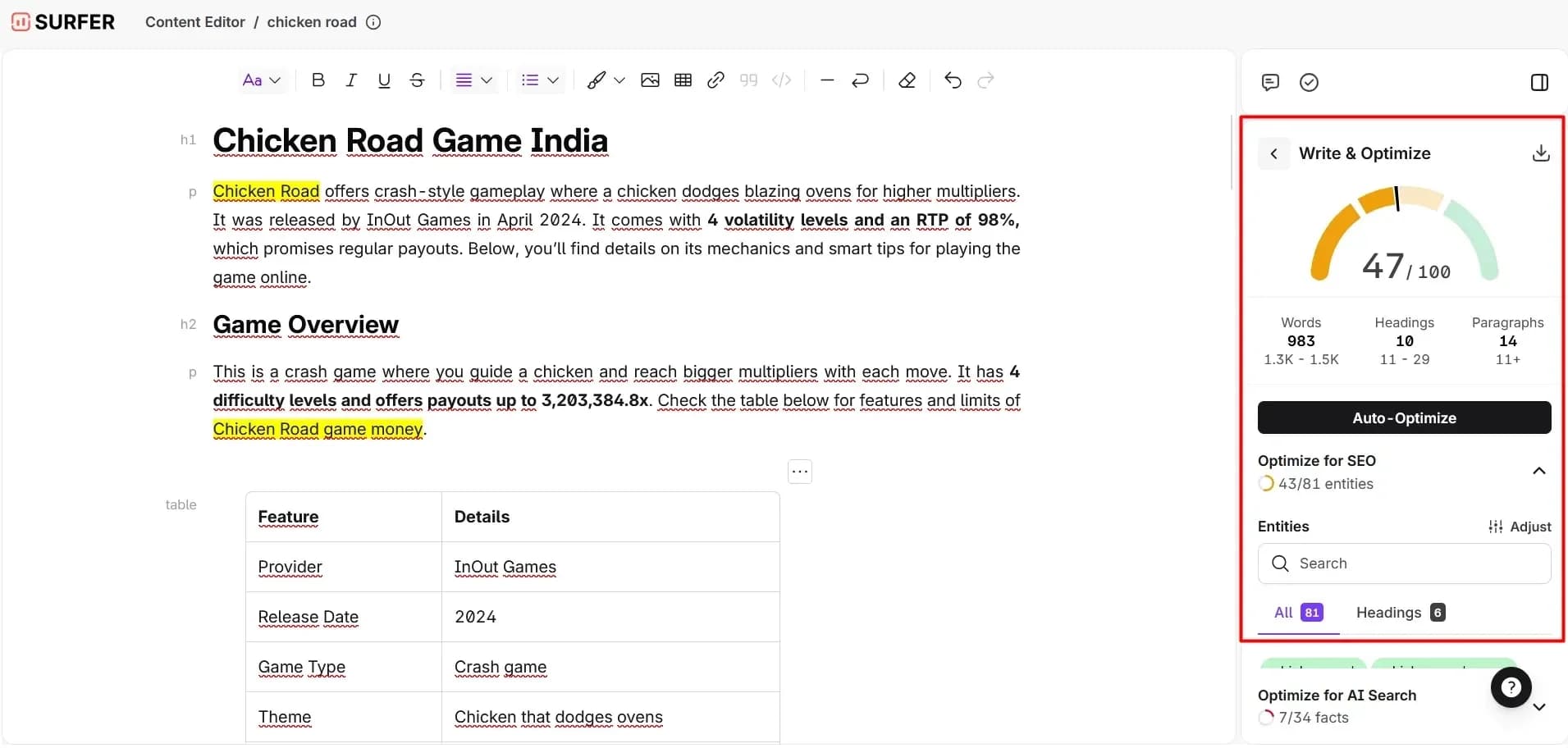
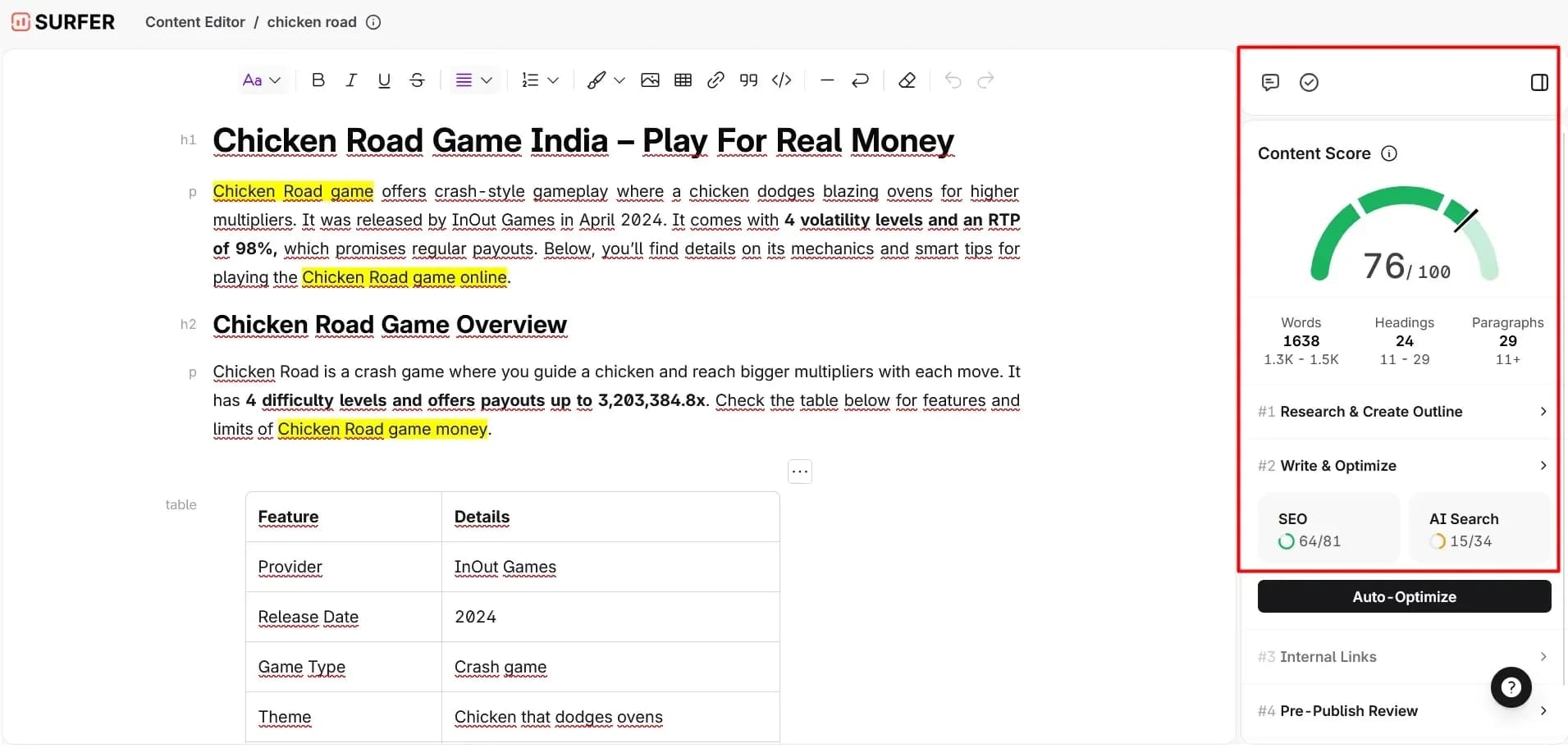
A real-world example demonstrates the practical application of these optimization principles. The We-Right team worked with a Chicken Road casino game page that initially scored 47 on Surfer SEO.
Initial Assessment
The original content showed clear optimization opportunities:
Baseline Metrics:
- Word count: 983 words
- Headings: 10 total
- Paragraphs: 14 sections
- Missing entities: 43 terms from Surfer's recommendations
Strategic Improvements Implementation
The optimization process involved systematic enhancements across all measured areas:
983 → 1,638
Word count increase (meeting 1.3K-1.5K+ range)
10 → 24
Heading structure expansion
14 → 29
Paragraph count optimization
43 → 64
Entity integration improvement
Specific Changes Made:
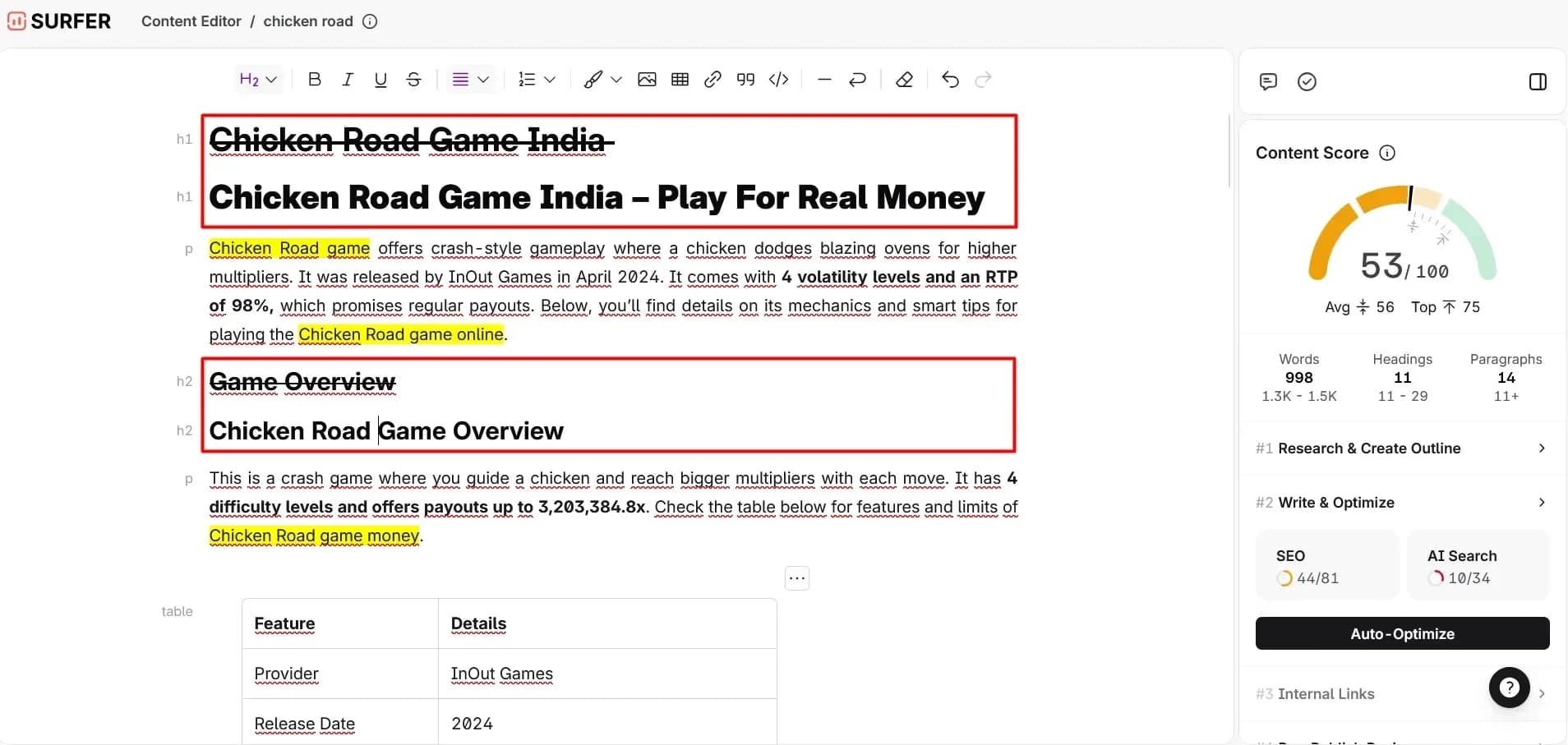
- H1 Enhancement: Upgraded to "Chicken Road Game India – Play For Real Money" for better keyword targeting
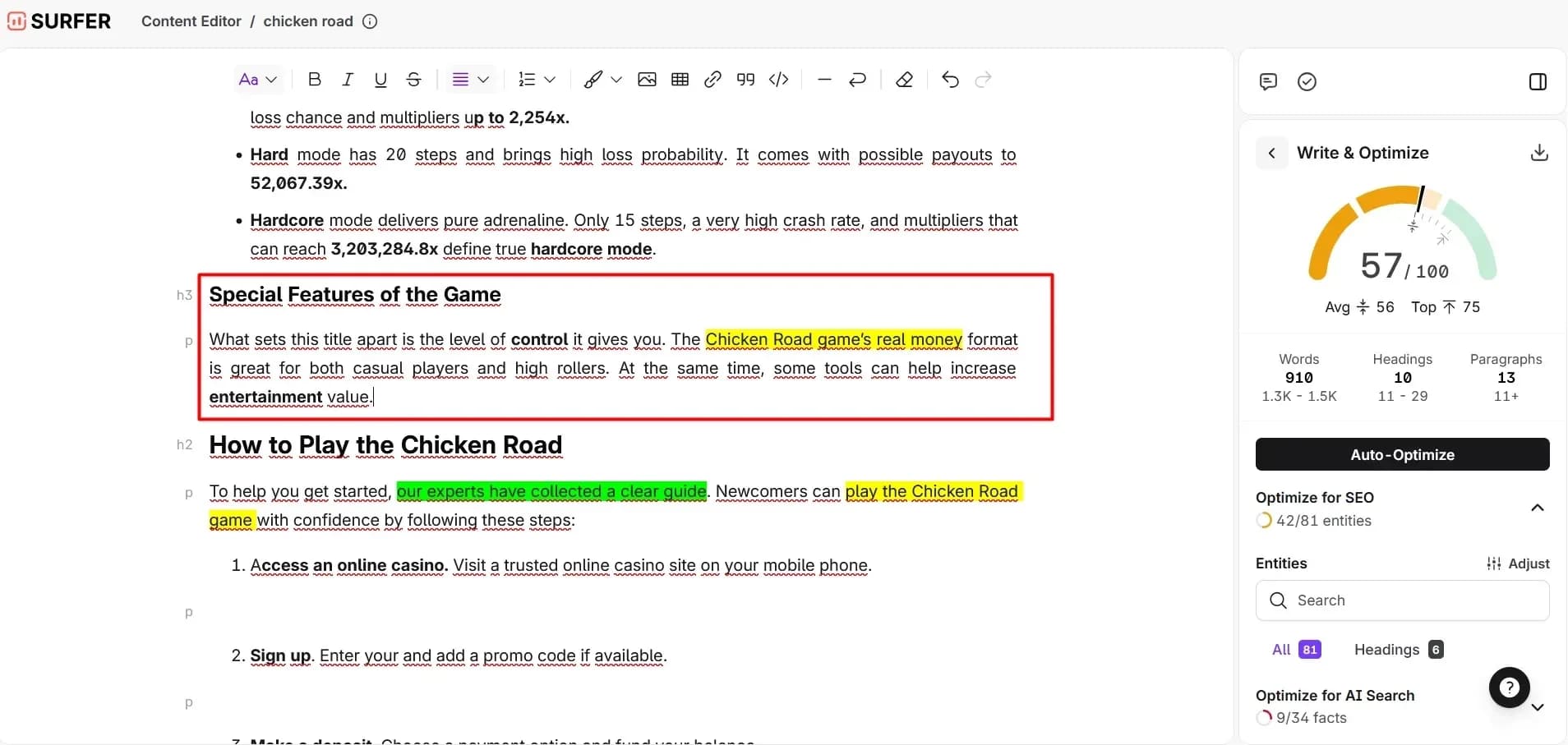
- Content Expansion: Added detailed sections covering game mechanics, payouts, betting limits, and strategic tips
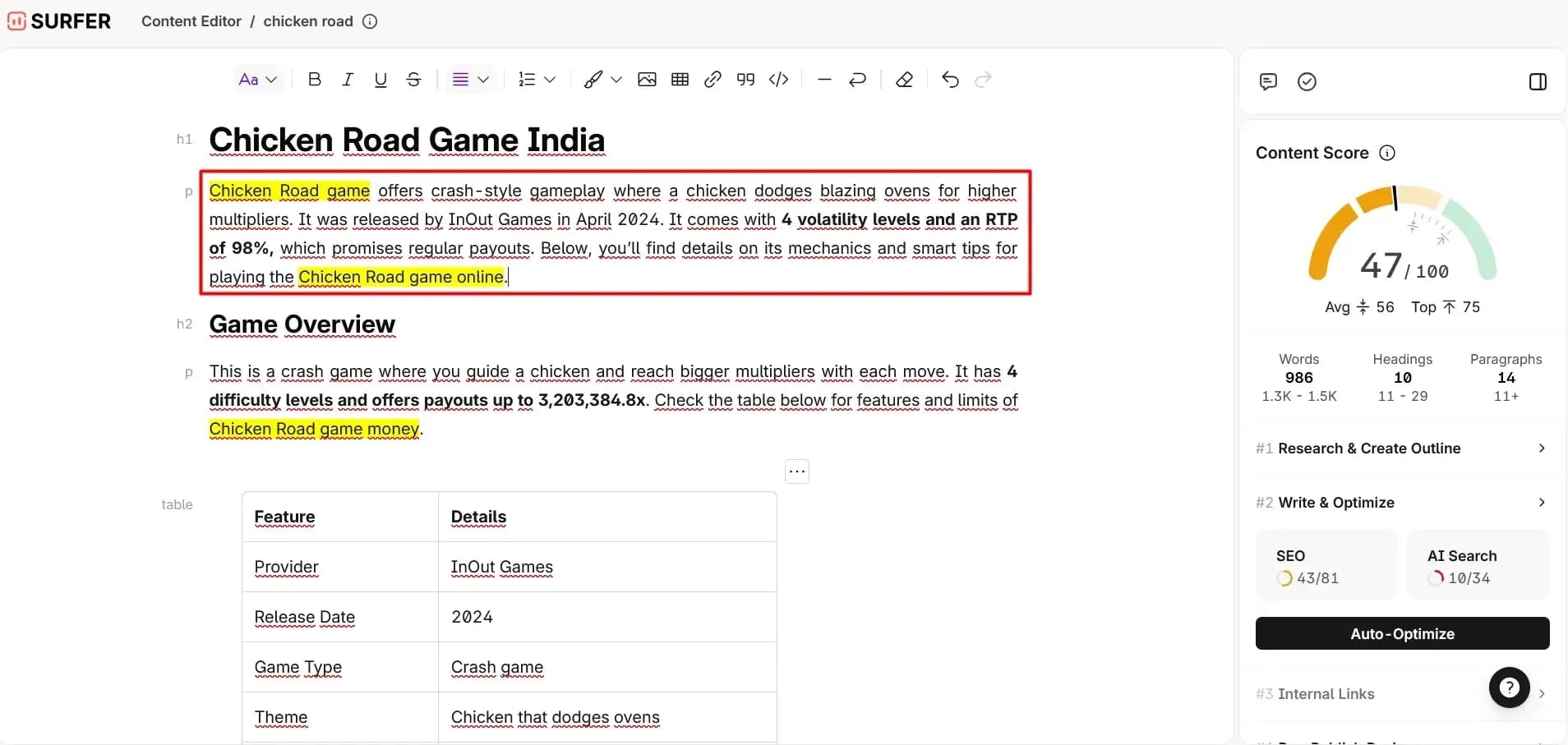
- Keyword Distribution: Natural placement of "Chicken Road game", "Chicken Road game online", and "Chicken Road game for real money" variants
- Entity Integration: Incorporated missing SEO entities from Surfer's competitive analysis
Results and Score Impact
These comprehensive changes elevated the Content Score to 76/100, representing a 29-point improvement that moved the page into competitive territory.
The systematic approach to Surfer optimization demonstrates that strategic content enhancement can achieve significant score improvements without compromising content quality or user experience.
Score vs. Performance Reality
Industry data shows that pages with Surfer scores between 65-75 often outrank those with 85+ scores in actual search results. Google's algorithm prioritizes user experience signals, page load speed, and content freshness alongside topical relevance. Monitor organic traffic and ranking positions alongside Surfer scores for complete optimization assessment.
Common Optimization Pitfalls in iGaming Content
Industry-specific challenges often lead to counterproductive optimization attempts. Understanding these pitfalls prevents wasted effort and potential penalties.
Critical Mistakes to Avoid
Warning
Score-Chasing Without Intent Consideration Prioritizing numerical improvement over search intent match leads to content that ranks poorly despite high Surfer scores.
Keyword Stuffing Practices Forcing keywords into unnatural positions triggers over-optimization flags while degrading user experience. Place terms where they serve genuine informational purposes.
Artificial Content Padding Doubling sentences or adding irrelevant sections to meet word count targets creates thin, low-value content. Instead, provide depth through practical examples, case studies, or detailed explanations.
Competitive Blind Spots Ignoring SERP competitor analysis while focusing solely on Surfer recommendations misses crucial context about successful content approaches in your specific niche.
Structural Over-Simplification Creating overly thin H2 and H3 structures that fail to comprehensively cover topic aspects limits both user value and search performance.
Technical Monitoring Requirements
Surfer recommendations change as competitor content evolves and new pages enter SERPs. Establish monthly audits of your optimized pages to identify score degradation caused by competitive shifts. Set up automated monitoring for keyword ranking changes that might signal when re-optimization becomes necessary.
Strategic Implementation Considerations
Effective Surfer SEO optimization within iGaming requires balancing multiple competing priorities. Regulatory compliance, user experience, and competitive positioning must all factor into content decisions.
Regulatory Content Integration
iGaming content faces unique challenges in incorporating required regulatory information while maintaining Surfer-friendly structure. Responsible gaming sections, licensing details, and geographic restrictions often create lengthy, low-engagement content blocks that can negatively impact scores.
Solutions include:
- Breaking regulatory content into scannable subsections with descriptive headings
- Integrating compliance information naturally throughout relevant content areas
- Using structured formatting to improve readability of required disclosures
Competitive Intelligence Application
Regular SERP analysis reveals shifting content patterns that affect Surfer benchmarks. Successful iGaming sites monitor:
- Emerging content themes in top-ranking competitor pages
- Seasonal variations in heading structures and entity usage
- Geographic content differences affecting local search performance
- New regulatory requirements influencing content expectations
Tip
Content optimization should align with both current SERP patterns and anticipated regulatory changes that may affect future ranking factors.
Effective Surfer optimization balances algorithmic recommendations with genuine user value creation, avoiding the trap of optimizing purely for tool scores while neglecting actual search performance metrics.
Industry Impact and Future Considerations
The relationship between Surfer SEO optimization and actual search performance continues evolving as Google's algorithm becomes more sophisticated in evaluating content quality and user satisfaction signals.
For iGaming operators, this creates both opportunities and challenges. Well-optimized content that genuinely serves user needs will likely continue benefiting from Surfer-guided improvements. However, purely technical optimization without user value consideration faces increasing risk of algorithm penalties.
The industry trend toward comprehensive, authoritative content aligns well with Surfer's emphasis on thorough topic coverage and competitive analysis. Operators investing in systematic content optimization while maintaining regulatory compliance and user focus position themselves advantageously for sustained search performance.
Key strategic considerations include:
- Balancing optimization metrics with genuine user value creation
- Maintaining compliance requirements within optimized content structures
- Adapting optimization approaches as search algorithms evolve
- Measuring actual traffic and conversion impact alongside score improvements
The evidence suggests that thoughtful Surfer SEO application can significantly improve iGaming content performance, but success requires understanding the tool's limitations and maintaining focus on fundamental content quality principles.
Most pages rank effectively with scores between 65 and 85. The green zone typically provides sufficient competitive positioning without requiring perfect optimization.
Surfer evaluates multiple factors beyond keyword presence, including content structure, paragraph distribution, topical depth, and entity coverage. Missing any element can limit score improvementt.
No. Pursuing 100-point scores often creates over-optimized, unnatural content. Focus on green zone performance while prioritizing readability and genuine user value.
Most pages need 1-3 hours for effective optimization. Extensive restructuring or major content additions can require a full working day for completion.
According to We-Right Blog.