Loading...
Indonesia maintains a strict prohibition-based approach to gambling, treating all forms as criminal activities rather than establishing any regulatory or licensing framework.

Feb 25, 2026 · 7 min read
Indonesia stands as one of the most restrictive gambling jurisdictions globally, maintaining a complete prohibition model that criminalises all forms of gambling activity rather than establishing any regulatory framework. The country deliberately excludes gambling from lawful economic activity, relying entirely on criminal law enforcement and digital oversight mechanisms.
Unlike most jurisdictions that regulate gambling through dedicated authorities, Indonesia does not operate any gambling regulatory body. The country's approach fundamentally rejects the concept of licensed or supervised gambling operations, instead channeling all gambling-related matters through general law enforcement institutions and digital oversight bodies.
Key Regulatory Structure
Indonesia handles gambling prohibition through the Criminal Code (KUHP), Gambling Control Law, and Electronic Information and Transactions Law, with enforcement managed by law enforcement authorities and the Ministry of Communication and Information Technology.
The absence of a gambling regulator reflects Indonesia's deliberate policy choice to prevent, restrict, and criminalize gambling activities rather than regulate or supervise them. This prohibition-based model treats gambling-related conduct as a matter of criminal law exclusively, without establishing any specialized gambling authority or sector-specific regulatory regime.
Indonesia's gambling prohibition rests on several key legal foundations that establish comprehensive criminal liability for all gambling-related activities. The Indonesian legal system deliberately excludes gambling from any form of regulatory or licensing framework, positioning it firmly within criminal law territory.
The primary legal instruments include:
These provisions apply comprehensively to all forms of gambling, regardless of whether activities occur offline or through digital platforms. The criminal nature of gambling offenses is explicitly set out in the Indonesian Penal Code (KUHP), which serves as the primary legal instrument governing gambling-related conduct throughout Indonesia.
Indonesia's approach to gambling stems from the governmental view that gambling constitutes a social and legal harm rather than an activity suitable for controlled market regulation. Academic legal analysis confirms that Indonesian law intentionally positions gambling outside the scope of permissible private or commercial activities.
By adopting a prohibition-based model, the state avoids creating legal certainty, contractual protection, or institutional oversight for gambling-related conduct.
This framework reinforces the principle that gambling does not create any lawful rights, obligations, or protections under Indonesian law. The prohibition model eliminates any potential for legal gambling operations while ensuring comprehensive criminal liability for all participants in gambling activities.
Online gambling in Indonesia falls under the Electronic Information and Transactions Law, which extends criminal liability to digital environments without creating a separate online gambling regime. The law reinforces general prohibition by criminalizing electronic dissemination, transmission, and facilitation of gambling-related content.
Under the Electronic Information and Transactions Law (Law No. 11 of 2008, as amended by Law No. 19 of 2016):
Article 27(2) prohibits the distribution, transmission, or making accessible of electronic content related to gambling.
Article 45 sets out criminal penalties for violations of Article 27(2) related to gambling content.
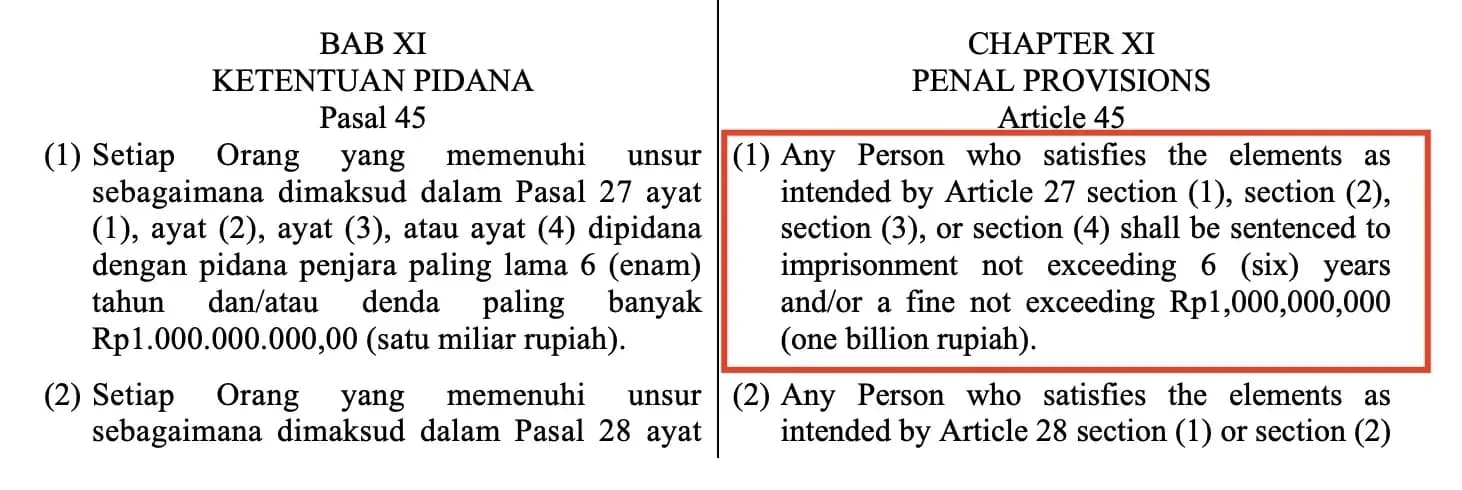
This legal structure confirms that online gambling is treated as an extension of offline gambling, subject to identical prohibition principles while allowing authorities to apply additional enforcement mechanisms in the digital sphere.
Important
These provisions enable authorities to pursue not only players, but also operators, administrators, promoters, and technical facilitators involved in online gambling activities.
Gambling-related offenses in Indonesia result in clearly defined criminal penalties, particularly severe in online contexts. The criminal sanctions framework establishes comprehensive liability across all participants in gambling activities.
6 years
Maximum imprisonment for online gambling violations
IDR 1,000,000,000
Maximum financial penalty
Multiple parties
Subject to sanctions depending on participation level
According to Indonesian law, violations related to online gambling may result in:
The enforcement framework targets all levels of gambling operations, from individual players to sophisticated commercial operators, ensuring comprehensive criminal liability throughout the gambling ecosystem.
Under Indonesian civil law, gambling activities possess no legal standing and cannot generate enforceable rights or obligations. This position reflects the broader prohibition model applied throughout Indonesia's legal system, ensuring complete exclusion of gambling from legitimate commercial activity.
From a contract law perspective, gambling-related agreements are void ab initio, meaning they are legally invalid from the outset. Indonesian courts do not recognize claims arising from gambling transactions, regardless of parties' consent or performance levels.
Warning
This approach eliminates any form of civil protection linked to gambling activities and prevents the use of civil courts to enforce gambling-related claims or recover losses.
The civil law framework ensures that gambling prohibition extends beyond criminal liability into commercial relationships, preventing any form of legal recognition or enforcement of gambling-related obligations.
Despite the clarity of legal prohibition, enforcement of gambling laws in Indonesia relies primarily on administrative and technical measures rather than traditional market regulation. Authorities employ a combination of website blocking, payment channel monitoring, and cooperation with digital service providers to limit access to online gambling platforms.
These enforcement measures focus on:
The cross-border nature of online gambling and use of offshore platforms significantly limit the effectiveness of traditional criminal prosecution methods. Consequently, Indonesia continues framing gambling enforcement as a matter of public order and cyber law enforcement rather than sectoral supervision.
Pro Tip
Operators should note that Indonesia's technical enforcement measures extend to payment processing, advertising, and any form of facilitation of gambling activities.
Indonesia's prohibition-based gambling framework represents one of the most restrictive regulatory environments globally for gambling operators and service providers. The complete absence of any licensing framework eliminates any possibility of legal market entry for international operators.
The comprehensive nature of Indonesian prohibition affects:
Indonesia's approach positions gambling enforcement as a matter of public order and legal compliance rather than regulatory oversight, ensuring continued exclusion of gambling from lawful economic activity.
Indonesia applies a strict prohibition-based gambling framework that provides absolute regulatory certainty through comprehensive illegality. Unlike jurisdictions with evolving regulatory frameworks, Indonesia's position remains consistent: all gambling activities constitute criminal conduct without exception.
This regulatory certainty stems from the absence of any gambling authority and reflects a deliberate legal position that excludes gambling from lawful economic activity entirely. The framework positions gambling enforcement exclusively within public order and legal compliance rather than regulatory oversight.
According to We-Right, Indonesia's gambling prohibition is grounded in statutory acts including the Criminal Code (KUHP), Gambling Control Law, Law No. 7 of 1974 on Gambling Control, and Electronic Information and Transactions Law.
No. Gambling is illegal in Indonesia and is not permitted as a licensed or regulated activity. National law treats gambling as a criminal matter, regardless of whether it occurs offline or online.
No. Indonesia does not operate a gambling regulator or licensing body. The country follows a prohibition-based approach and does not supervise or regulate gambling markets.
Online gambling is not regulated as a separate sector. Instead, it is addressed through general criminal legislation and electronic information law, which extend liability to digital gambling content and related online activities.
Violations may result in criminal penalties, including imprisonment and substantial fines. Enforcement can apply to different parties, depending on their roles and levels of involvement in gambling activities.
Legal Disclaimer
This content reflects a general overview of regulatory frameworks based on publicly available information. It does not constitute legal advice or a legal opinion. iGamingWriter.blog disclaims any liability arising from reliance on this material.

Austria operates a strict gambling monopoly overseen by the Federal Ministry of Finance, with only two federal concession holders authorized to operate in the market.

India's gambling regulation operates through a fragmented system of state laws and judicial interpretation rather than a centralised licensing authority.

The Gambling Regulatory Authority of Ireland marks a pivotal shift from fragmented licensing to centralised oversight, introducing graduated enforcement and comprehensive harm prevention measures.
Get regulation updates, content insights, and market news delivered to your inbox every week.
No spam. Unsubscribe anytime.
